Auto Earn vs. staking on Ndax: What’s the difference?
Learn the difference between Auto Earn and staking on Ndax, including automation, weekly rewards, eligible assets, release flexibility, fees, and risks.
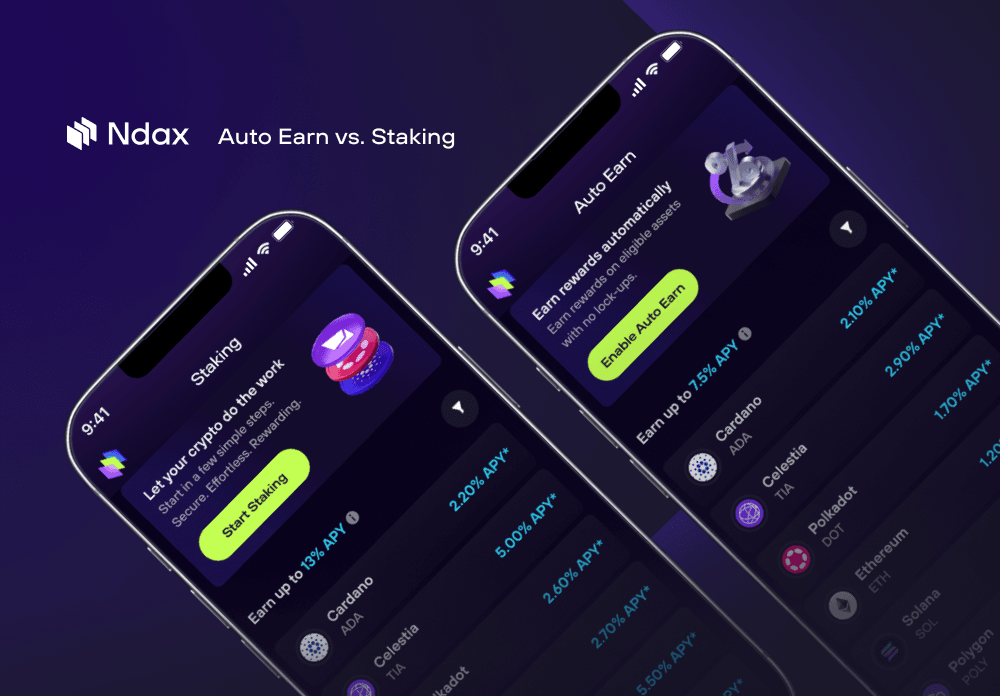
If you only read one thing
- Auto Earn and staking both let eligible Ndax users earn rewards on supported crypto assets.
- Staking is the more manual option. Users choose which eligible assets to stake, review the terms for each asset, and decide how much to stake.
- Auto Earn is the more automated option. Users enable the program once, and eligible assets are enrolled automatically.
- Auto Earn rewards are calculated weekly and paid every Monday directly to the user’s portfolio.
- Manual staking may appeal to users who want more asset-by-asset control, while Auto Earn may appeal to users who want a simpler earning experience.
- Rewards are not guaranteed. APYs can change, and crypto assets can lose value even while earning rewards.
Introduction
Auto Earn and staking are related products, but they do not provide the same user experience.
Both Auto Earn and Staking involve earning rewards on eligible crypto assets. Both depend on supported assets, network conditions, applicable terms, and program risks. Both require users to review and accept the relevant disclosures before participating.
The main difference is how the user participates. Staking usually requires users to choose an asset, review that asset’s terms, and manually stake a selected amount. Auto Earn is designed to be more automated. Users enable the program once, and eligible assets are enrolled automatically.
For users who want rewards with less manual management and no fixed lock-up period, Auto Earn may offer a simpler experience.
Ndax is a regulated crypto trading platform. Ndax provides an Order Execution Only service. Ndax executes clients’ instructions but does not provide investment advice. Clients decide when and what to trade.
Why the distinction matters
Crypto rewards products may look similar to many users. A user may see an APY, a supported asset list, and a rewards schedule and assume every product works the same way. But that is not the case.
The user experience can differ depending on whether the user is manually staking a specific asset or enabling an automated rewards program across eligible assets. Those differences are important because they affect flexibility, control, reward timing, dashboard visibility, and how users manage access to their assets.
Staking on Ndax
Staking allows eligible users to participate in staking for supported proof-of-stake assets through Ndax.
In a traditional staking workflow, the user generally selects the asset, reviews the APY, reward schedule, fees, bonding period, unbonding period, and other terms, then confirms the staking instruction.
Users should review each asset’s APY, reward schedule, fees, and unbonding period before confirming. Users can also track rewards, request to unstake, set up recurring staking, and automatically restake rewards from their Ndax account.
This model may appeal to users who want asset-by-asset control and are comfortable reviewing individual staking terms before participating.
Auto Earn on Ndax
Auto Earn is designed to make the earning process more automatic. Instead of manually staking each eligible asset, users enable Auto Earn once and accept the required agreements. After that, eligible assets are enrolled automatically.
Rewards are calculated weekly and distributed every Monday at 12:00 AM UTC. New eligible deposits and released assets are enrolled daily at 7:00 AM UTC, unless an active release request is still pending for that asset.
The Auto Earn dashboard shows enrolled balances, earned rewards, and upcoming reward dates. This model may appeal to users who want a simpler earning experience and do not want to manually manage each staking position.
Side by side comparison
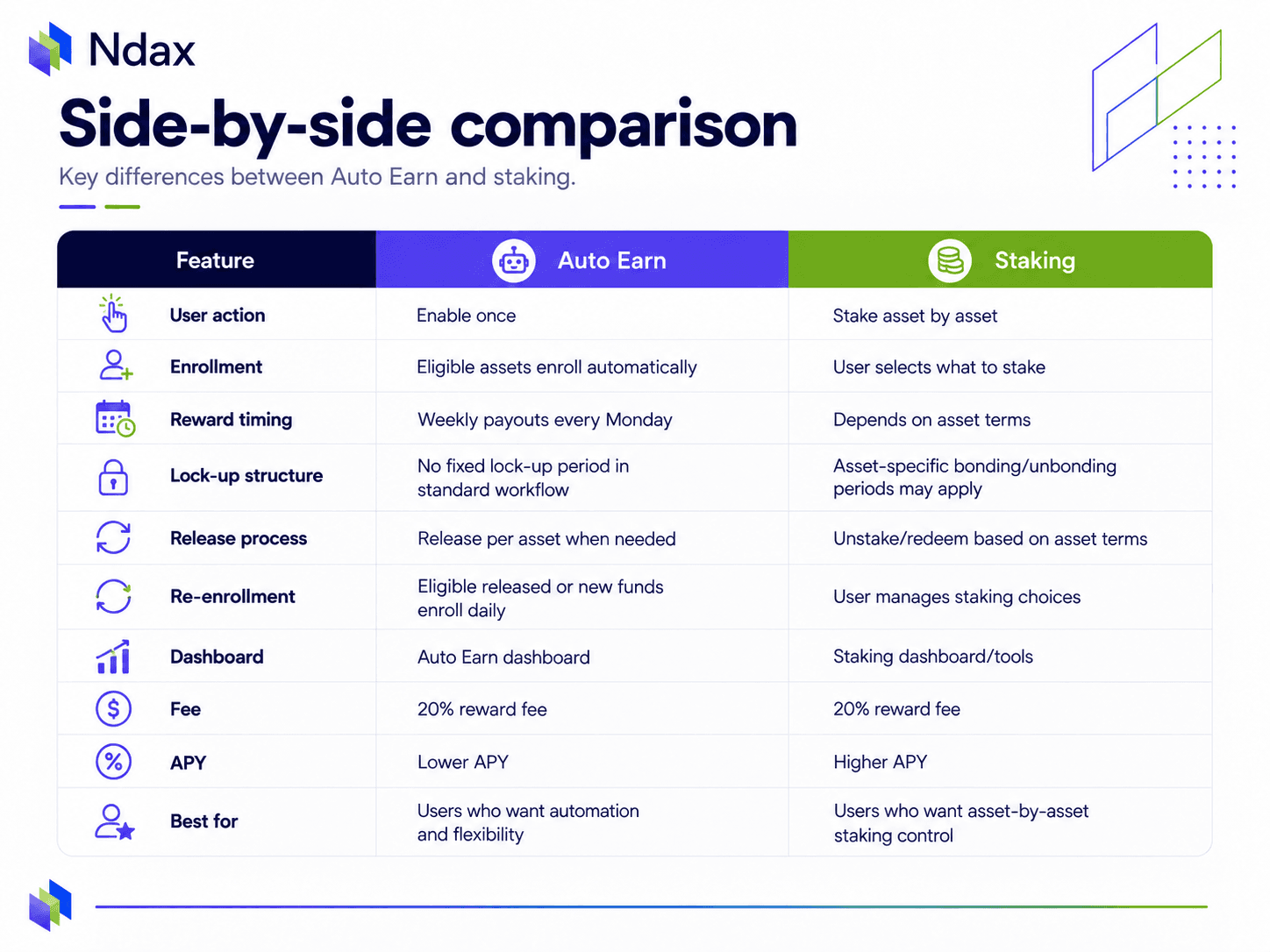
The biggest difference: automation
The main Auto Earn difference is automation. With staking, users need to decide which assets to stake, confirm eligibility, decide how much to stake, and determine when to adjust those positions.
With Auto Earn, the user enables the program once. Eligible assets are then enrolled automatically, and new eligible balances are enrolled daily.
That may be relevant for users who already hold eligible assets on Ndax and want a more convenient way to earn rewards without manually managing individual staking positions.
The second difference: release flexibility
Auto Earn is designed with no fixed lock-up period in the user workflow. Users can release an enrolled asset if they want to trade or withdraw it. The release is handled per asset and does not disable Auto Earn for the entire account.
That said, release flexibility does not mean all risks disappear. In rare cases, if pool liquidity is limited, a portion of the release may be queued. If release requests exceed the liquidity buffer, withdrawals may be subject to applicable network lock-up or unbonding periods under the Auto Earn disclosures and asset-specific terms.
Traditional staking may involve more direct asset-specific bonding and unbonding terms. Refer to Ndax’s staking agreement which defines bonding and standard redemption periods and explains that instant redemption may be available for flexible plans on a first-come, first-served basis, subject to availability.
The third difference: how users manage rewards
With Auto Earn, rewards are calculated weekly and paid every Monday directly to the portfolio. That provides users with a consistent weekly reward schedule.
With staking, reward timing depends on the asset and staking terms. Some assets may have daily payouts, while others may have weekly payouts or different conditions.
In both cases, users should remember that APY rates are estimates and can change. Rewards are not guaranteed, and estimated APYs may change over time.
Fees
Auto Earn uses the standard 20% administration fee on rewards after a promotional launch waiver period.
The fee applies to the rewards earned, not the original asset balance.
Which option is better?
There is no single answer. Auto Earn may appeal to users who want a simpler, automatic way to earn rewards on eligible assets without manually managing staking positions.
Manual staking may appeal to users who want asset-by-asset control and prefer reviewing the exact staking terms for each position before participating.
The differences users may want to consider include asset holdings, liquidity needs, comfort with staking risks, and preference for automation versus control.
Ndax does not provide investment advice or recommendations. Users decide whether to enable Auto Earn, manually stake eligible assets, hold, trade, withdraw, or take no action.
Bottom line
Auto Earn and staking both allow eligible Ndax users to earn rewards on supported crypto assets, but they are built for different user experiences.
Staking is more manual and asset-specific. Auto Earn is more automated and designed around weekly rewards, daily enrollment, and flexible release access.
Both carry risk. Rewards are not guaranteed. APYs can change. Crypto assets can lose value. Users should review the relevant terms and disclosures before participating.
Important Note: To trade or withdraw an asset enrolled in Auto Earn, you'll first need to disable Auto Earn for that asset. It will not earn rewards during this time.
Risk Disclosure: Auto Earn is not risk-free. Ndax maintains a liquidity buffer so that a portion of enrolled client assets remains available for withdrawals, while the remainder may be staked on underlying networks. Ndax determines, at its discretion, how much to stake and how much to keep liquid based on overall program activity and market conditions. If client opt-outs exceed the available liquidity buffer, withdrawals may be delayed and subject to applicable network lock-up or unbonding periods, as described in the Auto Earn disclosures and the applicable Crypto Asset Statement. Reward rates may change over time, and past returns do not guarantee future results. For more information on the risks of staking through Auto Earn, see the Risk Statement.
Don't forget to follow us on social media for more updates and join the conversation on our forums.
Disclaimer: This article is not intended to provide investment, legal, accounting, tax or any other advice and should not be relied on in that or any other regard. The information contained herein is for information purposes only and is not to be construed as an offer or solicitation for the sale or purchase of cryptocurrencies or otherwise.