Before Bitcoin had a price, it was a paper

Eighteen years after Satoshi Nakamoto introduced Bitcoin to a cryptography mailing list, the story of its white paper is worth revisiting. The story hasn’t changed: it is about how an idea became a global network that continues to operate while its creator remains absent from the public scene.
Before Bitcoin had a price, it was a paper

Introduction

On October 31, 2008, someone, or a group of people, using the name Satoshi Nakamoto shared a proposal with a cryptography mailing list. The idea was a new electronic cash system designed to operate without a trusted third party.

The document was titled Bitcoin: A Peer-to-Peer Electronic Cash System.

There was no Bitcoin exchange, no BTC market price, no exchange-traded funds, and certainly no live Bitcoin network. There was only a proposal describing how people could transfer digital money directly to one another without relying on a central institution to verify every transaction.

Today, Bitcoin boasts global recognition. It has an established network of miners, developers, node operators, and users, alongside exchanges, custody providers, and financial products built around it.

But none of that existed when the white paper first appeared.

As the Bitcoin white paper marks its 18th anniversary on October 31, 2026, the occasion offers an opportunity to revisit the beginning of Bitcoin’s story. Bitcoin had no market price and no functioning public network. It was an idea that still needed to prove it could work.
 

The problem Bitcoin set out to solve

Digital payments predate Bitcoin. In 2008, PayPal handled about $60 billion in net total payments, up 27% year-over-year. This shows the scale online payment services had already reached before Bitcoin’s network went live.

But what Satoshi proposed was radically different. Most electronic payment systems, such as PayPal, depend on a trusted intermediary to maintain records and confirm that funds have not already been spent. This addresses a fundamental challenge with digital value: unlike physical cash, digital information can be copied.

Without a reliable way to establish which transaction is valid, someone could potentially attempt to spend the same digital funds more than once. This is known as the double-spending problem.

Satoshi’s proposal brought together existing cryptographic ideas into a system intended to address that challenge without requiring a central authority to maintain the ledger. Instead of relying on one institution, Bitcoin would use a peer-to-peer network. Participants would verify transactions according to shared rules, while a proof-of-work process would help establish an agreed transaction history.

Miners would contribute computing power to create new blocks and receive economic rewards for doing so. Other network participants could independently verify whether those blocks followed the rules.

What’s most notable is how the proposal described a system in which participants could reach agreement on transaction history without placing that responsibility in the hands of one or more central operators.

What had yet to be proven at that point was whether such a system could function reliably outside the pages of a paper.
 

The first reactions: curiosity, skepticism, and questions

Bitcoin’s early reception is often described as though the idea was immediately dismissed. On November 2, 2008, James A. Donald responded to Satoshi’s proposal by acknowledging the need for such a system while questioning whether the design could support a sufficiently large network.

His main concern was scalability. If millions of users worldwide started interacting with a Bitcoin network, how much transaction information would participants need to store and share? Would a decentralized network be able to handle that demand efficiently?

Satoshi responded with an explanation of simplified payment verification and how different participants might interact with the network as it grew. A few days later, on November 7, cryptographer and software developer Hal Finney offered a more encouraging assessment, writing: “Bitcoin seems to be a very promising idea.”

Finney was attracted to the proposed security model and the possibility of a digital token with a predictable issuance schedule. But he also raised detailed questions about transaction verification, competing chains, and how network participants would handle conflicting information.

Some of the first Bitcoin-related discussions did not focus on valuation or price outlooks. Instead, they questioned whether the design was secure, practical, scalable, and capable of operating as intended. Even the earliest believers in Bitcoin still needed to understand how the system would behave in real-world conditions.

The next step would move from theory to software.

January 2009: From white paper to working network

It only took two months for Bitcoin to transition from a proposed protocol to a functioning network. On January 3, 2009, Satoshi created Bitcoin’s first block, dubbed the genesis block.

Embedded in that block was a headline from the January 3 edition of The Times, referring to the British government’s consideration of another bank bailout. This makes the headline one of the most discussed details in Bitcoin’s history, particularly because the network emerged during the global financial crisis.

It remains unclear what role, if any, the message played in establishing Satoshi’s motivation.

On January 8, 2009, Satoshi announced the first public release of the Bitcoin software. For the first time, others could download the program, run it, and participate in the early experiment. On January 12, Satoshi sent 10 BTC to Hal Finney in what is widely recognized as Bitcoin’s first person-to-person transaction, recorded in block 170.

These early milestones were modest by today’s standards. Still, they marked the point when Bitcoin was no longer only a document explaining how decentralized digital money might operate.

There was now software, a blockchain, and a transaction demonstrating that value could be transferred between participants. Bitcoin was a live project that people could test for themselves.
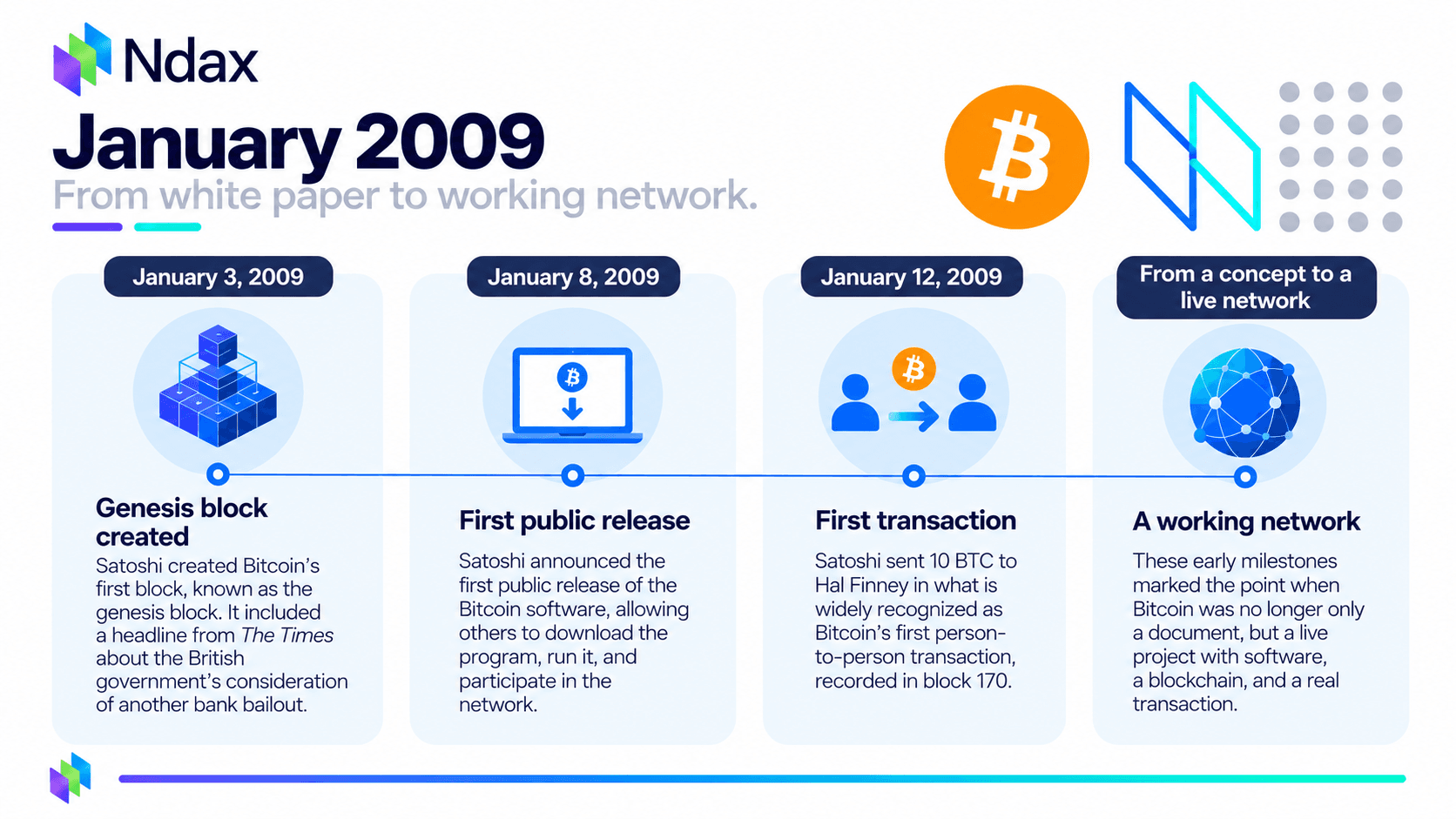
image.png

How Bitcoin became bigger than its creator

Bitcoin did not evolve to become a global network overnight. Its early development depended on a small group of people willing to download unfamiliar software, examine its code, run nodes, mine blocks, and report problems.

Over time, more contributors were motivated to join. Developers worked on the software, miners supplied computing power, and node operators independently checked the network’s rules and transaction history. As participation increased, a growing ecosystem formed around the protocol.

Exchanges made Bitcoin more accessible to people outside the original technical community. Wallet providers developed ways to store and transfer BTC. Businesses started to experiment with payments. Custody services and other infrastructure providers emerged to support a wider range of users.

The network experienced setbacks, technical disagreements and periods of intense scrutiny over the years. In 2010, a software vulnerability was exploited to create more than 184 billion BTC before developers released a fix and the invalid transaction history was abandoned.

But one of the most consequential changes was happening quietly in the background. Satoshi, Bitcoin’s creator, gradually withdrew from public involvement. Among Satoshi’s last widely documented communications was an April 23, 2011 email to developer Mike Hearn: “I’ve moved on to other things. It’s in good hands with Gavin and everyone.”

The reference was to Gavin Andresen, an early Bitcoin developer who had taken on a leading role in maintaining the software as Satoshi withdrew.

Still, Bitcoin continued operating without Satoshi’s involvement. Blocks were produced, transactions were verified, and developers continued maintaining and improving the network. Bitcoin’s operation no longer depended on the active participation of its anonymous creator.

The milestones that shaped Bitcoin's evolution

Bitcoin's development continued through several defining milestones. On November 28, 2012, the network completed its first halving, reducing the reward for mining a block from 50 BTC to 25 BTC according to its predetermined issuance schedule.

In February 2014, the collapse of Mt. Gox, then one of the world's largest Bitcoin exchanges, exposed the risks associated with the trading platforms emerging around Bitcoin. The network itself continued operating as normal, but the collapse provided one of the clearest early demonstrations of the difference between Bitcoin's underlying protocol and the businesses built around it.

Bitcoin's technology also continued to evolve. In August 2017, the network activated Segregated Witness (SegWit), an upgrade that improved transaction capacity and helped lay the groundwork for the Lightning Network, a system designed to facilitate faster Bitcoin payments. In November 2021, another major upgrade called Taproot introduced improvements to transaction efficiency, privacy and flexibility. 
In January 2024, the U.S. Securities and Exchange Commission approved the listing and trading of spot Bitcoin exchange-traded products, illustrating how far the infrastructure surrounding the network had developed.
Bitcoin reached another milestone in April 2024 with its fourth halving, reducing the reward for mining a block from 6.25 BTC to 3.125 BTC. In March 2025, U.S. President Donald Trump signed an executive order establishing a Strategic Bitcoin Reserve, initially capitalized with Bitcoin forfeited to the federal government.

Another milestone followed on March 9, 2026, when the network surpassed 20 million BTC mined, leaving fewer than one million coins to be issued over the coming century. Together, these developments reflected Bitcoin's continued operation under its original issuance rules, alongside growing involvement from traditional financial institutions and governments.
 

Bitcoin in 2008 vs. 2026: What 18 years changed

The contrast between Bitcoin’s beginnings and its position in 2026 is particularly striking when viewed through the development of its network rather than its market price or capitalization.

As of October 19, 2026, Blockchain.com showed Bitcoin at block height 972,184, with approximately 20.10 million BTC in circulation and an estimated network hash rate of 1,104.1 exahashes per second, or about 1.10 zettahashes per second.

While these metrics describe the network’s growth, mining activity and issuance, they do not establish how many individual people use Bitcoin or whether its economic role will continue expanding. What they do illustrate is the distance between a proposal without a functioning public network in 2008 and the infrastructure operating eighteen years later.
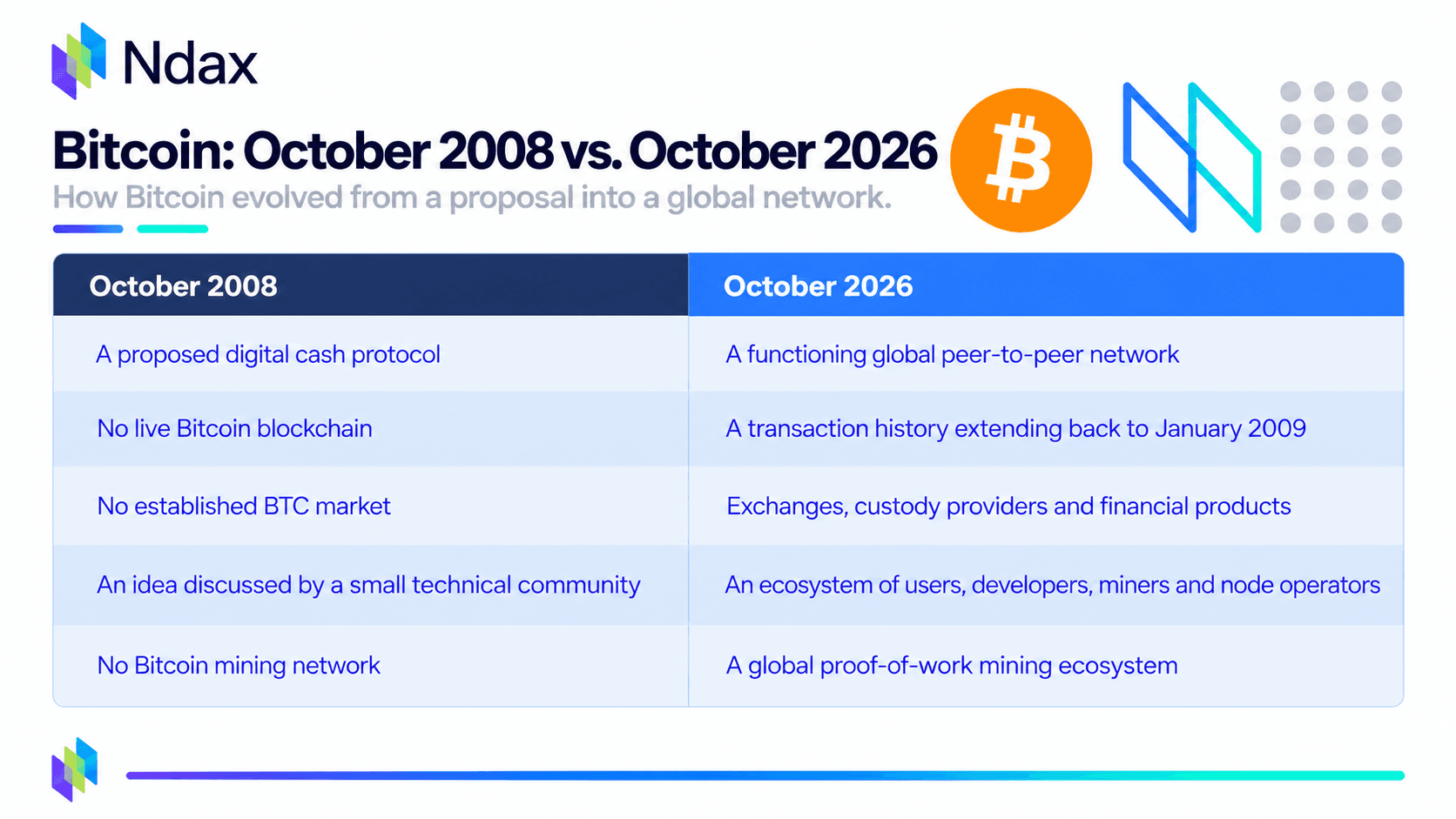
 

image.png

What hasn’t changed since the white paper

Bitcoin in 2026 looks very different from Bitcoin in 2008. The software has evolved. The network has grown. The ways people access, hold and interact with BTC have expanded far beyond what existed when the original proposal circulated.

Yet the foundational approach described in the white paper remains familiar. Bitcoin still relies on peer-to-peer communication, proof-of-work and agreement around a shared transaction history. Participants continue to verify transactions according to network rules rather than depending on a single central administrator.

The questions surrounding Bitcoin have also evolved. Discussions about transaction capacity, mining, decentralization and the role of intermediaries continue to shape how the network is understood and developed.

For example, the development of the Lightning Network has raised questions about how to make Bitcoin payments faster and cheaper without compromising decentralization. Meanwhile, the growth of spot Bitcoin ETFs and custodial services has introduced another important debate: how much of Bitcoin's continued adoption will depend on financial intermediaries when its original design was intended to reduce the need for them in electronic payments?

What is clear is that after 18 years, the white paper is more than a historical document. It is the starting point of a continuing experiment in decentralized digital money. On October 31, 2008, Bitcoin was an idea shared with a mailing list.

Today, it is a network that continues to operate without the ongoing involvement of its creator.

And the ideas introduced in the original paper are still being tested, one block at a time.


Don't forget to follow us on social media for more updates and join the conversation on our forums.

Disclaimer: This article is not intended to provide investment, legal, accounting, tax or any other advice and should not be relied on in that or any other regard. The information contained herein is for information purposes only and is not to be construed as an offer or solicitation for the sale or purchase of cryptocurrencies or otherwise.