Buying $500 vs. $50,000 of Bitcoin using Ndax: What Changes?
Learn how Bitcoin trade size can affect funding readiness, fees, slippage, order type, custody destination, settlement, records, and when larger-trade support may matter.
Key takeaways
- A $500 Bitcoin purchase may be focused on access, simplicity, funding, and learning the process.
- A $50,000 Bitcoin purchase requires more attention to funding readiness, execution quality, slippage, custody destination, settlement, records, and support.
- The larger the transaction, the more important it becomes to understand total cost, order type, liquidity, withdrawal planning, and whether dedicated execution support may be useful.
- Ndax may be relevant when comparing a Canadian platform that supports smaller self-directed trades and larger-transaction services.
Introduction
Buying $500 of Bitcoin and buying $50,000 of Bitcoin may involve the same asset, but they are not the same decision from a platform perspective. A smaller purchase may be mostly about getting started, understanding the fee, and learning how the platform works. A larger purchase usually requires more planning around funding readiness, execution quality, slippage, custody destination, settlement timing, records, and whether OTC support may be appropriate.
This is why Canadian users can compare whether a platform supports different trade sizes, account activity, and execution workflows.
Ndax is a regulated crypto trading platform. Ndax provides an Order Execution Only service. Ndax executes clients’ instructions but does not provide investment advice. Clients decide when and what to trade.
Same asset, different needs
A user buying $500 of Bitcoin may mainly want the process to feel clear. They want to know how to fund the account, what fee applies, what price they are getting, and where the Bitcoin will be held after the trade.
That is a natural starting point. But if that same user later wants to buy $50,000 of Bitcoin, the decision becomes more complex.
The user may now need to consider new factors, including: whether a market order is appropriate, whether a limit order offers more control, whether slippage could affect the final price, and where the Bitcoin will go after the transaction is finalized.
The asset is still Bitcoin, but the trade size changes the thinking process. That is where platform depth starts to matter. A platform that works well for a first purchase should ideally still be useful when the user becomes more confident, trades larger amounts, or needs more support.
What changes when the trade gets larger?
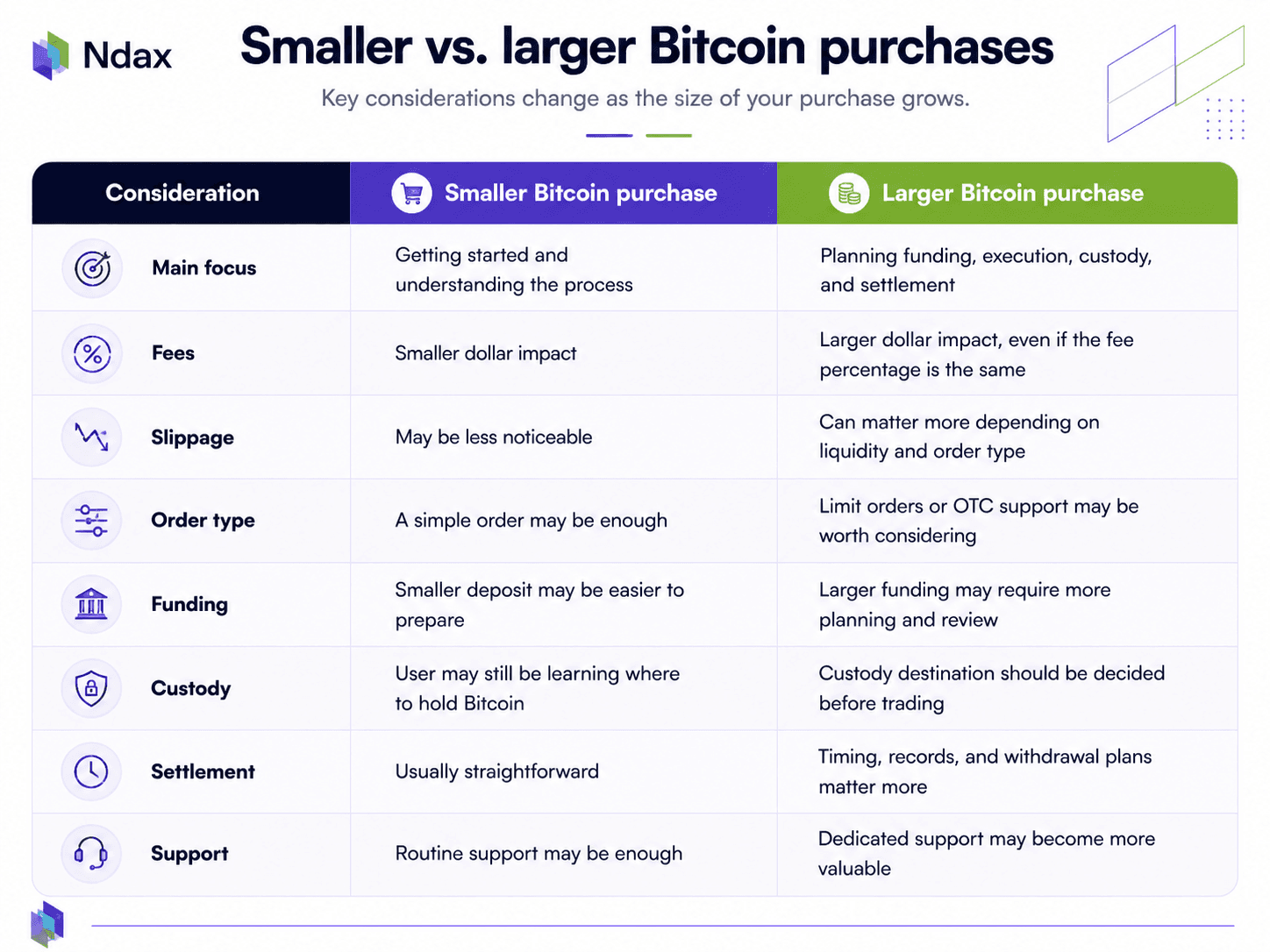
Fees matter more in dollar terms
Fees are an important consideration for every transaction, regardless of trade size. But the dollar impact becomes easier to notice for higher-value orders.
Ndax uses a flat trading fee model at 0.20%, along with free Canadian-dollar deposits. Users should still consider withdrawal fees, crypto network fees, and any asset-specific costs before placing a trade or withdrawing assets.
For example, a 0.20% trading fee on a $500 Bitcoin purchase would be $1 before considering withdrawal fees, network fees, or any other applicable costs. A 0.20% trading fee on a $50,000 Bitcoin purchase would be $100 before considering any other costs.
The fee rate stays the same, but the dollar amount is not. This is why larger trades require more attention to total cost. Users should consider the trading fee, quoted price, spreads, withdrawal fees, crypto network fees, funding method, and whether they plan to hold Bitcoin on the platform or withdraw it after purchase.
Slippage and order type become more important
Slippage is the difference between the expected price of a trade and the final price received. For smaller Bitcoin purchases, slippage may not be a major concern for many users. For a larger purchase, it can become more important because the order may interact with more available liquidity in the market.
This does not mean larger Bitcoin purchases by default receive poor execution on a platform like Ndax. But it does mean the user needs to consider how the order is placed.
This is because a market order prioritizes immediate execution at the best available price at a given time. A limit order gives the user control over the maximum price they are willing to pay, although the trade-off is that a limit order may not fill if the market does not reach that price.
Users placing larger transactions may compare standard order-book trading with Ndax Wealth OTC execution if they want a more structured process with dedicated support.
The larger the transaction, the more important it becomes to understand the trade-off between speed, price control, liquidity, and certainty of execution.
Funding is part of the trade
A smaller Bitcoin purchase may only require a basic funding plan. A larger Bitcoin purchase likely requires more preparation.
Users should think about how funds will arrive, whether the account is verified, whether the funding method fits the transaction size, whether there may be processing time, and whether they are comfortable holding Canadian dollars on the platform before placing the order.
Before placing a larger trade, the user should know whether the account is funded, whether the funds are available, and whether any additional review or timing considerations could affect execution.
Essentially, funding, execution, and custody should be part of the same planning process.
Custody destination should be decided before the trade
After buying Bitcoin, whether it is $500 or $50,000 worth, users need to decide where the asset will be held. Some users may choose to hold Bitcoin on the Ndax platform. Platform custody requires users to understand how assets are held, what controls apply, and what protections do and do not apply.
Others may withdraw Bitcoin to a personal wallet. For smaller amounts, some users may still be learning which option fits them, and their decision may change over time. For larger amounts, the custody decision should be planned before the trade is placed.
Self-custody can give users direct control over their Bitcoin, but it also creates responsibility. Users need to manage wallet security, seed phrases, addresses, device safety, and transfer accuracy. A mistake can have serious consequences.
Settlement and records are important, especially as size grows
For a larger Bitcoin purchase, users may also care about when funds arrive, when the order is executed, when Bitcoin is available, whether the asset will be withdrawn, what records are created, and what information the user may need later for personal tracking or tax reporting.
A basic $500 purchase may only require a standard confirmation. But a $50,000 purchase may require clearer records around funding, trade execution, fees, withdrawals, custody decisions, and account history.
This is another reason users should think beyond the first purchase. A platform becomes more important as account activity grows. Users may need to review transaction history, confirm deposits and withdrawals, track balances, access statements, or contact support if something needs attention.
When Ndax OTC may become relevant
OTC stands for over-the-counter trading. It is often used for larger transactions where a user may want dedicated execution support instead of relying only on a standard retail order workflow.
Ndax Wealth provides OTC execution for transactions starting at C$25,000. That means a $50,000 purchase easily falls into the range where a user may want to consider whether OTC provides a process they want to compare for a larger transaction.
OTC does not remove risk. Bitcoin remains volatile, and no execution method guarantees profit or protection from loss. But larger-trade support may be useful when users want to discuss liquidity, timing, settlement, funding, and execution before placing a larger order.
For a $500 purchase, Ndax’s OTC service is usually not part of the conversation, although it is an option that may become available if the user’s needs evolve over time. For a $50,000 purchase, it may be worth understanding.
Where Ndax fits in
Ndax may be relevant for Canadians who want a platform that can support both a smaller first Bitcoin purchase and more serious trading needs over time.
A user can start with a self-directed Bitcoin purchase, review the fee, take advantage of Canadian-dollar funding, and decide whether to hold or withdraw the asset. If their needs become more advanced over time, they can access CAD trading pairs, charting tools, order-book information, advanced order types, supported crypto withdrawals, staking for eligible assets, and larger-trade services through Ndax Wealth.
A platform should not only be judged whether it can help someone buy their first $500 of Bitcoin. It should also be judged by whether it can support the same user if they later need better execution tools, clearer records, larger-trade support, and more control over custody and settlement.
Ndax’s platform is designed for Canadians who may want to start small, but want a platform they do not need to outgrow.
Bottom line
Buying $500 of Bitcoin and buying $50,000 of Bitcoin are not just different versions of the same action. They require different levels of planning.
A smaller purchase may be about getting started, understanding the platform, and learning how fees and funding work. A larger purchase requires more attention to funding readiness, execution quality, slippage, custody destination, settlement, records, and support.
The right platform should be simple enough for a first Bitcoin purchase, but serious enough to support larger transactions and more advanced needs later. Ndax is built for Canadians who may start with a smaller self-directed trade but want access to more tools, clearer execution options, and larger-transaction support as their needs evolve.
Don't forget to follow us on social media for more updates and join the conversation on our forums.
Disclaimer: This article is not intended to provide investment, legal, accounting, tax or any other advice and should not be relied on in that or any other regard. The information contained herein is for information purposes only and is not to be construed as an offer or solicitation for the sale or purchase of cryptocurrencies or otherwise.