Crypto custody and asset handling at Ndax

Learn how Ndax holds client crypto and Canadian dollars, separates client assets, uses third-party custodians, and approaches proof of reserves, audits, insurance, and investor protection.
Crypto custody and asset handling at Ndax

Key takeaways

  • Ndax uses a combination of third-party and internal custody.
  • At least 80% of client crypto assets are held with acceptable third-party custodians regulated as trust companies.
  • Up to 20% of client crypto assets may be held temporarily through Ndax’s internal custody solution to support deposits, withdrawals, settlement, and certain staking activity
  • Client assets are held separately from Ndax’s own assets.
  • Unstaked client crypto assets cannot be re-pledged, rehypothecated, or otherwise used by Ndax.
  • Proof of reserves may provide important information about assets held at a certain time, but it does not necessarily show all liabilities and other key details.
  • Crypto assets are not covered by CIPF or deposit insurance.

Introduction

When crypto remains in a trading account, someone has to control the private keys and approve transactions on the user’s behalf. Users should also understand who holds their assets, how client property is separated from company property, whether the assets can be lent or pledged, how balances are reconciled, what insurance may cover, and what would happen if the platform or a custodian failed.

Ndax is registered as an Investment Dealer under applicable securities laws, is approved to operate an alternative trading system, and is a member of the Canadian Investment Regulatory Organization (CIRO) and the Canadian Investor Protection Fund (CIPF). These registrations and memberships form part of the regulatory framework applicable to Ndax; however, crypto assets continue to involve risks that investors should carefully consider.

Ndax provides an Order Execution Only service. Ndax executes clients’ instructions but does not provide investment advice. Clients decide when and what to trade.

How Ndax holds client crypto

Ndax uses a hybrid custody model.

Under Ndax’s current custody arrangements, no less than 80% of the total value of client crypto assets must be held with one or more acceptable third-party custodians that have been approved by the applicable regulatory body and are functionally independent of Ndax.

Ndax’s Custody Disclosure Statement states that at least 80% of client crypto assets are held in cold and warm storage with acceptable third-party custodians regulated as trust companies.

Up to 20% of client crypto may be held through Ndax’s internal custody solution. This is meant to support routine platform operations, including client deposits and withdrawals, settlement with liquidity providers, and certain crypto assets that clients have chosen to stake.

These internally held assets may be kept in hot-wallets because they need to be readily available for operational use.

This means the 80% requirement should not be described simply as “80% in cold storage.” Rather, the requirement covers assets held in both cold and warm storage with approved third-party custodians.
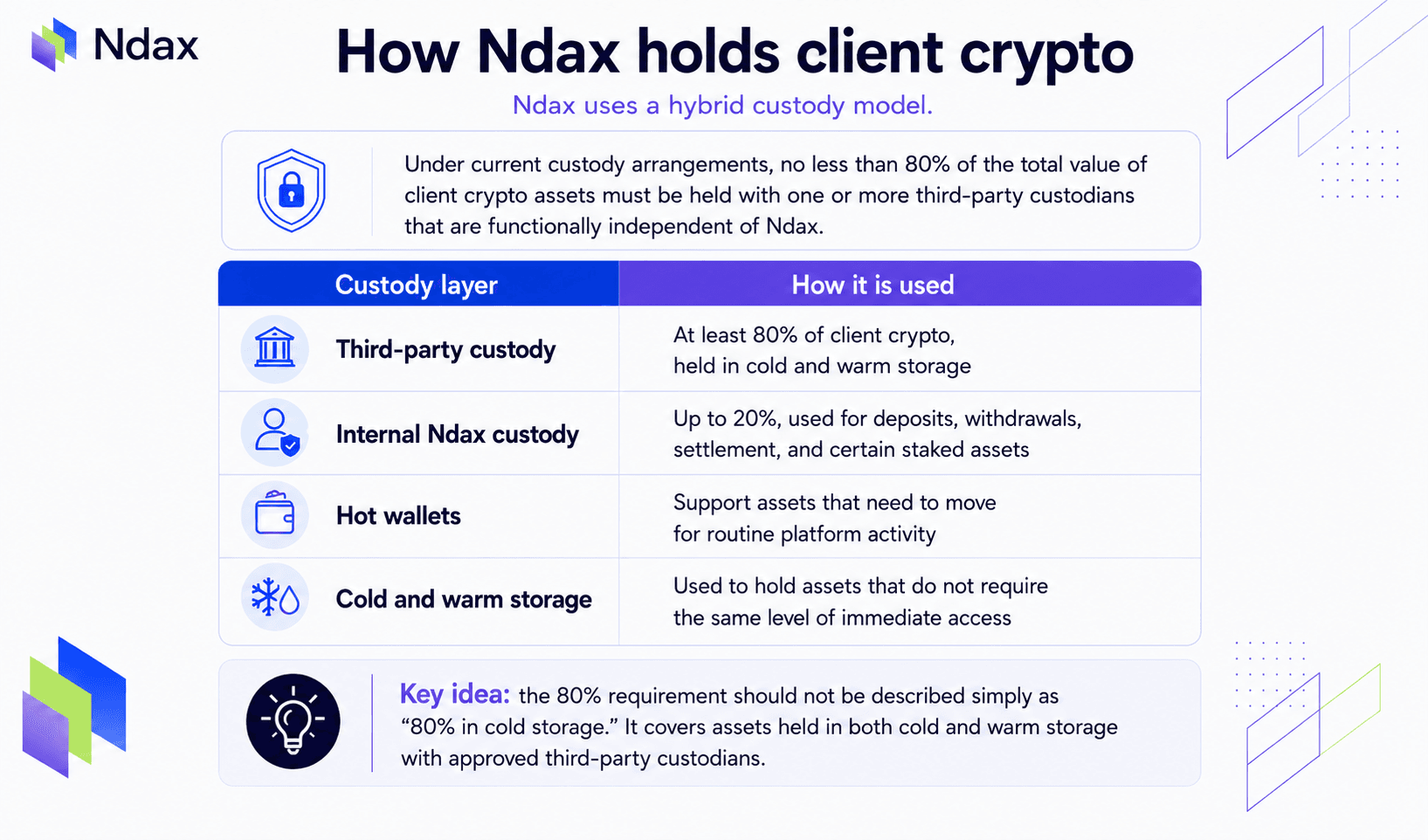
image.png


 It is important to note that cold, warm, and hot wallets describe how keys and transaction systems can be accessed. They do not explain legal ownership, segregation, transaction approvals, insurance, or recovery during an insolvency.

Which third-party custodians does Ndax use?

Ndax’s current Custody Disclosure Statement lists three third-party custodians:

  • Coinbase Custody Trust Company
  • Tetra Trust Company
  • BitGo Trust Company

Coinbase Custody is a New York trust company. Tetra is an Alberta-regulated trust company. BitGo is a South Dakota trust company. Their use remains subject to applicable regulatory conditions and Ndax’s custody arrangements.

Ndax says it reviews each custodian’s policies, procedures, controls, financial condition, insurance, business-continuity planning, and SOC 2 Type 2 examination reports. Ndax also confirms monthly that the crypto held with these custodians reconciles with its books and records.

The custodian list and arrangements may change. The current Custody Disclosure Statement, available on the Ndax website, should be treated as the primary source.
 

How client assets are separated

Crypto held with Ndax’s third-party custodians is maintained in segregated omnibus accounts in the name of Ndax, in trust for or for the benefit of Ndax clients.

An omnibus account holds assets belonging to more than one client. Ndax’s internal records are used to identify how much belongs to each account holder. The fact that an account is omnibus does not mean client assets are treated as Ndax’s corporate property.

The third-party custody accounts are held separately from: 

  • Ndax’s own assets
  • Assets belonging to Ndax affiliates
  • Assets belonging to the custodians’ other clients

Crypto held through Ndax’s internal custody solution is also held separately from the assets of Ndax, its affiliates, and its custody-technology providers.

The Canadian Investment Regulatory Organization describes segregation as a core investor-protection measure. Its custody framework focuses on keeping client assets identifiable and traceable, protecting them from general creditor claims, and preserving client ownership rights during an insolvency or similar proceeding.

Segregation is intended to reduce legal and operational risk, but it does not guarantee that assets will be returned immediately or without loss. Ndax’s disclosure notes that Canadian bankruptcy legislation does not specifically address the treatment of virtual assets, meaning the result of a future insolvency proceeding cannot be stated with certainty. The treatment of virtual assets in an insolvency proceeding may depend on the specific facts, applicable law, and court determinations at the relevant time.

For more information, read: Why custody and segregation matter more than most crypto users think 

Does Ndax lend or use client crypto?

Other than assets a client chooses to use through an eligible staking service, Ndax does not pledge, rehypothecate, or otherwise use client crypto assets.

Rehypothecation occurs when a firm uses assets held for a client as collateral or for another business purpose. It can create additional credit, liquidity, and counterparty risk because the assets may no longer be immediately available to the client.

Staking is treated separately because it occurs only when a client chooses to participate. Staked assets are held in omnibus staking wallets separate from assets belonging to clients who have not agreed to stake them. Staking introduces its own risks and conditions, including protocol, validator, lock-up, and liquidity risks.

How are Canadian dollars held at Ndax?

Client Canadian-dollar balances deposited with Ndax are segregated from Ndax’s operational cash and held in trust for clients at Alberta Treasury Branch, in accordance with applicable CIRO requirements.

Ndax has access to the funds for purposes such as settling client transactions and collecting fees, which means operational and fraud risks cannot be eliminated entirely.

Eligible Canadian-dollar balances held in a crypto trading account with a Canadian Investor Protection Fund (“CIPF”) member may be treated differently from crypto assets. Any CIPF protection remains subject to CIPF's coverage policy, eligibility requirements, exclusions, and applicable limits. CIPF states that cash held in a crypto trading account with a member firm may be eligible for protection, subject to its coverage policy. Crypto assets themselves are excluded.
 

What proof of reserves can show

Proof of reserves is a way for a crypto platform or custodian to provide evidence that it controls certain assets.

Depending on the method used, it may involve publishing wallet addresses, signing a message from a blockchain address, or using a cryptographic structure such as a Merkle tree. A Merkle-tree process can allow a user to check that their balance was included in a platform’s reported client liabilities without publicly revealing every individual account balance.

A proof-of-reserves process is meant to provide useful evidence that identified assets existed and were controlled by the platform or custodian at a given time. While this is certainly useful information, it should not be considered the full picture.

For more information, read Regulated audits vs. proof of reserves: What Canadians should compare. 

What proof of reserves does not show

The term “proof of reserves” is used for several different types of reports, and their scope varies across companies. A typical proof-of-reserves report may not establish:

QuestionWhy proof of reserves may not answer it
Does the platform have more assets than liabilities?Some reports verify assets without examining all client, corporate, or off-chain liabilities.
Do the assets legally belong to clients?Control of a wallet does not establish the legal terms under which the assets are held.
Were any assets temporarily borrowed?A point-in-time report may not identify whether assets were moved in before the review.
Are assets segregated?Wallet balances do not necessarily show whether assets are protected from creditor claims.
Are internal controls effective?Proof of reserves does not usually test governance, access controls, reconciliation, or risk management.
Will the assets remain available?A snapshot does not show what happens after the report date.
Is the company solvent?Solvency requires a wider review of assets, liabilities, capital, liquidity, and obligations.

The Public Company Accounting Oversight Board states that proof-of-reserves engagements are not audits. Its investor advisory notes that these reports may not address liabilities, ownership rights, borrowed assets, internal controls, governance, or what happens to the assets after the reporting date.

Does Ndax provide proof-of-reserves?

Ndax does not currently publish a public proof-of-reserves dashboard. Instead, its transparency framework relies on several forms of oversight and verification:

  • Monthly reconciliation of assets held with third-party custodians against Ndax’s books and records 
  • Monthly regulatory reporting
  • Regular audits performed by an independent CIRO-approved audit firm
  • Review of third-party custodian SOC 2 Type 2 reports
  • An annual SOC 2 Type 2 report covering Ndax’s custody solution
  • \Regulatory requirements concerning capital, liquidity, custody, segregation, and internal controls

Ndax’s independent audits are conducted in accordance with applicable professional standards and regulatory requirements and may include reviews of controls, custody arrangements, records, and other matters within the scope of the audit engagement.

These measures are not meant to provide the same public, cryptographic visibility as a proof-of-reserves dashboard. Instead, audits, proof-of-reserves processes, reconciliations, regulatory oversight, and custody controls each address different aspects of asset verification and risk oversight and should be considered together where available.

The two approaches are not mutually exclusive. Cryptographic proofs may become more useful as methods improve, particularly where they address both assets and client liabilities. They should still be considered alongside audits, custody agreements, segregation, regulatory reporting, capital, liquidity, and operational controls.

For more information, read: Regulated audits vs proof of reserves: What Canadians should compare

Insurance and limits

Ndax maintains crime and financial institution bond insurance for crypto held through its internal custody solution. Insurance coverage remains subject to policy terms, conditions, exclusions, deductibles, coverage limits, and claims procedures. Coverage may not apply to all assets, wallets, incidents, losses, or clients. The Custody Disclosure Statement confirms aggregate coverage for at least C$1 million for specific events involving internally held assets, including certain third-party hacks, insider theft, dishonest employee acts, and loss of private keys.

Ndax also reviews insurance maintained by its third-party custodians as part of its custody due diligence.

Private insurance is not the same as deposit insurance or CIPF protection. Insurance should not be viewed as a guarantee that all client losses will be reimbursed. Coverage remains subject to the applicable policy terms, limits, deductibles, conditions, exclusions, and claims process. A policy may not cover every asset, wallet, incident, client loss, or cause of loss.

Ndax’s own disclosure states that there is no guarantee its insurance will be sufficient to protect against every potential loss.

CIPF and deposit insurance do not cover crypto

Crypto assets held in a client account are not eligible for CIPF protection, even though Ndax is a CIPF member firm.

CIPF may protect eligible cash, securities, and certain other assets held by a member firm if the firm becomes insolvent and fails to return that property, subject to CIPF’s policy and limits. It specifically excludes crypto assets held on behalf of clients.

Crypto assets are also not bank deposits and are not covered by the Canada Deposit Insurance Corporation.

What users should check on any crypto platform

A custody review should go beyond the percentage held in cold storage. Users should be able to find clear answers to the following questions:

  • Which legal entity holds the client relationship?
  • Is the platform registered in Canada?
  • Who controls the private keys?
  • Which third-party custodians are used?
  • How much crypto can the platform hold internally?
  • Are client assets kept separate from company assets?
  • Can the platform lend, pledge, or rehypothecate client crypto?
  • How often are custodial holdings reconciled with client records?
  • What audits or assurance reports are completed?
  • What does private insurance cover, and what are its limits?
  • Does the platform publish proof of reserves, and what is included in its scope?
  • How would client assets be treated if the platform or custodian became insolvent?
  • Which assets are not protected by CIPF or deposit insurance?

For more information, read: How to compare crypto platform safety without relying on marketing claims 

FAQ

Does Ndax keep at least 80% of client crypto in cold storage?
Ndax states that at least 80% of client crypto assets are held in cold and warm storage with acceptable third-party custodians regulated as trust companies. The remaining portion may be held temporarily through Ndax’s internal custody solution in hot wallets.

Does Ndax publish a proof of reserves?
No. Ndax relies instead on regulatory reporting, reconciliation, independent audits, custody disclosures, and control reviews.

Does proof of reserves prove that a platform is solvent?
No. Proof of reserves may show that certain assets existed at a particular time. It may not show all liabilities, borrowed assets, legal ownership, internal controls, or the firm’s overall financial condition.

Are crypto assets held at Ndax covered by CIPF?
No. Crypto assets held by a CIPF member firm on behalf of a client are not eligible for CIPF protection. Eligible Canadian-dollar balances may be treated differently under CIPF’s coverage policy.

Are crypto assets covered by CDIC deposit insurance?
No. Crypto assets are not eligible for deposit insurance under the CDIC Act.

Does insurance guarantee that all client losses will be repaid?
No. Private insurance applies only in accordance with the policy’s coverage, limits, conditions, deductibles, and exclusions. It should not be treated as a guarantee of every client's balance.

Does Ndax use client crypto for its own purposes?
No. Ndax does not pledge, rehypothecate, or otherwise use client crypto, except for eligible assets that a client has chosen to stake.

Does segregation guarantee that assets will be returned during insolvency?
No. Segregation is intended to preserve client ownership and protect assets from general creditor claims. However, the legal treatment of virtual assets in a Canadian bankruptcy has not been fully settled, and recovery could be delayed or affected by the circumstances.


Don't forget to follow us on social media for more updates and join the conversation on our forums.

Disclaimer: This article is not intended to provide investment, legal, accounting, tax or any other advice and should not be relied on in that or any other regard. The information contained herein is for information purposes only and is not to be construed as an offer or solicitation for the sale or purchase of cryptocurrencies or otherwise.

Ndax Crypto Custody, Security & Asset Protection