Crypto education in Canada: What new investors can learn before their first trade

Before buying crypto for the first time, Canadians may want to understand more than how to place an order. Regulation, fees, custody, scams, taxes, and crypto transfers can all affect the experience after the first trade is complete.
Crypto education in Canada: What new investors can learn before their first trade

Key takeaways

  • Users can verify a crypto platform’s Canadian regulatory status.
  • The full cost of trading can include more than the advertised trading fee or commission.
  • Know how crypto assets are held and what custody model applies.
  • Crypto transfers are often irreversible.
  • Treat promises of guaranteed returns, urgent requests for funds, and unsolicited crypto investment messages as warning signs.
  • Crypto activity can create tax and recordkeeping obligations.
  • Registration, custody controls, security features, and clear fee disclosures may address certain operational risks or costs, but they do not remove crypto market risk.
  • Investing and trading in crypto assets can be risky.

Introduction

Prior to the first crypto trade, users may want to understand the platform and trading process before choosing a crypto asset. New Canadian crypto users may want to understand  how to verify whether a platform is registered, what fees they will pay, how their crypto assets are held, how withdrawals work, what scams commonly target crypto users, and what records they may need for tax purposes.

Learn how to verify a crypto platform in Canada

A claim that an app is “regulated” needs to be confirmed. Before funding an account, Canadians can check whether the legal entity behind a crypto platform appears in official Canadian regulatory records. The Canadian Securities Administrators states that registered firms are subject to requirements involving areas such as risk management and disclosure, although registration itself does not remove investment risk.

For crypto platforms, users should also check the CSA’s list of crypto asset trading platforms authorized to do business with Canadians. That list is crypto-specific and helps users confirm whether a platform appears in the Canadian crypto platform framework.
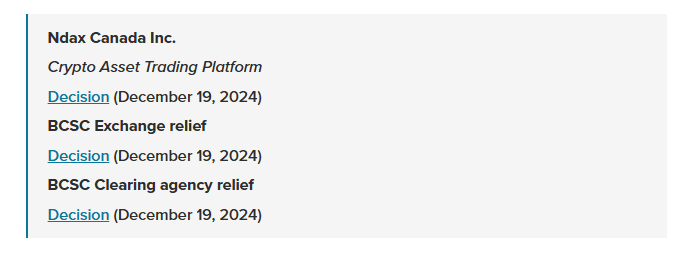
 

image.png
Ndax Canada Inc. appears on the CSA’s crypto asset trading platform list. Users can click the decision link to review the platform’s crypto-specific authorization details, including the December 19, 2024 decision and related exemptive relief.

Understand what you are actually buying

Crypto assets are not interchangeable. Bitcoin, Ether, stablecoins, utility tokens, and other digital assets can have different technologies, use cases, liquidity profiles, risks, and market structures. Their characteristics and risk profiles can therefore differ significantly.

Before buying an asset, a new investor may want to understand some basic questions:

  • What is the asset designed to do?
  • What network does it use?
  • How liquid is it?
  • Where can it be transferred?
  • Is it supported by the platform's custody infrastructure?
  • Does it have staking or other protocol-specific risks?
  • How volatile has the asset historically been?
  • What could cause the asset to lose value?

Learn the difference between a trading fee and the total cost

An advertised trading fee is only one part of the cost of using a crypto platform. New users may want to familiarize themselves with multiple fee structures, including trading fees, spreads, CAD deposit fees, CAD withdrawal fees, crypto withdrawal fees, blockchain network fees, staking or rewards fees, and more.

A platform that advertises “zero commission” may be using a spread-based pricing model, meaning part of its revenue may come from the difference between its buy and sell prices. Another platform may charge an explicit trading fee that is easier to calculate.

Neither structure should be evaluated from the headline number alone.

Ndax uses a flat 0.20% trading fee on buy and sell orders, with no volume tiers or maker/taker split. The fee is shown before the order is confirmed. CAD and crypto deposits are free, while withdrawal costs are published separately.

For example, a $500 purchase at a 0.20% trading fee has a $1 trading commission. That makes the explicit trading cost straightforward to calculate, but new users may still want to consider the entire transaction path. A person who plans to buy Bitcoin and later withdraw it to a private wallet can review both the trading commission and the applicable BTC withdrawal fee before making the purchase.

Understand custody before leaving crypto on a platform

Buying crypto and storing crypto are two separate conversations. If crypto remains on a trading platform, the user relies on that platform's custody infrastructure. If the user withdraws it to a personal wallet, the user takes on more direct responsibility for safeguarding access to the assets.

When reviewing custodial storage, beginners may want to look at how client assets are segregated, whether third-party custodians are used, how much is stored offline, what operational balances are maintained, and what protections do and do not apply.

On Ndax, at least 80% of client virtual assets are held in cold and warm storage with acceptable third-party custodians regulated as trust companies. Assets held with those custodians are maintained in segregated omnibus accounts in the name of Ndax in trust for or for the benefit of clients and are separate from Ndax's own assets.

The remaining portion may be held through Ndax's own custody infrastructure to support operational needs such as deposits, withdrawals, settlement, and certain staking activities.

Learn what self-custody actually means

Self-custody means holding crypto in a wallet where the user controls the private keys. That reduces reliance on a trading platform for custody while placing responsibility for key and wallet management on the user.

If private keys or recovery information are lost and no backup exists, there may be no way of restoring access. Before moving assets to self-custody, a new user may want to understand:

  • Private keys
  • Recovery or seed phrases
  • Wallet addresses
  • Supported blockchain networks
  • Hardware versus software wallets
  • Safe backup practices
  • Phishing risks
  • Test transfers

Treat crypto transactions as irreversible

Blockchain transfers generally cannot be undone in the same way a credit or debit card transaction can be reversed. A wrong wallet address, wrong network, or missing destination tag may result in assets being permanently lost or becoming difficult or impossible to recover.

When withdrawing crypto from Ndax, users need to confirm the destination address and select a supported blockchain network. Using an incorrect address or unsupported network may result in loss of assets, and a submitted blockchain withdrawal generally cannot be reversed.

Learn to recognize crypto scams before someone targets you

Crypto scams often rely on social engineering rather than technical attacks. Common warning signs include:

  • Guaranteed returns
  • Pressure to act immediately
  • Unsolicited investment advice
  • Requests to send crypto to "unlock" or "recover" funds
  • Fake support representatives
  • Fake regulator or government representatives
  • Requests for seed phrases, passwords, or 2FA codes
  • Websites that imitate legitimate crypto platforms

According to Canadian regulators, the CSA and CIRO worked to deactivate 11,728 fake investment platforms and cryptocurrency scam websites between June 2025 and June 2026, involving nearly 20,000 URLs. This means investment scams are not a theoretical risk and are a real concern for crypto users.

Security continues with the user’s account

Platform security is an important part of the equation, but users also play a role in protecting access to their own accounts. Common account-security practices may include:

  • Using a unique password
  • Enabling two-factor authentication
  • Securing the email account connected to the crypto account
  • Avoiding shared or public devices for account access
  • Checking URLs before logging in
  • Never sharing one-time security codes
  • Reviewing withdrawal details carefully

Understand that crypto can create tax obligations

Crypto may feel separate from traditional finance, but Canadian tax rules still apply. The CRA says crypto activity can result in business income or loss, or capital gains or losses, depending on the facts and circumstances.

The CRA requires taxpayers engaging in crypto transactions to maintain adequate records, including information such as the asset and quantity, date and time, Canadian-dollar value, nature of the transaction, and relevant wallet addresses. It also recommends regularly exporting exchange records while users still have access to their accounts.

Learn the difference between investing and trading

Buying crypto does not make a user an active trader. A beginner may choose to make a single purchase, make purchases gradually over time, set up recurring purchases, or trade more actively. Each approach involves different levels of time, risk, cost, and decision-making.
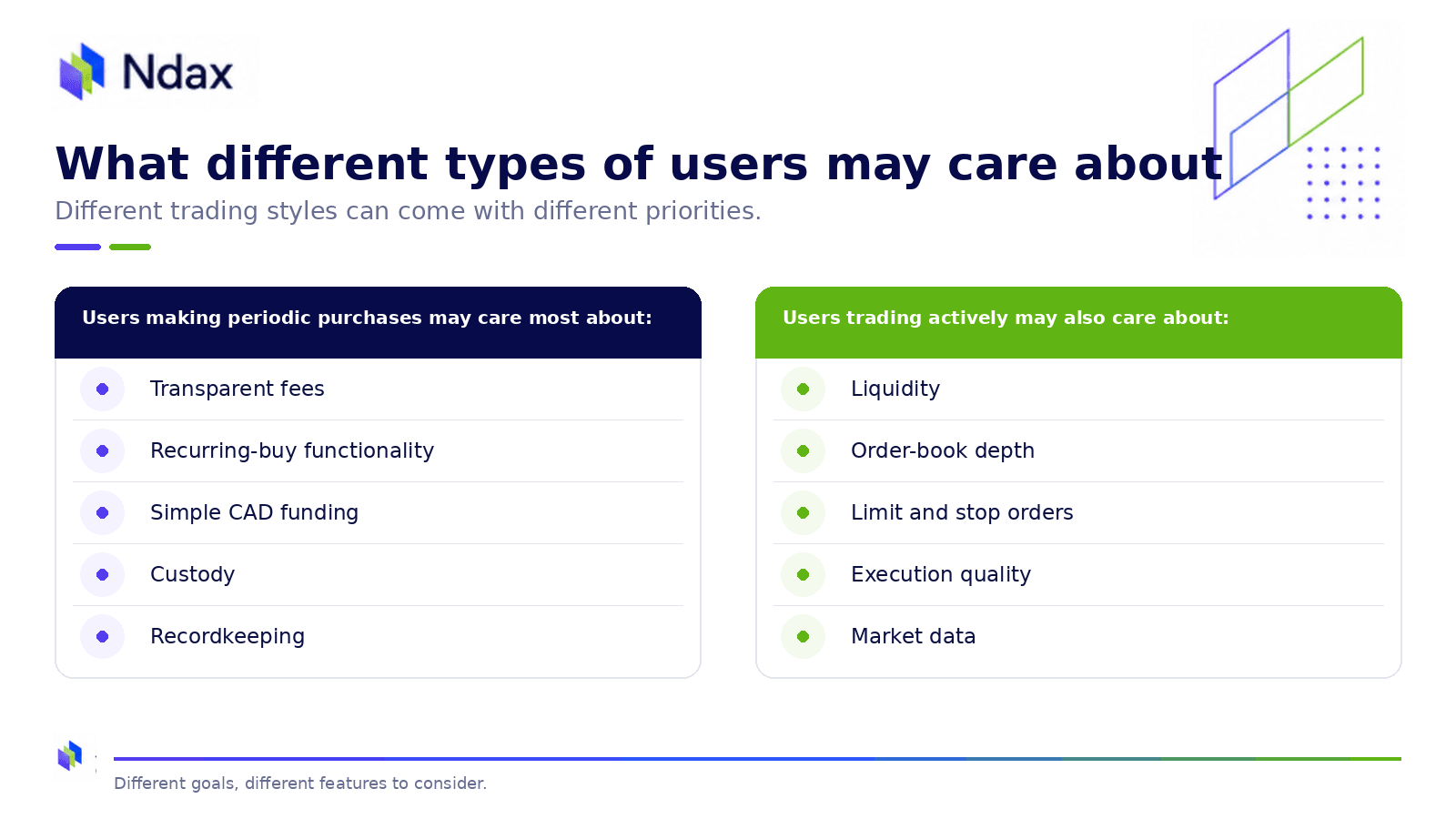
image.png

Understand how purchase size affects crypto risk

Crypto markets can move sharply in either direction. Crypto assets can fall significantly after purchase and may remain below the purchase price for an extended period. There is no platform feature, recurring-buy strategy, staking product, or order type that removes that fundamental market risk.

Where Ndax fits for new Canadian users

Ndax offers retail trading features alongside additional tools that may be relevant as users become more familiar with the platform. It is a regulated Canadian crypto trading platform that is based in Canada and only serves Canadian users.

Ndax is registered as an Investment Dealer under securities legislation in all provinces and territories of Canada and is a member of the Canadian Investment Regulatory Organization (CIRO).

Ndax charges a flat 0.20% trading fee on buy and sell orders, with no maker/taker tiers or volume threshold required for that rate. Interac e-Transfer, bank wire, and crypto deposits are free to receive, and applicable withdrawal costs are published separately.

For users who eventually want to take direct custody, Ndax also supports external crypto withdrawals across supported assets and networks.

Ndax offers features ranging from CAD-funded purchases and recurring buys to advanced order types, staking, external withdrawals, and larger-transaction services. The process starts from the first CAD-funded purchase to recurring buying, and can evolve to include advanced order types, staking, external wallets, or larger transactions.


Don't forget to follow us on social media for more updates and join the conversation on our forums.

Disclaimer: This article is not intended to provide investment, legal, accounting, tax or any other advice and should not be relied on in that or any other regard. The information contained herein is for information purposes only and is not to be construed as an offer or solicitation for the sale or purchase of cryptocurrencies or otherwise.