Crypto tax records in Canada: What platform information users should keep
Learn what crypto transaction records Canadians should keep for tax purposes, what information a trading platform can provide, and why account history should be reviewed throughout the year rather than only at tax time.
Key takeaways
- The CRA requires crypto users to maintain records supporting their transactions.
- Important information includes the crypto asset, quantity, date and time, CAD value, transaction type, wallet addresses, deposits, withdrawals, and related costs.
- Users should keep both trade records and transfer records.
- A transfer between wallets does not automatically mean a sale or other disposition, but records are important for showing where the assets moved and whether ownership changed.
- Crypto-to-crypto trades, including swaps, can constitute a disposition for tax purposes and need to be included in records, even if no Canadian dollars were involved.
- Platform records should be downloaded regularly rather than relying indefinitely on online account access.
- The CRA generally requires tax records to be kept for at least six years from the end of the last taxation year to which they relate.
- Ndax users can generate ledger reports and download monthly or quarterly statements directly from their account.
Introduction
Canadian crypto users should keep records of their trades, deposits, withdrawals, transfers, fees, wallet activity, and the Canadian-dollar value of transactions when they occur. The Canada Revenue Agency requires all individuals and businesses engaging in crypto-asset transactions to maintain adequate books and records supporting each transaction. For users of crypto exchanges or other custodial platforms, the CRA specifically identifies trade ledgers, transfer ledgers, and records supporting other transactions on the platform as information that should be retained.
On Ndax, users can generate ledger reports, access monthly and quarterly account statements, and review detailed account activity. Transaction confirmations and account information include details such as trades, deposits, asset values, and transaction fees. Ndax also offers tax-reporting resources and an integration with Koinly, which can help users organize platform transaction data as part of a broader tax workflow.
Why crypto recordkeeping matters in Canada
Crypto transactions can become difficult to remember after the fact. A user may buy Bitcoin several times, transfer some to a private wallet, receive staking rewards on other assets, swap Ethereum for a stablecoin, move crypto back to a platform, and sell part of the position months later.
Each transaction may need to be supported by adequate records. The CRA says taxpayers engaging in crypto-asset transactions must maintain adequate books and records supporting those transactions. It also recommends that people using exchanges and custodial platforms regularly export their activity, rather than assuming they will always be able to retrieve the information later.
The CRA also generally requires those records to be retained for at least six years from the end of the last taxation year to which they relate.
What crypto transaction information should users keep?
The CRA identifies several pieces of information that should be maintained for crypto transactions, including:
- The type of crypto asset
- The number of units involved
- The date and time of the transaction
- The Canadian-dollar value at the time
- The nature of the transaction
- The other party to the transaction, where applicable
- Wallet addresses associated with the transaction
- Beginning and ending wallet balances and their cost
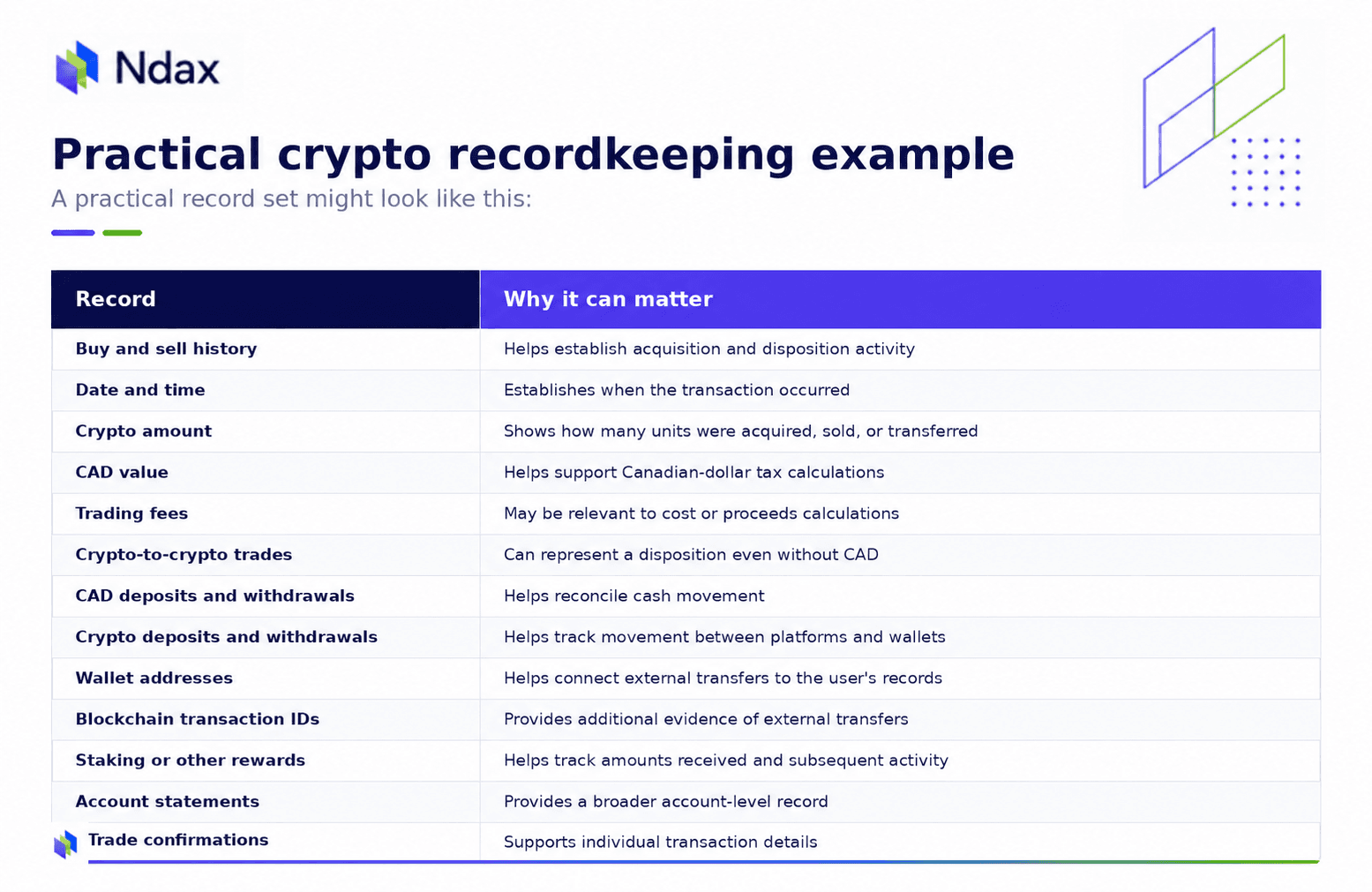
Trade history and transfer history are not the same thing
A trade ledger tells you what was bought, sold, or exchanged. A transfer ledger tells you what moved into or out of an account.
For example, a user buys 0.1 BTC and sends it to a hardware wallet. The purchase and the withdrawal are two separate entries in the user’s records. Later, if that BTC is returned to a trading platform, another deposit is entered.
Without proper transfer records, it may appear as though the Bitcoin disappeared from one account and appeared in another without a clear record connecting the two movements. This problem becomes even harder to reconcile when someone uses several platforms and wallets.
This is why the CRA specifically recommends retaining both trading and transfer records from custodial platforms.
Record the Canadian-dollar value at the time of the transaction
Canadian tax reporting is done in Canadian dollars. That means crypto users need more than the number of tokens involved.
The CRA says users should maintain the value of the crypto asset in Canadian dollars at the time of each transaction. Where a direct CAD value is not readily available, the CRA generally accepts fair market value determined using a reasonable and consistently applied method. This becomes particularly important for activity such as:
- Crypto-to-crypto trades
- Staking rewards
- Payments made in crypto
- Crypto received from another party
- Transactions occurring on platforms quoted primarily in another currency
If the CAD value has to be determined several years later, the process can become considerably more difficult.
Do not overlook crypto-to-crypto trades
Selling Bitcoin for Canadian dollars and transferring CAD to a user’s financial institution is an obvious transaction to record. But trading Bitcoin for a stablecoin can be easier to overlook.
For Canadian tax purposes, however, exchanging one crypto asset for another can constitute a disposition. The CRA says the value of the crypto asset received generally needs to be converted into Canadian dollars for reporting purposes.
That means a useful transaction history should capture more than fiat purchases and withdrawals, especially if a user buys BTC with CAD, trades BTC for USDC, and later trades USDC for another asset. The records need to document each stage rather than showing just the original CAD deposit and final withdrawal.
Adjusted cost base requires historical records
For crypto activity treated on capital account, the CRA notes that a capital gain or loss is generally calculated by comparing proceeds of disposition with the asset’s adjusted cost base (ACB), along with applicable outlays and expenses.
That makes historical acquisition information important to maintain. Someone who has purchased Bitcoin repeatedly over several years cannot necessarily determine their tax position by looking only at the most recent purchase price. Records may need to support:
- Acquisition dates
- Amounts purchased
- Acquisition costs
- Transaction fees
- Prior dispositions
- Remaining holdings
This is another reason transaction history should be treated as an ongoing record rather than recreated at tax season.
What records are available on Ndax?
Ndax users have several ways to retain their account information. Through the Reports section, users can create a ledger report by choosing the report format, report type, and date range. Ndax also allows users to generate and download monthly or quarterly account statements.
Ndax's account documentation also provides users with transaction confirmations and detailed account information, including:
- Positions in crypto assets
- Transactions completed through the account
- Currency deposits
- Crypto deposit values at the time of deposit
- Transaction fees
- Monthly statements
- Quarterly statements
Trade confirmations are also available electronically following completed transactions.
A practical Ndax tax-record workflow
Users do not need to wait until April to organize their records.
On Ndax, a straightforward process is:
- Open Reports from the account.
- Create a ledger report for the required period.
- Download the relevant account statements.
- Keep copies of trade confirmations where additional transaction-level documentation is useful.
- Reconcile external crypto withdrawals with the receiving wallet.
- Reconcile external deposits with the wallet or platform they came from.
- Keep the files with records from any other platforms or wallets used during the year.
- Provide the full record set to tax software or a tax professional where appropriate.
Ndax also offers tax-reporting resources and integration with Koinly, which can help users organize platform transaction data as part of a broader tax workflow. Koinly currently supports automatic synchronization with Ndax as well as transaction-history imports.
Keep withdrawal and wallet records
When crypto leaves a platform, the platform's record represents only one side of the transaction. Users should also keep enough information to identify where the assets went. The CRA includes wallet addresses among the crypto transaction information taxpayers should retain.
This becomes particularly useful when records are needed to show that a withdrawal represents a transfer between wallets or accounts controlled by the same person rather than a transfer of ownership or another type of disposition.
Staking creates another recordkeeping layer
Users earning staking rewards may need additional information beyond ordinary trades. Useful records often include the asset received, quantity received, date and time, CAD fair market value, reward history, and any subsequent sale or transfer of the reward.
The reason is that receiving a reward and later disposing of the same asset can create separate tax considerations depending on the user's circumstances. The CRA states that staking rewards received through a centralized crypto-asset exchange will generally be considered income when credited to the taxpayer’s wallet on the platform.
How Ndax helps keep the record trail organized
For Canadian users, Ndax combines trading with account-level reporting tools that remain accessible from the same platform. Users can generate ledger reports for selected periods, download monthly and quarterly statements, access trade confirmations, and review transaction, deposit, withdrawal, and fee information through their account.
A user making one Bitcoin purchase may not think much about reporting. Someone with recurring purchases, staking rewards, multiple withdrawals, several assets, or years of trading history has a different recordkeeping problem.
Having detailed platform records available from the start can make it easier to keep that history organized rather than rebuilding it later.
Don't forget to follow us on social media for more updates and join the conversation on our forums.
Disclaimer: This article is not intended to provide investment, legal, accounting, tax or any other advice and should not be relied on in that or any other regard. The information contained herein is for information purposes only and is not to be construed as an offer or solicitation for the sale or purchase of cryptocurrencies or otherwise.