How to buy crypto in Canada?
Learn the main ways Canadians can buy crypto, how regulated trading platforms work, what fees and risks to check, and how a first crypto purchase works on Ndax.

If you only read one thing (TL;DR)
- Canadians can legally buy crypto through regulated crypto trading platforms, P2P transactions, crypto ATMs, and some card-based services.
- Users could consider evaluating a platform based on regulatory status, fees, identity verification, custody, funding and withdrawal options, and security controls.
- Funding options vary by platform. Interac e-Transfer, wire transfers, bank transfers, and cards may be available depending on the provider.
- Ndax currently supports CAD deposits through Interac e-Transfer and wire transfer. Crypto deposits are also supported, but they are separate from CAD funding.
- A first purchase on Ndax involves account verification → CAD deposit → Simple Trading → reviewing the order and fee → confirming the purchase → order execution → crypto appearing in the Ndax wallet.
- Strong passwords, 2FA, and careful wallet and network checks remain important even when using a regulated platform.
Introduction
Canadians can buy crypto through regulated crypto trading platforms, peer-to-peer (P2P) transfers, crypto ATMs, and card-based services. A regulated Canadian crypto trading platform provides an account-based process within a defined Canadian regulatory framework. On Ndax, a first crypto purchase involves creating and verifying an account, depositing Canadian dollars through Interac e-Transfer or wire transfer, choosing a crypto asset through Simple Trading, reviewing the order and trading fee, and confirming the purchase. Once the order fills, the crypto will appear in the user’s Ndax wallet.
Is it legal to buy crypto in Canada?
Yes. Canadians can legally buy, sell, and hold crypto assets. However, crypto is not legal tender in Canada. The Financial Consumer Agency of Canada distinguishes crypto assets from official currencies such as the Canadian dollar. Crypto assets are also not eligible for CIPF coverage.
Canadian regulators also consistently caution that crypto assets can be highly volatile and involve significant risk. Canadians who choose to use a crypto trading platform can verify its regulatory status through official Canadian sources, including the CSA’s crypto platform list and registration databases.
Canadians who choose to use a crypto trading platform can verify its regulatory status through official Canadian sources, including the CSA’s crypto platform list and registration databases. Using a regulated platform does not remove market, custody, operational, or fraud risk.
Ndax Canada Inc. is registered as an Investment Dealer under securities legislation in all provinces and territories of Canada and is a member of CIRO and CIPF. Ndax operates on an Order Execution Only (OEO) basis, meaning clients decide what and when to trade.
What are the main ways to buy crypto in Canada?
There are several ways Canadians can buy, sell, and hold crypto.
- Regulated crypto trading platforms
A regulated crypto trading platform allows users to create an account, complete identity verification, deposit supported fiat currency or crypto, and place buy and sell orders. Learn more: The Canadian crypto platform checklist: regulation, fees, custody & support - Peer-to-peer transactions
Peer-to-peer buying involves purchasing crypto directly from another person or entity rather than placing an order through a conventional trading platform. - Crypto ATMs
Crypto ATMs allow users to purchase certain crypto assets from physical kiosks, often using cards or cash. - Card-based purchases
Some crypto services allow purchases through debit or credit cards.
What is Ndax?
Ndax is a Canadian crypto trading platform that allows users to buy, sell, hold, deposit, stake, and withdraw supported crypto assets using Canadian dollars and crypto.
Ndax Canada Inc. is registered as an Investment Dealer under securities legislation in all provinces and territories of Canada and is a member of CIRO and CIPF. Ndax operates on an Order Execution Only (OEO) basis, meaning clients decide what and when to trade.
For Canadians making a first crypto purchase, Ndax provides CAD funding through Interac e-Transfer and wire transfer, a Simple Trading interface for buying supported crypto assets, custody for assets held on-platform, and the ability to withdraw supported crypto to compatible external wallets.
How a first crypto purchase works on Ndax
For a user making a first purchase through Ndax, the process can be broken down into five steps.
Step 1. Create and verify an Ndax account
New users must first create an account and complete identity verification.
Ndax’s verification process includes personal information, phone verification, government-issued photo identification, and a selfie verification step. Users must have reached the age of majority in their province or territory of residence. Verification is required before users can fund the account or trade.
Step 2: Deposit Canadian dollars
Ndax currently supports two CAD deposit methods: Interac e-Transfer and wire transfer. Ndax does not currently charge a deposit fee for either method. Interac e-Transfer deposits are commonly used for everyday CAD funding. Users retrieve their unique Ndax deposit instructions and message code from their account and then send the transfer through their Canadian financial institution. Ndax states that Interac deposits are typically credited within 0–30 minutes after being sent by the bank. Wire transfers provide another CAD funding option and are typically processed within 0–1 business days after being sent by the financial institution.
Step 3: Choose a crypto asset through
Once CAD is available in the account, users can open Ndax’s trading interface and choose the crypto asset they want to purchase. Simple Trading is Ndax’s simplified trading platform, designed as a streamlined buy-and-sell interface and currently uses only market orders.
Step 4: Enter the amount and review the order
Users enter the Canadian-dollar amount they want to spend and review the order details before confirming. Ndax currently charges a flat 0.20% trading fee on buy and sell orders, with no maker/taker split or volume-based trading tiers. The fee is displayed before the order is confirmed.
Step 5: The crypto appears in the Ndax wallet
Once the order is filled, the purchased crypto is added to the user’s Ndax wallet. Completed trades can also be reviewed in the user’s order or trade history. From there, the user can decide whether to continue holding the asset through Ndax’s custody arrangement or withdraw supported crypto to an external compatible wallet.
General Canadian funding methods vs. Ndax funding methods
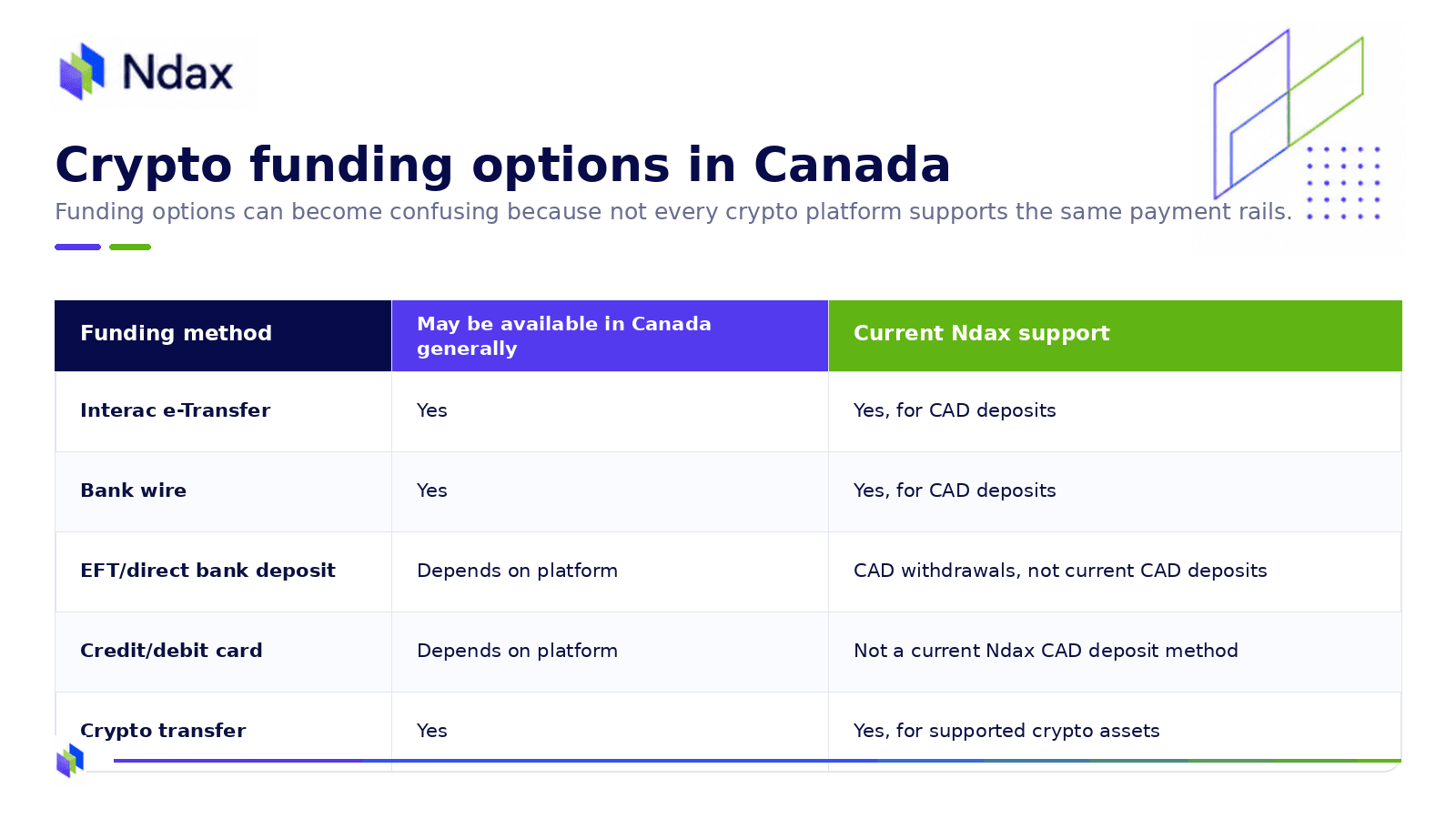
Users could always follow the deposit instructions displayed inside the platform rather than assuming a funding method is available because another Canadian service supports it.
What fees could Canadians expect when buying crypto?
The cost of buying crypto often includes more than the standard advertised commission or trading rate. Common costs include:
- Trading fees
- Bid-ask spreads
- CAD withdrawal fees
- Crypto withdrawal fees
- Blockchain network-related costs
- Payment-method fees, depending on the provider
Users should therefore compare the total transaction process rather than looking at only one advertised fee.
What does it cost to buy and sell crypto on Ndax?
CAD deposits through Interac e-Transfer and wire transfer are free on Ndax. Ndax currently charges a flat 0.20% trading fee on buy and sell orders.
For CAD withdrawals, Ndax currently charges C$1.50 for Interac e-Transfer and C$4.99 for EFT/direct bank deposit. Interac withdrawals are currently limited to C$10,000 per transaction and C$10,000 during a 24-hour period, while Ndax lists no maximum limit for EFT withdrawals.
Crypto withdrawal fees vary by asset and supported blockchain network and are displayed before the withdrawal is confirmed. Users should check the current fee schedule before trading or withdrawing because fees and limits can change.
Learn more: Crypto fees in Canada: trading fees, spreads, and total costs explained
How to buy crypto in Canada FAQs
Do I need to verify my identity to buy crypto in Canada?
Regulated Canadian crypto trading platforms generally require identity verification before users can fund or trade on their account. Ndax requires account verification before deposits, withdrawals, and trading are enabled.
What CAD deposit methods does Ndax support?
Ndax currently supports CAD deposits through Interac e-Transfer and wire transfer. Both are currently free from the Ndax side.
Can I use an EFT to deposit money into Ndax?
Interac e-Transfer and wire transfer are the only two current CAD deposit methods. EFT/direct bank deposit is available as a CAD withdrawal method.
How do I make my first crypto purchase on Ndax?
Create and verify an account, deposit CAD through a supported funding method, open Simple Trading, choose a supported crypto asset, enter the amount you want to buy, review the order and fee, and confirm. Once the order fills, the crypto is credited to the Ndax wallet.
Do I need a personal crypto wallet before buying?
No. New users can purchase crypto through a custodial platform before deciding whether to transfer it to an external self-custody wallet.
Can crypto transactions be reversed?
Crypto transactions are generally irreversible once confirmed on the blockchain. Users should carefully verify the wallet address, asset, and blockchain network before sending crypto externally.
Are crypto assets insured in Canada?
Crypto assets are not covered by Canadian deposit insurance, and crypto assets are not eligible for CIPF coverage.
Bottom line
There is more than one way to buy crypto in Canada. Canadians can use regulated crypto trading platforms, P2P transactions, crypto ATMs, and certain card-based services. However, the fees, verification requirements, custody arrangements, and risks can differ significantly.
For users choosing a crypto trading platform, the first-purchase process should be clear from the beginning: how to verify the account, how to fund it, how fees are disclosed, how the order is placed, and where the purchased crypto goes afterward.
On Ndax, that process is straightforward: verify an account, fund it through Interac e-Transfer or wire transfer, open Simple Trading and select an asset, review the order and 0.20% trading fee, confirm the purchase, and receive the crypto in the Ndax wallet once the order fills.
Ndax is a regulated crypto trading platform and provides an Order Execution Only (OEO) service. Ndax executes clients’ instructions but does not provide investment advice. Clients decide when and what to trade.
Crypto trading involves risk. Prices can move quickly, crypto assets can be volatile, and trading tools do not guarantee profit or protection from losses. This content is for general educational purposes only and is not investment advice, a recommendation, research, or a solicitation to buy or sell crypto assets.
Don't forget to follow us on social media for more updates and join the conversation on our forums.
Disclaimer: This article is not intended to provide investment, legal, accounting, tax or any other advice and should not be relied on in that or any other regard. The information contained herein is for information purposes only and is not to be construed as an offer or solicitation for the sale or purchase of cryptocurrencies or otherwise.