How to invest in cryptocurrency in Canada: A beginner’s guide
Learn how cryptocurrency investing works in Canada, what beginners should understand before buying, how to compare crypto platforms, and how fees, custody, taxes, and risk fit into the process.

Key takeaways
- Cryptocurrency is a broad category of digital assets. Bitcoin, Ethereum, stablecoins, and other tokens all have different structures and uses.
Investing in crypto is not the same as short-term trading. Time horizon, activity level, and risks can differ.
Understanding an asset before buying it can help users make more informed decisions
When choosing a Canadian crypto platform, users may want to review regulatory status, fees, funding methods, custody, supported assets, withdrawals, and trading tools.
Buying crypto and deciding where to store it are separate decisions.
Crypto transactions can have Canadian tax consequences. The CRA requires users to keep adequate books and records supporting their crypto transactions.
Crypto assets can be highly volatile, and neither regulation nor a particular investment approach guarantees profit or protects against losses.
Ndax currently supports 65+ crypto assets and charges a flat 0.20% fee on buy and sell orders.
Introduction
Investing in cryptocurrency generally means buying one or more crypto assets with the intention of holding them for some period of time rather than repeatedly trading short-term price movements. Before buying, beginner users should understand what the asset does, the risks involved, how the trading platform is regulated, what fees apply, how the crypto will be held, and what records need to be kept. Canadian users may want to verify whether a crypto trading platform is authorized to do business with Canadians through the Canadian Securities Administrators (CSA). Ndax Canada Inc. appears on the CSA’s current list and is registered as an Investment Dealer under securities legislation in all provinces and territories of Canada and is a member of CIRO and CIPF
What is cryptocurrency?
Cryptocurrency is a broad term that refers to crypto assets that use cryptography and distributed-ledger technology to record and validate transactions. Bitcoin was the first widely recognized cryptocurrency and was designed as a peer-to-peer digital asset with a fixed issuance framework.
Ether is the native asset of Ethereum, a blockchain network used to run smart contracts and decentralized applications. Other crypto assets may be used for payments, blockchain governance, decentralized finance, gaming, infrastructure, and other use cases.
Not every crypto asset is designed to function as money, and not every blockchain operates in the same way. This is why evaluating crypto as one single investment category may not be the best approach. Different assets can have different supply structures, networks, use cases, risks, governance arrangements, and market liquidity.
The same logic holds true across other asset classes. For example, saying a user “invests in stocks” can refer to very different companies, sectors, business models, and risk profiles. A bank stock, data center provider, retailer, mining company, technology firm, and utility stock are all equities. But investors would not evaluate them using exactly the same criteria.
Crypto works in a similar way: Bitcoin, Ethereum, stablecoins, and smaller protocol tokens all fall under the cryptocurrency label, but they can behave very differently.
Investing in crypto vs. trading crypto
Investing and trading in crypto both involve buying and selling crypto assets, but the terms describe different approaches and strategies. Someone investing in crypto may intend to hold an asset over a long period of time and make relatively few transactions.
On the other hand, someone actively trading may buy and sell more frequently based on short-term price movements, market conditions, technical analysis, or execution strategies.
Neither approach is better by default, nor does one guarantee a better outcome over the other.
For Canadian tax purposes, the Canadian Revenue Agency states that gains and losses from crypto dispositions may be treated as either capital gains and losses or business income and losses depending on the circumstances.
How much money is needed to invest in crypto?
Crypto assets are divisible, which means someone can purchase a fraction of one coin or token. This means users normally do not need to buy an entire cryptocurrency unit.
On Ndax, the minimum is displayed when the trade is entered and is generally only a few Canadian dollars, depending on the asset, ranging between CAD$1 and CAD$5.
While it is important to understand how much money is needed to start investing in crypto, users should also understand whether crypto exposure is appropriate for their own financial circumstances and tolerance for loss.
Crypto prices can move substantially in either direction, including over short periods. Users should make their own decisions about whether to participate and how much capital they are prepared to expose to that volatility.
Step 1: Understand the crypto asset before buying it
Before buying a cryptocurrency, users may want to research questions such as:
- What blockchain or network does it operate on?
- What is the asset used for?
- How is new supply created?
- Is there a maximum supply?
- Who develops or governs the network?
- How concentrated is ownership?
- Does the token provide a genuine function within the network?
- How liquid is the asset?
- What are the main technical, regulatory, custody, and market risks?
Different assets require different research. For example, evaluating Bitcoin involves different questions from evaluating a proof-of-stake network, stablecoin, governance token, or newly launched project.
Step 2: Choose a crypto trading platform
A useful platform comparison should go beyond asking which app has the largest number of coins.
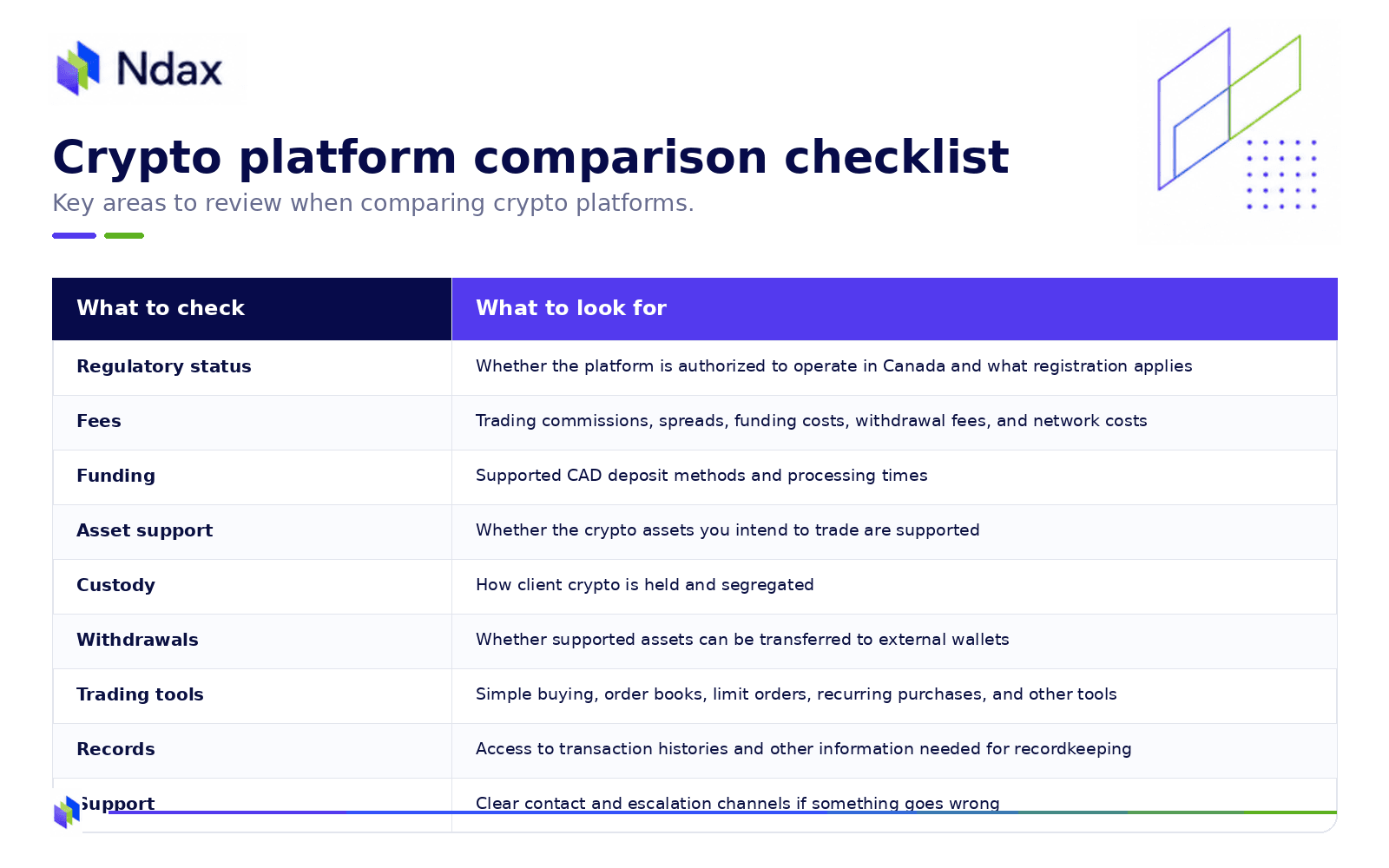
Canadians can check the CSA’s list of crypto platforms authorized to do business with Canadians rather than relying only on a platform describing itself as “regulated.”
Read more: How to verify if a crypto platform is registered in Canada.
How Ndax works for Canadian crypto investors
Ndax is a Canadian crypto trading platform registered as an Investment Dealer under securities legislation in all provinces and territories of Canada. Ndax is also a member of CIRO and CIPF and operates under an Order Execution Only model. Ndax executes client instructions but does not provide investment advice or recommendations.
Ndax currently provides access to 65+ cryptocurrencies and supports both simplified and advanced trading interfaces. For someone purchasing crypto with Canadian dollars, the basic process is:
- Create and verify an Ndax account.
- Deposit CAD through Interac e-Transfer or wire transfer.
- Select a supported crypto asset.
- Enter the amount to buy.
- Review the order and trading fee.
- Confirm the trade.
- Once filled, the crypto appears in the user’s Ndax wallet.
Ndax currently charges a flat 0.20% trading fee on buy and sell orders, with no maker/taker split or volume-based trading tiers. CAD deposits through Interac e-Transfer and wire transfer are free from the Ndax side.
Step 3: Fund the account
Funding methods vary by platform. Ndax currently supports Canadian-dollar deposits through Interac e-Transfer and wire transfers.
Users who already hold crypto can also deposit supported assets from an external wallet, provided they use a blockchain network supported for that specific asset.
Step 4: Place the crypto purchase
Once funds are available, users need to choose how to place the order. For beginners, Ndax’s Simple Trading interface provides a streamlined buy-and-sell process using market orders. Users select the asset, enter the amount, review the details, and confirm.
Users who want more control over price can use Advanced Trading and order types such as limit orders.
Step 4: One-time purchases vs. recurring purchases
A one-time purchase means buying the intended amount in a single transaction. A recurring-purchase approach divides purchases across a regular schedule, such as daily, weekly, or monthly. This is often referred to as dollar-cost averaging, or DCA.
Ndax allows users to create recurring purchases and choose the asset, Canadian-dollar amount, and purchase schedule. Users can edit, stop, or delete the schedule.
Step 5: Decide where to hold the crypto
Buying crypto and deciding how it will be stored are two separate decisions. Users can hold their crypto through the Ndax platform, where the crypto asset appears in their Ndax wallet.
Users can also withdraw to self-custody. Self-custody means moving crypto to a wallet where the user controls the private keys. This reduces reliance on a trading platform for ongoing custody but transfers substantially more responsibility to the user.
Self-custody is not automatically “safer.” Users become responsible for protecting private keys and recovery phrases, maintaining backups, verifying addresses, selecting compatible networks, and avoiding phishing and wallet-security mistakes.
Step 6: Understand the fees
A trading fee is only one part of the total cost of buying, holding, and moving crypto. Other costs may include:
- Bid-ask spreads
- Slippage
- CAD withdrawal fees
- Crypto withdrawal fees
- Blockchain network-related costs
Ndax charges a flat 0.20% commission on buy and sell orders. Interac e-Transfer and wire deposits are currently free. CAD withdrawals currently cost C$1.50 through Interac e-Transfer or C$4.99 through direct bank deposit/EFT. Crypto withdrawal fees vary by asset and network.
Step 7: Keep crypto transaction records
The CRA says individuals and businesses involved in crypto transactions must keep adequate books and records supporting those transactions. Relevant information includes the type and number of units, date and time, Canadian-dollar value, wallet addresses, transaction details, and platform records.
Buying and simply holding crypto does not necessarily create an immediate taxable event. Selling crypto, exchanging one crypto asset for another, using crypto to buy goods or services, and certain other transactions can result in a disposition with tax consequences.
Common beginner mistakes to avoid
Buying something you do not understand
A familiar ticker or rapidly rising price does not explain an asset’s tokenomics, governance, technology, liquidity, or risks.
Assuming every crypto asset works like Bitcoin
Crypto assets can have substantially different issuance models, networks, governance structures, and use cases.
Choosing a platform based only on the number of coins
Regulatory status, custody, fees, CAD funding, withdrawals, records, and support can be just as relevant.
Confusing registration with a guarantee
Registration creates a regulatory framework for the platform. It does not guarantee that a crypto asset will appreciate or prevent losses.
Assuming self-custody is automatically safer
Self-custody changes the risk. It removes certain platform dependencies while making the user responsible for private-key and wallet security.
Ignoring fees and execution
The advertised trading fee is only one potential cost. Additional factors, including spreads, slippage, withdrawal charges, and network fees, may also apply.
Failing to keep records
Waiting until an asset is sold to reconstruct years of purchases, transfers, wallet addresses, and fees can make Canadian tax reporting much more difficult.
Treating staking rewards as guaranteed income
Staking rewards are not guaranteed. Reward rates can fluctuate, the value of staked assets may decline, and staking involves additional risks related to network protocols and operations
Bottom line
Beginners should understand the asset they are considering, verify the platform they intend to use, review fees and available liquidity, decide how the crypto will be held, and start keeping transaction records from the beginning.
For Canadians who choose to buy crypto directly, registered trading platforms provide a defined framework for account verification, CAD funding, trading, custody, and withdrawals.
Ndax provides access to 65+ crypto assets, CAD deposits through Interac e-Transfer and wire transfer, Simple and Advanced Trading interfaces, a flat 0.20% trading fee, recurring purchases, external crypto withdrawals, and staking for supported assets.
Don't forget to follow us on social media for more updates and join the conversation on our forums.
Disclaimer: This article is not intended to provide investment, legal, accounting, tax or any other advice and should not be relied on in that or any other regard. The information contained herein is for information purposes only and is not to be construed as an offer or solicitation for the sale or purchase of cryptocurrencies or otherwise.