How to read liquidity, order books, and slippage before placing a crypto trade

Learn how to evaluate crypto liquidity, read an order book, understand bid-ask spreads and market depth, and understand how liquidity and order size can affect potential slippage before placing a trade.
 

How to read liquidity, order books, and slippage before placing a crypto trade

If you only read one thing

  • Liquidity refers to how easily an asset can be bought or sold without materially affecting its price.
  • An order book displays current buy orders (bid) and sell orders (ask).
  • The best bid and best ask only show the top of the order book.
  • Larger orders may need to move through several price levels.
  • The bid-ask spread is the difference between the highest current bid and the lowest current ask.
  • Slippage occurs when the average execution price is different from the price a user expected.
  • Larger orders can be more sensitive to market depth and available liquidity.
  • Market orders prioritize immediate execution.
  • Limit orders let users set a price condition, but the order may not fill.  
  • Trading fees, spread, and slippage are different parts of the trading cost.

Introduction

Before placing a crypto trade, the displayed market price is one of several numbers to consider. A trader, investor, or user can also look at the bid-ask spread, available liquidity at different price levels, order-book depth, trade size, and likely slippage. Liquidity describes how easily an asset can be bought or sold without materially affecting its price. An order book shows the prices and quantities buyers and sellers are currently willing to trade. Slippage occurs when the actual execution price differs from the price expected when the order was placed.

What is liquidity in crypto

Liquidity describes how easily a crypto asset can be bought or sold without materially affecting its market price. A liquid market generally has more available quantity near the current market price and smaller gaps between price levels.

A less liquid market will have fewer available orders or larger gaps between buyers and sellers. An illiquid market may have little to no available orders.

Liquidity is not fixed. It can change throughout the day and during periods of high volatility.

For example, buying $100 worth of an asset may have very little effect on a market with millions of dollars of available liquidity. A significantly larger order placed into a thinner market may need to fill across several different prices.

How to read an order book

An order book is a live list of open buy and sell orders for a crypto trading pair. On Ndax, the order book records the amount of cryptocurrency buyers and sellers are offering and the prices they are willing to pay or accept. Ndax’s matching engine uses those orders to determine which trades can be executed.

The screenshot below shows an actual BTC/CAD order-book snapshot from Ndax.
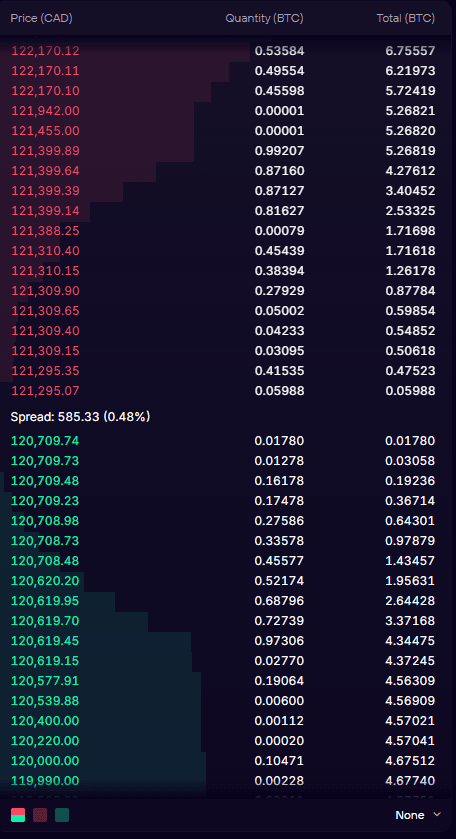
image.png
Point-in-time BTC/CAD order-book snapshot (Sept. 23, 2026). Prices, quantities, and available liquidity can change continuously.


In this snapshot, the lowest ask was $121,295.07 for 0.05988 BTC. The highest bid was $120,709.74 for 0.01780 BTC. Those are the prices immediately beside the spread, but they only represent the first level of each side of the market.

What is the bid-ask spread?

The bid-ask spread is the difference between the highest current bid and the lowest current ask. In the BTC/CAD snapshot above”

  • Best ask: C$121,295.07
  • Best bid: C$120,709.74
  • Spread: C$585.33
  • Ndax’s platform quantifies that spread as 0.48%.

What this means is a user submitting a market buy order would begin matching against the C$121,295.07 ask. A user submitting a market sell order would begin matching against the C$120,709.74 bid.

The spread is not the same as a trading fee. A spread reflects the difference between the prices buyers are currently offering and the prices sellers are currently asking. Ndax's trading fee is separate. Ndax currently charges a flat 0.20% trading fee on every buy and sell order, with no volume tiers or maker/taker split.

Why the best bid and ask only tell part of the story

A user looking at the order book might see C$121,295.07 and think of that as the current Bitcoin purchase price. But only 0.05988 BTC was displayed for sale at that price. The next ask was only slightly higher at C$121,295.35 for 0.41535 BTC.

Together, those first two levels provided 0.47523 BTC of cumulative displayed liquidity. After that, the next ask increased to C$121,309.15. That means a sufficiently small market order could potentially remain within the first price level, while a larger order would need to use additional sellers at progressively higher prices.

As such, the price at the top of an order book is not necessarily the average price an entire larger transaction will receive.

What does market depth show?

Market depth shows how much buying or selling interest is available at different prices. The Total column in the Ndax order book makes this easier to follow because it shows how cumulative quantity increases as the user moves deeper into the book.

On the ask side of the screenshot, the visible sell side ultimately reached approximately 6.76 BTC of cumulative displayed quantity. The bid side reached approximately 4.68 BTC across the visible levels.

Those figures do not represent all liquidity available on Ndax. They are only the orders visible in this particular snapshot at that moment.

What is slippage?

Slippage is the difference between an expected execution price and the final execution price. This can occur when markets move or when there is not enough liquidity available near the top of the order book.

The BTC/CAD screenshot provides a real example. The best ask was C$121,295.07. A 0.05 BTC market buy could fit completely within the 0.05988 BTC displayed at that price, assuming the order book remained unchanged. However, a 1 BTC market buy could not fit completely. It would need to execute across several ask levels:

  • C$121,295.07
  • C$121,295.35
  • C$121,309.15
  • C$121,309.40
  • C$121,309.65
  • C$121,309.90
  • C$121,310.15

Using the quantities shown in the screenshot, the approximate average execution price for a 1 BTC market buy would be C$121,302.94. That is approximately C$7.87 per BTC above the original best ask. The difference comes from the fact that there was not enough Bitcoin available at C$121,295.07 to fill the entire order.

Why gaps in the order book matter

The distance between price levels is often overlooked. The first several asks in the screenshot are relatively close together:

  • C$121,295.07
  • C$121,295.35
  • C$121,309.15
  • C$121,309.40
  • C$121,309.65

But deeper in the order book, larger gaps begin to appear. After cumulative displayed sell liquidity reaches approximately 1.71618 BTC at C$121,310.40, the next visible ask is C$121,388.25. Shortly afterward, the market reaches C$121,399.14.

An even larger gap appears later in the screenshot. After approximately 5.26819 BTC of cumulative displayed liquidity at C$121,399.89, there is almost no displayed quantity at C$121,455.00 and C$121,942.00 before the next meaningful order appears at C$122,170.10.

That gap may be irrelevant for a small order. It could matter considerably if a large market order consumed enough of the lower-priced liquidity to reach it. For example, based solely on the displayed screenshot, a 5 BTC market buy would still remain below C$121,400.

However, a 5.3 BTC market buy would begin reaching the C$122,170.10 level because the two intervening displayed orders contain only 0.00001 BTC each.

Market orders and limit orders interact with liquidity differently

A market order prioritizes execution at the best available price at the given time. Essentially, it matches against the best available prices in the order book until the requested amount is filled.

That means a sufficiently large market order can execute at several prices. A limit order allows the user to set the maximum price they are willing to pay when buying or the minimum price they are willing to accept when selling.
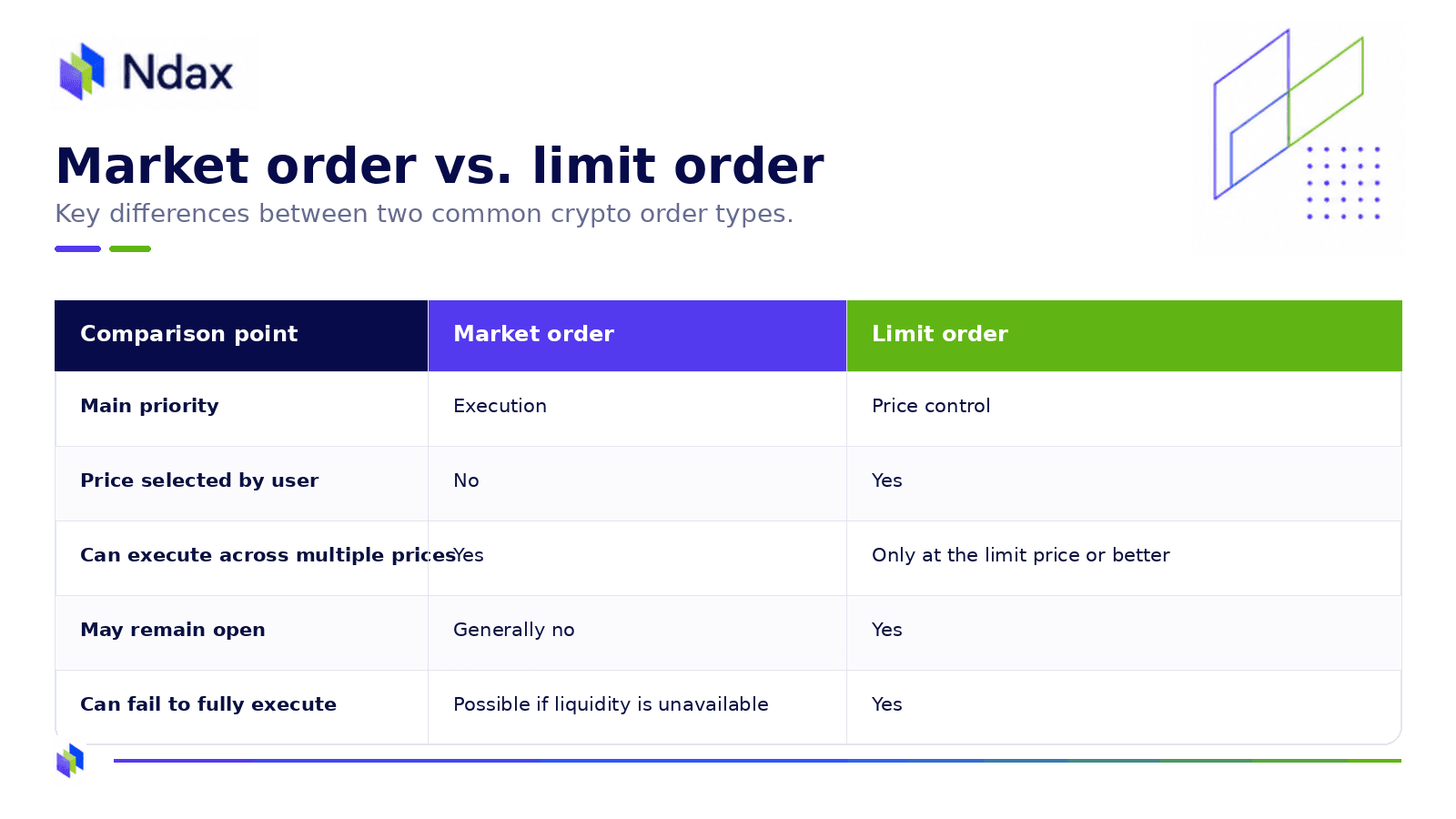
image.png

A limit order can help prevent execution beyond the selected price, but it introduces another trade-off: the order may only partially fill or may not execute at all. Limit orders depend both on the market reaching the specified price and sufficient liquidity being available. Orders ahead at the same price can also affect whether the user’s order is filled.

Trading volume and liquidity are not the same thing

Trading volume is a measure of how much an asset has changed hands during a specific period. Liquidity references to how easily a particular transaction can be executed around the current market price.

The two can be related or even correlated, but they are not interchangeable. An asset can have heavy 24-hour trading volume while a particular order book still contains limited quantity at certain prices.

The BTC/CAD screenshot above illustrates what a broad volume number cannot show. A user can see exactly:

  • How much Bitcoin is available at the best price;
  • How quickly cumulative liquidity builds;
  • Where gaps appear between orders; and
  • How far into the order book a particular trade may need to move.

Trading fee, spread, and slippage are all different

Trading fees, spreads, and slippage all affect the trading process, but they come from different places. A trading fee is the commission charged by the platform. The bid-ask spread is the difference between the highest current bid and lowest current ask. Slippage is the difference between the expected price and the actual average execution price.

Using the BTC/CAD example above:

  • Best ask: C$121,295.07
  • Best bid: C$120,709.74
  • Spread: C$585.33, or 0.48%
  • Approximate average price for a 1 BTC market buy: C$121,302.94
  • Approximate difference from the initial best ask: C$7.87 per BTC

Ndax's 0.20% trading fee is separate from all of these market conditions. Ndax charges the same percentage on every buy and sell order and shows the trading fee before an order is confirmed. For example, a 1 BTC trade executed at an average price of approximately C$121,302.94 would have a trade value of approximately C$121,302.94.

At a 0.20% commission, the trading fee would be approximately C$242.61. That fee can be calculated in advance and is confirmed to the user before the trade is submitted.

The spread and eventual execution price depend on the order book and market conditions.

What should users check before placing a crypto trade?

Before submitting an order, users can review:

  • The best bid and ask
  • The current spread
  • The quantity available at the first price level
  • The cumulative quantity available deeper in the book
  • Gaps between different price levels
  • Their intended order size
  • Whether they are buying or selling
  • Recent trading activity
  • Current market volatility
  • The type of order being used
  • The platform trading fee

The BTC/CAD screenshot shows why looking at these factors together can be useful. Someone wanting to buy 0.05 BTC could see enough displayed liquidity at the C$121,295.07 best ask to potentially fill the entire order there.

Someone wanting to buy 1 BTC would need several price levels. Someone wanting to buy 5 BTC would move considerably deeper into the book. As such, the same Bitcoin market can therefore produce different execution outcomes based on the size of the transaction.

How to read the order book on Ndax

Ndax users can access the order book from the Trade screen. The order book shows the amount of crypto available, the prices buyers and sellers are offering, the spread, and recently completed transactions.

When preparing to buy, users can review the ask side and consider:

  • How much Bitcoin is currently offered at the best ask?
  • How much cumulative quantity is available near that price?
  • Are there large gaps further down the book?
  • How many levels would the intended transaction need to consume?
  • When selling, the same process can be applied to the bid side.

The screenshot used throughout this article provides a point-in-time example. Users should always review the live order book because prices and available quantities often change continuously.

Common mistakes to avoid

Looking only at the best ask
The best ask in the screenshot was C$121,295.07, but only 0.05988 BTC was displayed there. Larger market orders would require additional liquidity.

Ignoring the quantity beside the price
Price and quantity need to be read together. A low ask containing very little Bitcoin may only cover a small portion of a larger order.

Ignoring the Total column
Cumulative quantity shows how much liquidity becomes available as a trade moves further through the book.

Missing gaps between price levels
The screenshot includes several areas where prices remain tightly grouped and others where the next available price is substantially further away. Those gaps can become relevant when an order consumes the liquidity before them.

Assuming the same liquidity exists on both sides
The bid and ask sides have different quantities and different spacing between price levels. Buy-side and sell-side slippage can therefore differ.

Treating the spread as a trading fee
The C$585.33 spread in the screenshot was created by the difference between the best current buyer and seller. It was separate from Ndax's 0.20% platform trading fee.

Assuming a market order has one price
A larger market order may execute at several prices, producing a weighted-average execution price different from the best bid or ask shown when the order was placed.

Assuming a limit order will always fill
A limit order sets a price condition. It may fill fully, fill partially, remain open, or not execute at all depending on market prices, available liquidity, and order-book priority.

Treating one screenshot as permanent liquidity
The numbers throughout this article come from a real Ndax BTC/CAD order-book snapshot, but they represent only that point in time. The live order book can change immediately.
 

Bottom line

An order book shows more than the current price of a crypto asset. In the BTC/CAD snapshot used throughout this blog, the best ask price was C$121,295.07 and the best bid price was C$120,709.74 with a calculated spread of C$585.33, or 0.48%.

But the liquidity available behind those prices must also be considered. Only 0.05988 BTC was displayed at the best ask. Approximately 0.47523 BTC was available across the first two ask levels. A 1 BTC market buy would have needed to move through several prices and, based on the snapshot, would have produced an approximate average execution price of C$121,302.94.

As trade size increased, the order would have needed to reach progressively deeper into the book.

Before placing a crypto trade, users can review the bid and ask, spread, available quantity, gaps between prices, cumulative liquidity, intended trade size, and order type to better understand how their order may interact with the market.


Don't forget to follow us on social media for more updates and join the conversation on our forums.

Disclaimer: This article is not intended to provide investment, legal, accounting, tax or any other advice and should not be relied on in that or any other regard. The information contained herein is for information purposes only and is not to be construed as an offer or solicitation for the sale or purchase of cryptocurrencies or otherwise.