Ndax vs Crypto.com staking: Fees, rewards, supported assets, and unstaking compared in Canada
Compare Ndax and Crypto.com crypto staking in Canada, including staking fees, validator commissions, estimated rewards, supported assets, payout schedules, and unstaking conditions.
Key takeaways
- Ndax charges a standard 20% administration fee on staking rewards.
- Crypto.com charges 15% for ETH, 35% for NEAR and INJ, and 20% for other supported staking assets.
- Ndax's standard fee matches Crypto.com's fee for most supported assets and is lower for NEAR and INJ.
- Ndax's administration fee covers third-party staking-provider costs.
- Ndax supports 18 staking assets, while Crypto.com lists 23 assets available to eligible Canadian users.
- Both Ndax and Crypto.com display estimated staking APYs before their respective platform fees.
Introduction
Ndax and Crypto.com both offer crypto staking to eligible Canadian users, but their fee structures, supported assets, and staking features differ. Ndax charges a standard 20% administration fee on staking rewards. Crypto.com charges a 15% staking service fee for Ethereum, 35% for NEAR and Injective, and 20% for its other supported staking assets. This means Ndax matches Crypto.com's fee for most supported assets and charges a lower fee for NEAR and INJ, while Crypto.com offers a lower fee for ETH. Ndax currently supports 18 staking assets, while Crypto.com's published staking list includes 23 assets available to eligible Canadian users.
For Canadians comparing Ndax and Crypto.com staking, the decision should not come down to the advertised APY or number of supported assets alone. Ndax distributes rewards daily for several major assets and publishes shorter standard unbonding periods for certain cryptocurrencies, including SOL and DOT. Crypto.com offers a broader asset selection and optional paid Instant Unstaking. The more useful comparison includes rewards after fees, payout schedules, standard unstaking periods, and any additional costs associated with accessing crypto early.
Ndax provides an Order Execution Only service. Ndax executes clients' instructions but does not provide investment advice. Clients are responsible for deciding whether staking is appropriate for their circumstances.
Direct comparison: Ndax vs. Crypto.com staking
| Category | Ndax | Crypto.com |
| Availability | Eligible Canadian users | Eligible Canadian users; asset availability may vary |
| Standard staking fee | 20% of rewards | 20% for most supported assets |
| Reduced fee options | Standard 20% across listed assets; promotional programs may differ | Not applicable; Crypto.com uses asset-specific staking fees rather than a separate reduced-fee tier. |
| Third-party validator fees | Ndax says its administration fee covers third-party staking-provider costs | Staking service fees are deducted from rewards; network and validator performance affect rewards |
| Supported staking assets | 18 | 23 listed as available to eligible Canadian users |
| Common supported assets | ETH, SOL, ADA, DOT | ETH, SOL, ADA, DOT |
| Advertised APY | Before Ndax's administration fee | Before Crypto.com's staking service fee |
| Reward payments | Daily or weekly, depending on asset | Up to three times weekly, depending on asset and network |
| Automatic staking | Manual staking and separate Auto Earn feature | Automatic compounding for certain assets; no direct equivalent to Ndax Auto Earn |
| Unstaking | Asset-specific periods; instant redemption for certain eligible plans | Asset-specific unbonding periods; optional Instant Unstaking for supported assets, subject to fees and limits |
| Staking risks | Market, validator, slashing, custody, and liquidity risks | Market, validator, slashing, custody, and liquidity risks |
| Main consideration | Standard fee structure and broader asset selection | Broad staking selection, lower ETH fee, and optional paid Instant Unstaking |
Sources: Ndax Staking Policy, Crypto.com Staking Crypto in the App, and Crypto.com Instant Unstaking. Terms may change.
Staking fees: Is Ndax or Crypto.com cheaper?
Staking fees are one of the clearest differences between Ndax and Crypto.com. Both platforms charge fees on staking rewards rather than directly deducting the stated platform-fee percentage from the original amount of crypto staked. However, their fee structures are different.
Ndax staking fees
Ndax charges a standard 20% administration fee on generated staking rewards. For example, if a staking position generates 100 units of an eligible crypto asset in fee-eligible rewards, Ndax's administration fee would be 20 units, leaving the user with 80 units in rewards.
Ndax's administration fee covers infrastructure management, staking-provider costs, and related services. The standard 20% administration fee is consistently applied across all 18 assets. This makes the fee structure relatively straightforward: users do not need to account for different platform commission percentages when comparing assets within Ndax's staking suite.
Crypto.com staking fees
Crypto.com uses an asset-specific staking service fee structure as follows:
- Ethereum (ETH): 15% of staking rewards.
- NEAR Protocol (NEAR): 35% of staking rewards.
- Injective (INJ): 35% of staking rewards.
- Other supported staking assets, including SOL, ADA, DOT, and ATOM: 20% of staking rewards.
Crypto.com deducts its service fee from the staking rewards generated, not directly from the original amount staked. The platform reserves the right to update its fees.
This is an important distinction: Crypto.com does not apply the same staking fee to every asset. Its 15% Ethereum staking fee is lower than Ndax's standard 20% administration fee, while its 35% fees for NEAR and Injective are higher.
For Solana, Cardano, Polkadot, Cosmos, and most other supported assets, Crypto.com's published 20% staking service fee matches Ndax's standard 20% administration fee. As a result, Crypto.com does not have a platform-fee advantage for most of the assets available on both exchanges.
Crypto.com also explains that its staking service uses third-party validators. The rewards generated depend on the relevant blockchain protocol and validator performance. Crypto.com publishes estimated rewards based on validator data before deducting its service fee.
Unlike a fee schedule that separately identifies a universal validator commission, Crypto.com's standard staking documentation specifies the service fee deducted from rewards. Users should still recognize that differences in validator performance and underlying network rewards can affect the final amount received.
Which platform has the lower staking commission?
Based on published platform-fee percentages alone:
- Ndax's standard 20% fee matches Crypto.com's 20% fee for Solana, Cardano, Polkadot, Cosmos, and most other supported assets.
- Ndax's standard 20% fee is lower than Crypto.com's 35% fees for NEAR and Injective.
- Crypto.com's 15% Ethereum staking fee is lower than Ndax's standard 20% fee.
For Canadians staking SOL, ADA, or DOT, the published platform-fee percentage alone does not distinguish the two services. Reward payment frequency, unstaking conditions, and the actual rewards generated may therefore be more useful comparison points.
However, the applicable cryptocurrency, underlying staking rewards, and validator performance must be considered before determining the total impact on returns.
The platform with the lower fee percentage does not necessarily generate higher net rewards, because underlying staking performance and the calculation of fees may differ.
Staking rewards example: What happens to 100 SOL?
A practical example can help illustrate the difference between platform fees and validator-generated rewards. Suppose a user stakes 100 SOL and the underlying staking activity generates a hypothetical 5 SOL in gross rewards over a year. This example uses a 5% gross reward rate assumption for ease and clarity. It is not a forecast of actual Solana staking returns.
If each platform generated 5 SOL in fee-eligible rewards before any differences in validator performance, the calculation would look like this:
| Platform | Fee-eligible rewards | Platform fee | Rewards after platform fee |
| Ndax | 5 SOL | 20% | 4.00 SOL |
| Crypto.com | 5 SOL | 20% | 4.00 SOL |
The table above does not account for differences in the rewards generated by the validators used by each platform. Crypto.com states that actual staking rewards depend on blockchain conditions and validator performance.
Because both platforms charge 20% on Solana staking rewards, differences in the rewards generated before platform fees can affect which service produces higher net rewards.
To illustrate this, suppose the same 100 SOL position generated different amounts of fee-eligible rewards because of differences in validator performance or network conditions. These are hypothetical scenarios, not published reward rates or additional validator-fee percentages. The net rewards are updated as follows:
| Platform and scenario | Fee-eligible rewards | Platform fee | Net rewards |
| Ndax; baseline assumption | 5.00 SOL | 1.00 SOL | 4.00 SOL |
| Crypto.com; same gross rewards | 5.00 SOL | 1.00 SOL | 4.00 SOL |
| Crypto.com;10% fewer gross rewards | 4.50 SOL | 0.90 SOL | 3.60 SOL |
| Crypto.com; 10% more gross rewards | 5.50 SOL | 1.10 SOL | 4.40 SOL |
Under the same gross reward assumption, both platforms produce 4.00 SOL after their 20% platform fees. The additional scenarios illustrate why identical commission percentages do not guarantee identical staking outcomes.
However, the total reward calculation is not the only consideration. Ndax distributes Solana staking rewards daily, while Crypto.com publishes a general distribution schedule of up to three times weekly. Ndax also lists a three-day standard SOL unbonding period, compared with Crypto.com's estimated five days.
These differences do not establish that Ndax generates higher Solana staking returns. They may nevertheless matter to users who prefer more frequent reward credits and a shorter published standard waiting period.
Note: These calculations exclude changes in SOL's market price, compounding, bonding periods, variations in network rewards, validator performance, and other factors. They are illustrations, not guaranteed returns.
Ndax vs. Crypto.com APY: Why the displayed rate matters
APY, or annual percentage yield, is an annualized measure of potential staking rewards. Some platforms also use APR, or annual percentage rate, which does not incorporate compounding in the same way.
That distinction matters when comparing staking opportunities because Ndax and Crypto.com display estimated yields before their respective platform fees.
Ndax states that its advertised staking APYs are shown before its 20% administration fee. For example, if an eligible asset displays a hypothetical 5% APY, deducting a 20% fee from the generated rewards would produce an approximate 4% annualized reward rate, before other effects.
Crypto.com also states that its displayed staking reward estimates are based on validator data before its service fee is deducted. The actual rewards credited to users reflect the applicable Crypto.com service fee and the rewards received from the blockchain.
For example, a hypothetical 5% displayed Crypto.com APY for Solana, subject to its standard 20% service fee, would produce an approximate 4% annualized reward rate after that fee, before other effects. For Ethereum, the same hypothetical displayed rate subject to a 15% fee would produce approximately 4.25%.
This means a user comparing a 5% displayed Ndax APY with a 5% displayed Crypto.com APY should still review the asset-specific fee and the assumptions underlying each estimate.
What should Canadians compare?
Canadian users should consider:
- Whether the displayed yield is gross or net of fees.
- Whether it is APR or APY.
- The applicable platform fee.
- Any validator-related differences in generated rewards.
- The time before rewards begin.
- How frequently rewards are credited.
- Whether rewards are automatically restaked.
- The unstaking period and any additional fees for faster access.
Supported staking assets: Ndax vs. Crypto.com
Supported assets are another major difference between the two platforms. Ndax currently lists 18 assets in its staking suite:
- Ethereum (ETH)
- Solana (SOL)
- Cardano (ADA)
- Polkadot (DOT)
- Cosmos (ATOM)
- NEAR Protocol (NEAR)
- Sui (SUI)
- Celestia (TIA)
- Injective (INJ)
- Sei (SEI)
- Polygon (POL)
- The Graph (GRT)
- Sonic (S)
- Veranta (AVNT)
- Bittensor (TAO)
- Hedera (HBAR)
- Gram (GRAM)
- Hyperliquid (HYPE)
Each asset has its own estimated reward rate, payout schedule, bonding period, and redemption conditions.
Crypto.com's published staking documentation currently lists 25 assets globally. However, Sonic (S) and VeChain (VET) are explicitly unavailable for staking in Canada, leaving 23 listed assets available to eligible Canadian users. These include:
- Ethereum (ETH
- Solana (SOL)
- Cardano (ADA)
- Polkadot (DOT)
- Cosmos (ATOM)
- NEAR Protocol (NEAR)
- Sui (SUI)
- Celestia (TIA)
- Injective (INJ)
- Sei (SEI)
- Polygon (POL)
- Bittensor (TAO)
- Cronos (CRO)
- Avalanche (AVAX)
- MultiversX (EGLD)
- Aptos (APT)
- Kusama (KSM)
- Osmosis (OSMO)
- dYdX (DYDX)
- Fetch.ai (FET)
- Tezos (XTZ)
- Algorand (ALGO)
- Flare (FLR)
Crypto.com also supports different reward-crediting arrangements depending on the blockchain. Some assets distribute rewards directly into the staked balance, while others credit rewards to the available wallet balance.
Crypto.com's broader selection includes assets such as Avalanche, Aptos, Cronos, and Tezos, which are not currently part of Ndax's listed staking suite. Ndax offers assets such as HBAR, GRAM, HYPE, and AVNT that are not included in Crypto.com's published staking list.
For users primarily interested in major assets such as ETH, SOL, ADA, DOT, and ATOM, both platforms provide staking access. In those cases, comparing the fee, reward payment schedule, and redemption conditions of the specific asset may be more useful than comparing the total number of supported assets.
However, a larger selection does not necessarily make a platform more suitable. Each asset carries different risks, reward conditions, and liquidity considerations.
Staking reward payments: How often do Ndax and Crypto.com pay?
Staking rewards are generally paid in the same cryptocurrency being staked. However, reward payment schedules vary by network and platform. For four assets supported by both Ndax and Crypto.com, the published schedules are:
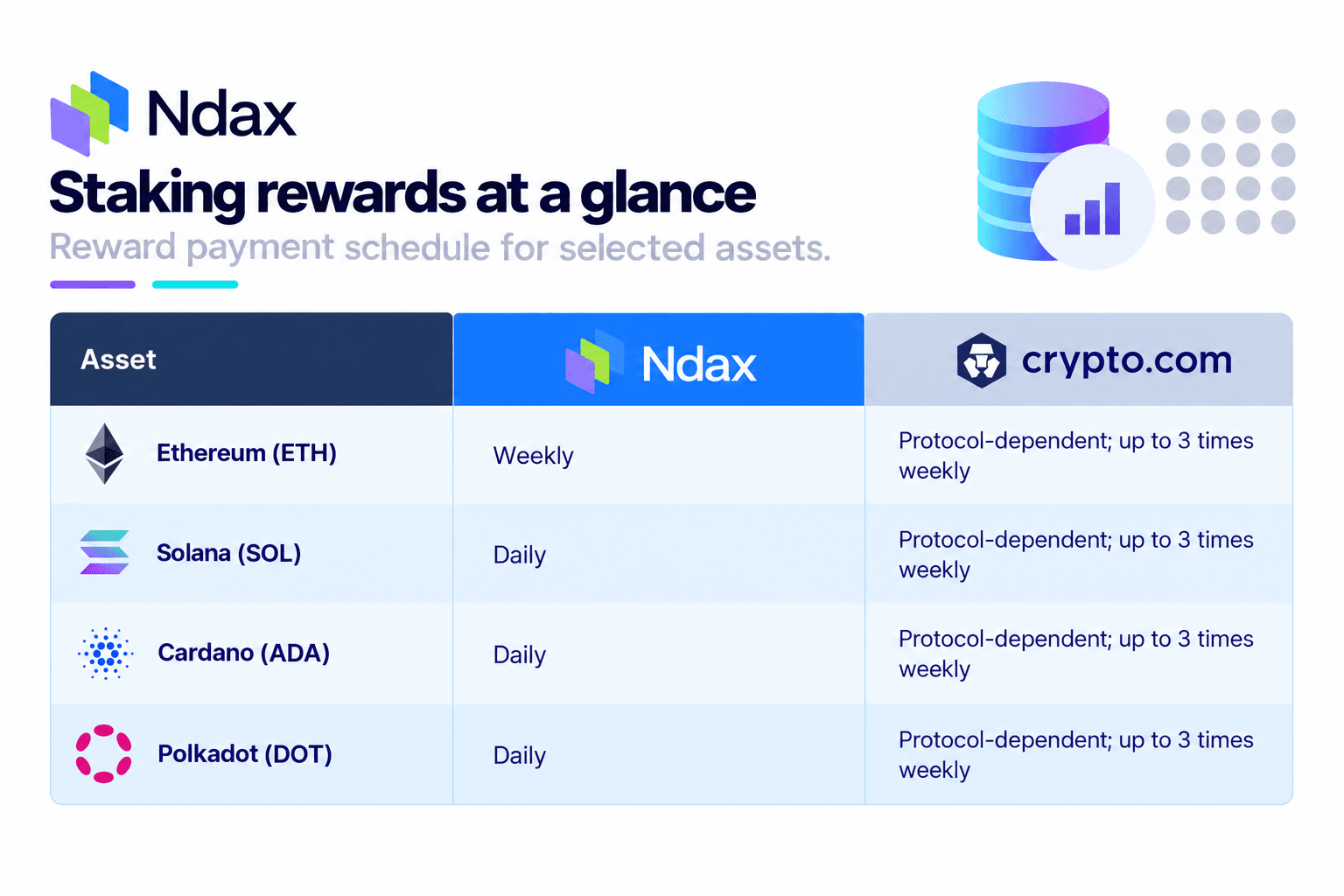
Crypto.com publishes a general staking reward frequency of up to three times weekly rather than a distinct fixed payout interval for each asset in its staking guide. These are published schedules, not guarantees. Network and platform conditions can affect actual payments.
For Solana, Cardano, and Polkadot, Ndax's daily reward schedule is a practical distinction. Users can see rewards credited more frequently, which may make it easier to monitor staking activity and track the rewards generated by their holdings.
More frequent reward payments do not necessarily mean higher total rewards. The actual amount earned still depends on the staking rate, applicable fees, and network conditions.
When do rewards begin?
The first staking reward may take longer to arrive than subsequent rewards. Ndax lists asset-specific bonding periods before rewards begin. For example, Ndax's Staking Policy currently lists:
- ETH: 3-day bonding period.
- SOL: 3-day bonding period.
- ADA: 1-day bonding period.
- DOT: 2-day bonding period.
Crypto.com also has asset-specific staking activation conditions. Its documentation explains that assets begin generating rewards only after the staking transaction reaches the Staked status. The activation period depends on the relevant blockchain's staking cycle and validator processing.
Crypto.com does not impose a universal minimum staking term, but some blockchain protocols have their own restrictions. For example, Avalanche staking requires a minimum 14-day activation period before a user can initiate unstaking.
These differences may matter to users who want to understand when rewards start accumulating and appearing in their accounts. However, faster payments do not necessarily translate into higher total returns.
Unstaking: How quickly can you access your crypto?
Unstaking refers to the process of removing crypto from a staking arrangement so it becomes available for trading or withdrawal. This is an important consideration because staking can restrict access to assets during periods of market volatility.
Ndax publishes standard unbonding periods for each supported staking asset. For four assets available on both platforms:
- Ethereum (ETH): 3 days.
- Solana (SOL): 3 days.
- Cardano (ADA): 1 day (standard) or zero days for instant.
- Polkadot (DOT): 2 days (standard) or zero days for instant.
Ndax also offers instant redemption for certain eligible staking plans, including supported ADA and DOT plans. Instant redemption is subject to available liquidity and applicable conditions. Users selecting instant redemption forfeit rewards generated during the current reward period.
Crypto.com also allows users to unstake eligible crypto, but waiting periods vary by asset. Its published estimated unbonding periods include:
- Ethereum (ETH): Days to weeks, depending on network conditions.
- Solana (SOL): 5 days.
- Cardano (ADA): 1 day.
- Polkadot (DOT): 29 days.
The difference is particularly notable for Polkadot. Ndax's published standard unbonding period for its eligible DOT plan is two days, compared with Crypto.com's estimated 29 days. For users who may need to access their DOT holdings, this is a meaningful difference in the published waiting periods. Other Ndax DOT plans may have different terms.
Solana also has a shorter published standard unbonding period on Ndax: three days compared with Crypto.com's estimated five days.
Crypto.com offers an Instant Unstaking feature for supported assets, including ETH, SOL, ADA, and DOT. This allows eligible users to exchange their staked position for the underlying native asset without waiting for the standard network unbonding period.
However, Instant Unstaking is subject to a token-specific fee calculated on the amount unstaked, which is displayed before confirmation. The feature also has daily limits. For example, Crypto.com currently lists a daily Instant Unstaking limit of 50 SOL and 3 ETH.
There is no difference in how rewards are treated during standard unstaking. Ndax states that users do not receive scheduled rewards during its standard unbonding period. Crypto.com states that staked assets stop generating rewards during the unbonding period.
This means users should consider not only how long it takes to access their assets but also whether rewards continue during the waiting period.
Which platform offers more flexibility?
Ndax publishes relatively short standard unbonding periods for several supported assets and offers instant redemption for certain eligible plans. Crypto.com offers standard unstaking and optional Instant Unstaking for supported assets, although instant access involves an additional fee and daily limits.
For DOT, Ndax's two-day standard unbonding period on the eligible plan is substantially shorter than Crypto.com's published 29-day estimate. For SOL, Ndax also lists a shorter standard waiting period.
These instant-access arrangements operate differently. Crypto.com's Instant Unstaking involves exchanging the staked position for the underlying asset and paying a token-specific fee based on the amount unstaked. Ndax's instant redemption, where available, does not apply the same type of fee but results in forfeiture of rewards for the applicable payout period. The financial impact depends on the amount unstaked, applicable rewards, fees, and redemption conditions.
Neither platform should be assumed to offer immediate access to every staked asset.
The appropriate choice depends on the cryptocurrency, staking plan, applicable fees, and how quickly a user may need access to their holdings.
Automatic staking: Ndax Auto Earn vs. Crypto.com Rewards Maximiser
Both Ndax and Crypto.com offer features that can make earning rewards more convenient. However, they work differently.
Ndax's Auto Earn is a program that automatically enrolls eligible assets after a user enables the feature. Auto Earn supports 17 of Ndax's 18 staking assets, excluding Veranta (AVNT). Key features are:
- Eligible assets are enrolled automatically.
- Rewards are calculated and distributed weekly.
- Users do not need to manually enroll each eligible asset.
- There is no fixed lock-up period, although release delays may still occur.
- Reward rates are variable and not guaranteed.
Auto Earn is not the same as manual Ndax staking, where users select individual assets and staking amounts. Reward rates can also differ between the programs.
Read Auto Earn vs. Staking on Ndax for more information.
Crypto.com also offers a feature called Rewards Maximiser, which allows eligible users to review multiple earning opportunities and allocate supported assets through a simplified process. The feature scans eligible wallet balances and presents earning options based on factors such as the available assets, program conditions, and regional eligibility.
However, Rewards Maximiser should not be confused with automatically enrolling all future eligible purchases or deposits into staking. Users still review and confirm the proposed allocations.
Crypto.com also automatically credits staking rewards to the staked balance for certain assets, including ETH, SOL, and ADA, allowing rewards to compound where the underlying blockchain supports this arrangement. For other assets, rewards are credited to the available wallet balance instead.
Which platform is more convenient?
Crypto.com may suit users who want staking integrated with their existing Crypto.com account and prefer tools that simplify the allocation of assets across supported earning programs. Ndax may appeal to users who want the choice between manually managing individual staking positions and enabling a separate automated earning program.
Ndax's Auto Earn may be particularly convenient for users who want eligible holdings enrolled automatically after enabling the feature, rather than reviewing and confirming individual allocations.
The two services should be compared based on the actual enrollment rules, eligible assets, fee arrangements, and liquidity conditions, not simply whether they offer automation.
When Ndax staking may be a better fit
Ndax may appeal to Canadian users who value:
- A platform-wide, standardized 20% staking administration fee.
- The same or lower staking commission than Crypto.com on most commonly supported assets, excluding ETH.
- Daily reward payments for assets such as SOL, ADA, and DOT.
- Shorter published standard unbonding periods for SOL and eligible DOT plans.
- Continued scheduled rewards during standard unbonding periods.
- Instant redemption on certain eligible staking plans.
- The choice between manual staking and Auto Earn.
For users comparing platform commissions alone, Ndax's 20% standard fee matches Crypto.com's fee for Solana and most other assets, while being lower than Crypto.com's 35% fees for NEAR and Injective.
However, the more meaningful differences may appear when fees are considered alongside reward payment frequency and unstaking conditions. Ndax's daily reward schedules and shorter published standard waiting periods for certain assets may be particularly relevant to users who value regular reward credits and flexibility in accessing their holdings.
Users should still compare estimated net rewards and other staking conditions before deciding.
When Crypto.com staking may be a better fit
Crypto.com may appeal to Canadian users who value:
- Staking integrated into their existing Crypto.com account.
- A broader publicly listed selection of staking assets.
- A lower 15% staking service fee for Ethereum.
- Automatic compounding on eligible staking assets.
- Optional Instant Unstaking for supported assets, subject to fees and limits.
Users who primarily stake Ethereum may find Crypto.com's lower published ETH commission particularly relevant, although actual net rewards and unstaking conditions still need to be considered.
Crypto.com's broader asset selection may also appeal to users interested in staking assets such as Avalanche, Aptos, Cronos, and Tezos. Users who already hold eligible crypto on Crypto.com may prefer the convenience of staking without transferring assets to another platform.
Is Ndax or Crypto.com better for beginners?
Neither platform is automatically the better choice for every beginner. Crypto.com may appeal to someone who already uses its app and wants to stake one of its supported assets.
Ndax may appeal to someone who prefers a consistent staking fee across supported assets, daily reward payments for several cryptocurrencies, and published asset-specific redemption conditions.
A beginner should understand the following before staking on either platform:
- How staking rewards are generated.
- Which fees are deducted.
- Whether the displayed APY is before or after fees.
- How long it takes to receive the first reward.
- How unstaking works.
- What risks apply to the asset and platform.
- Whether they can afford to have their crypto temporarily unavailable.
Frequently asked questions
Is Ndax staking cheaper than Crypto.com staking?
Ndax charges a standard 20% administration fee on staking rewards. Crypto.com charges 15% for Ethereum, 35% for NEAR and Injective, and 20% for its other supported staking assets. Ndax therefore matches Crypto.com's published platform fee for most supported assets and charges less for NEAR and INJ. Crypto.com charges less for ETH.
Does Crypto.com charge 15%, 20%, or 35% for staking?
Crypto.com's staking service fees depend on the asset. Ethereum has a 15% fee, NEAR and Injective have 35% fees, and other supported assets generally have a 20% fee. Crypto.com reserves the right to update its fee schedule, so users should review the current rate before staking.
Does Crypto.com charge validator fees on top of staking fees?
Crypto.com uses third-party validators to provide staking services. Its published staking documentation identifies service fees deducted from rewards and explains that actual rewards depend on blockchain conditions and validator performance. It does not publish a separate universal validator commission in addition to its standard staking service fee.
Does Ndax charge 20% of the crypto staked?
No. Ndax's standard 20% administration fee is applied to staking rewards, not the original amount of cryptocurrency staked.
Does Ndax offer more staking assets than Crypto.com?
Ndax currently lists 18 supported staking assets. Crypto.com's published staking list includes 23 assets available to eligible Canadian users, after excluding Sonic and VeChain, which are not available for staking in Canada. Both platforms support assets such as ETH, SOL, ADA, DOT, ATOM, NEAR, SUI, TIA, INJ, SEI, POL, and TAO.
Is Ndax's staking APY before or after fees?
Ndax states that its advertised staking APY is shown before its administration fee. The fee is deducted from rewards generated.
Is Crypto.com's staking APY before or after fees?
Crypto.com states that its estimated staking reward rates are shown before its staking service fee. Actual rewards are distributed after the applicable fee is deducted. Reward rates are estimates and do not guarantee actual future earnings.
Can I unstake Ethereum faster on Ndax than Crypto.com?
Ndax currently lists a standard three-day ETH unbonding period. Crypto.com states that standard ETH unstaking can take days to weeks, depending on network conditions. However, eligible users may have access to optional Instant Unstaking for a fee, subject to daily limits. Neither timeline is guaranteed.
Does Crypto.com automatically stake my crypto?
Crypto.com offers Rewards Maximiser to help users allocate eligible assets across earning programs. However, users must review and confirm the allocations.
Crypto.com also automatically credits rewards to the staked balance for certain assets, allowing rewards to compound where supported. This is different from automatically staking all future purchases.
Are staking rewards guaranteed?
No. Both Ndax and Crypto.com disclose that staking rewards are variable and not guaranteed. Market volatility, network conditions, validator performance, and other risks can affect results.
Bottom line
Ndax and Crypto.com both offer crypto staking to eligible Canadian users, but their fee structures and staking features differ. Ndax charges a standard 20% administration fee on staking rewards, matching Crypto.com's fee for most supported assets. Crypto.com charges a lower 15% fee for Ethereum but higher 35% fees for NEAR and Injective.
Crypto.com offers a broader publicly listed staking selection, with 23 assets available to eligible Canadian users compared with Ndax's 18 supported assets. However, Ndax provides daily reward payments for several major assets, shorter published standard unbonding periods for certain assets, and continued scheduled rewards during standard unbonding.
Crypto.com may appeal to users who value a wider asset selection, its lower Ethereum staking commission, or optional paid Instant Unstaking. Ndax may appeal to users who value consistent staking fees, more frequent reward payments, and shorter standard waiting periods for assets such as SOL and eligible DOT plans.
Explore Ndax Staking to review supported assets, estimated rewards, fees, and current staking terms.
Don't forget to follow us on social media for more updates and join the conversation on our forums.
Disclaimer: This article is not intended to provide investment, legal, accounting, tax or any other advice and should not be relied on in that or any other regard. The information contained herein is for information purposes only and is not to be construed as an offer or solicitation for the sale or purchase of cryptocurrencies or otherwise.