New CSA research: What actually helps Canadians avoid crypto investment scams?

A new study from Canadian securities regulators suggests that knowing the warning signs may not be enough to change how people respond to fraudulent investment opportunities.
New CSA research: What actually helps Canadians avoid crypto investment scams?

Introduction

On Nov. 17, the Canadian Securities Administrators (CSA) released new research examining which types of anti-fraud messages are most effective at helping Canadians identify and avoid online investment scams.

The findings suggest that interactive quizzes and videos demonstrating how scams work can be more impactful than standard reminders to be cautious.

For Canadian cryptocurrency users, the research offers important insights into how fraudulent investment promotions can influence decisions and what can help interrupt that process. 

What did securities regulators announce?

The CSA published a behavioral research study titled Disrupting scam susceptibility: Effective social media strategies. The study was conducted by the Behavioral Insights Team on behalf of the CSA. It examined whether different types of educational content could reduce the likelihood of someone investing in fraudulent cryptocurrency opportunities promoted through social media.

The researchers conducted an online randomized controlled trial involving 2,500 Canadian adults who use social media at least once a week. Participants viewed a simulated social media feed consisting of ordinary posts, legitimate investment opportunities, and fraudulent crypto investment promotions.

Some participants also encountered one of four anti-fraud messages. Others received no anti-fraud message.

After viewing the feed, participants were asked to allocate a hypothetical $10,000 across all investment opportunities they had encountered. Researchers then measured how much participants allocated to the fraudulent opportunities. 

The goal was to examine whether different messages could influence investment decisions, rather than simply measuring whether people remembered or liked the warnings. The findings were published during Financial Literacy Month and form part of the CSA’s broader investor-protection initiative. 

Which anti-fraud messages worked the best?

The researchers tested four approaches to discouraging investment in fraudulent opportunities. Two produced statistically significant reductions in the amount participants allocated to scams.
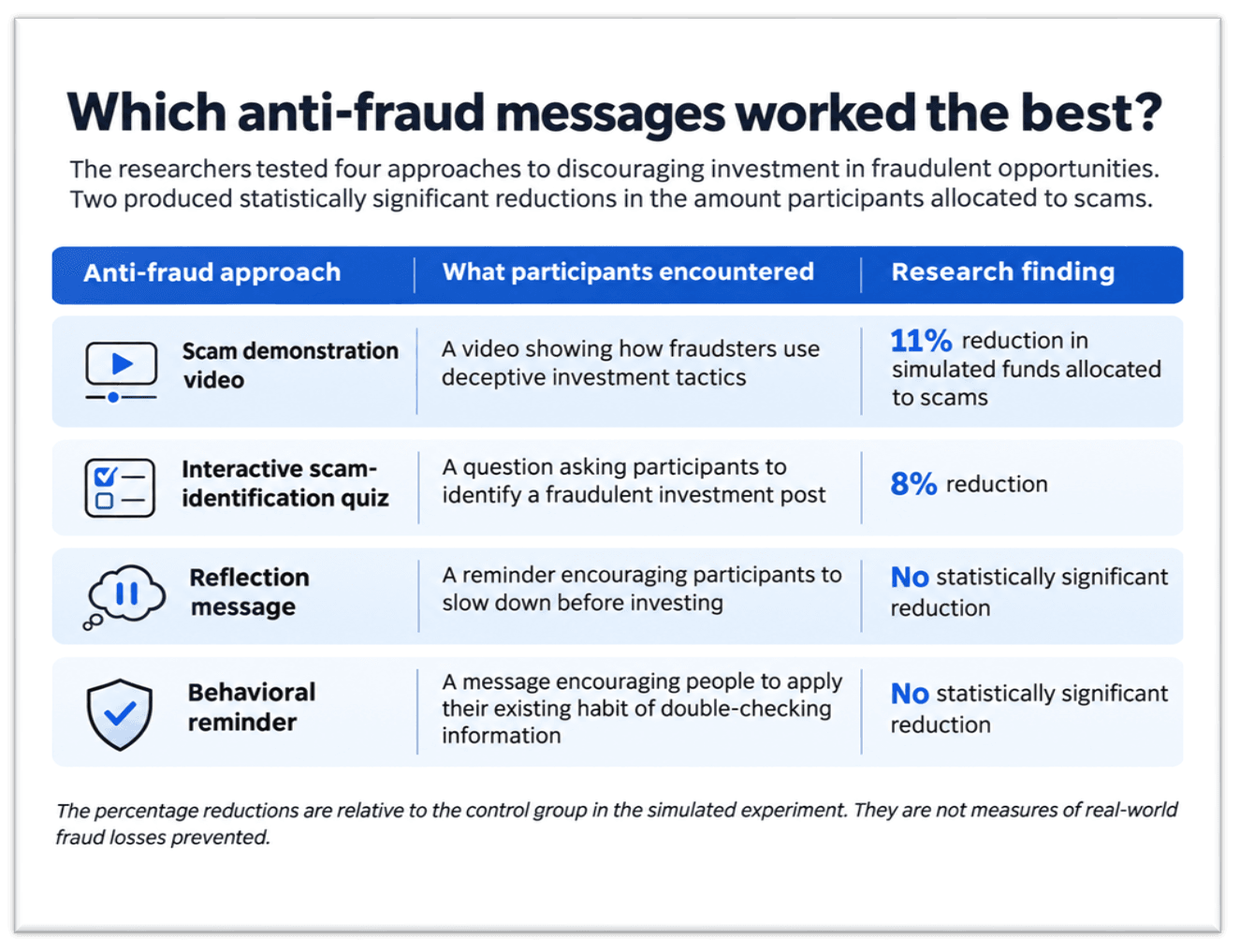
image.png

Participants who received no anti-fraud message allocated roughly 53% of their hypothetical funds to fraudulent opportunities. The video and interactive quiz reduced those allocations compared with the control group.

However, the study also produced a surprising finding: the messages that participants liked most were not the ones that most effectively changed their investment decisions. The two more effective approaches received less favorable reactions than conventional reminders.

This suggests that anti-fraud education may need to do more than communicate information in an appealing format. It may also need to interrupt the way people normally engage with investment promotions. 

Why might interactive content help people recognize crypto scams?

One explanation offered by the researchers is that interactive content interrupts passive scrolling. When people scroll and browse social media, they may encounter investment promotions that appear alongside legitimate personal updates, advertisements, and other familiar forms of content.

A fraudulent investment advertisement can appear without requiring the viewer to examine its claims. An interactive quiz changes that experience by asking the viewer to make a judgment call.

Similarly, a video showing how a scam operates can demonstrate the techniques fraudsters use before the viewer encounters a similar promotion. The CSA report describes this video approach as inoculation: exposing people to a recognizable example of manipulation, so they may be better prepared to identify it later.

The researchers found that the more effective messages did not meaningfully improve participants' overall knowledge of scam warning signs. Instead, they may have encouraged greater vigilance when participants evaluated the opportunities.

Someone may already know that guaranteed returns are a warning sign but may still respond to a well-crafted advertisement when it appears in their social media feed. 

Can you recognize the warning signs in a crypto investment promotion?

Consider the following hypothetical social media advertisement:

Exclusive crypto opportunity

Earn guaranteed daily profits with our automated trading system. Registration closes in four hours, and only six spots remain. Message our investment manager to reserve your position now and receive your deposit instructions.

This made-up advertisement promises guaranteed daily returns, creates urgency, and directs potential investors into a private conversation. It does not provide independently verifiable information about the business.

Now consider a different type of message:

Cryptocurrency trading service

Review our registration information, published trading fees, account terms, and risk disclosures before deciding whether to open an account. Cryptocurrency prices are volatile, and losses are possible.

The second message provides information that a potential user can investigate independently. However, the wording alone does not establish that the company is legitimate. Fraudsters can also imitate regulatory language, invent registration details, and copy disclosures from real businesses.

The appropriate next step is to verify the claims through independent sources rather than rely on the advertisement itself. This is the practical lesson from the CSA research: actively questioning an investment promotion can be more useful than simply recognizing that scams exist. 

How can Canadians verify a cryptocurrency platform before investing?

Canadian crypto users can take several steps to investigate an unfamiliar investment opportunity before sending money or cryptocurrency.

Check the company's registration. The CSA provides a National Registration Search that allows users to look up firms and individuals registered with Canadian securities regulators.

The legal name and registration category should be checked carefully. A company using a name similar to a registered firm is not necessarily the same business.

Review the investment claims. Promises of guaranteed profits, unusually consistent returns, or opportunities with little or no risk should be treated with skepticism.

Verify the website and contact information. A professional-looking website does not establish legitimacy. Fraudsters may copy the branding, layout, and contact details of established financial businesses.

Look for published investor alerts. Canadian securities regulators issue warnings about suspicious investment firms, websites, and individuals.

Avoid making decisions under pressure. An offer that requires an immediate transfer or discourages independent verification may be using urgency to prevent closer scrutiny.

These checks do not guarantee that an investment will be legitimate or profitable. They can, however, help users identify claims that require further investigation. 

What does the CSA research mean for Canadians using regulated crypto platforms?

The CSA’s research reinforces the importance of confirming the identity and reputation of a business behind an investment promotion. It also highlights a risk that applies even when a user already has an account with a legitimate cryptocurrency platform: fraudsters can impersonate that platform to obtain user information and account details.

For example, Ndax recently published a phishing alert about fraudulent emails impersonating the company. The messages used claims about Canadian cryptocurrency tax reporting to encourage recipients to follow links to suspicious websites.

A message that mentions a real company or an actual regulatory issue should not automatically be treated as authentic. Ndax Canada Inc. is registered as an investment dealer under Canadian securities legislation and is a member of the Canadian Investment Regulatory Organization (CIRO). Users can review our regulatory disclosures and independently verify registration information.

Ndax also publishes information about its security and custody practices, including client asset arrangements and operational controls. These disclosures give users information they can examine rather than relying solely on promotional claims. 

Does the CSA study mean these messages prevent real-world crypto fraud?

Not necessarily. The research provides evidence that certain educational messages can influence decisions in a controlled experiment.

However, the participants were using hypothetical funds and viewing a simulated social media feed. The researchers did not measure actual financial losses prevented, nor did they establish whether the effects would persist over weeks or months.

The findings therefore should not be interpreted as proof that an interactive quiz or educational video will prevent a particular percentage of real-world scams. The CSA's recommendations focus on adapting the more effective approaches and continuing to test their impact.

The report is not meant to introduce new registration rules, custody obligations, or mandatory anti-fraud disclosures. Instead, it offers evidence that regulators, financial institutions, and other organizations can use when developing investor education and fraud-prevention initiatives. 

What should you do if you suspect a crypto investment scam?

If you encounter a suspicious investment promotion, avoid sending funds or sharing personal information until the business and its claims have been independently verified.

If you have already transferred money or cryptocurrency, stop making additional payments, even if someone claims another transfer is required to release your funds or recover a previous loss.

Preserve relevant information, including website addresses, screenshots, wallet addresses, transaction records, and messages.

You can report suspected investment fraud to the Canadian Anti-Fraud Centre, including through its online reporting service. Victims should also contact local police and any financial institution or cryptocurrency platform involved.

If the suspected scam involves an Ndax account or a transfer from Ndax, contact our support team through a verified channel on the official website.

Reporting suspected fraud may help authorities identify related incidents, although recovery of transferred cryptocurrency is not guaranteed.


Don't forget to follow us on social media for more updates and join the conversation on our forums.

Disclaimer: This article is not intended to provide investment, legal, accounting, tax or any other advice and should not be relied on in that or any other regard. The information contained herein is for information purposes only and is not to be construed as an offer or solicitation for the sale or purchase of cryptocurrencies or otherwise.