What ‘institutional-grade’ crypto trading can mean in Canada
Learn what institutional-grade crypto trading could mean in Canada, including regulation, custody, liquidity, execution, reporting, support, and operational controls.
Key takeaways
- Claims of “institutional-grade” crypto trading can be evaluated through platform standards.
- Trade size matters, but so does regulation, custody, liquidity, execution quality, funding readiness, reporting, support, and operational controls.
- A platform supporting larger or more complex transactions can be evaluated on more than a simple buy or sell order.
- A platform should also provide clear processes around larger transactions, asset handling, records, and risk.
- Ndax may be relevant for Canadian users, businesses, and larger-balance clients who want access to a regulated crypto trading platform with CAD trading pairs, flat trading fees, advanced order types, staking for supported assets, and Ndax Wealth for larger crypto transactions.
Introduction
When users compare claims of “institutional-grade” crypto trading, relevant factors may include regulatory status, custody practices, liquidity access, execution support, account records, risk disclosures, operational controls, and support for larger or more complex crypto transactions.
For Canadian users, institutional-grade should not be treated as a marketing label. It should be evaluated based on how a platform handles assets, orders, funding, settlement, reporting, support, and risk.
Why ‘institutional-grade’ is misunderstood
Crypto platforms may market the phrase institutional-grade to imply sophistication, scale, or credibility. However, the term itself is vague.
For some users, institutional-grade means a large trade size. For others, it may mean access to advanced charts, an API, or deeper liquidity. Some may associate it with custody, account reporting, or dedicated support.
Those features are certainly important, but none of them should define the term on their own. This means a platform should not be considered institutional-grade only because it supports large orders. It should also have the infrastructure and controls needed to support those orders responsibly.
That includes how client assets are held, how transactions are executed, how records are maintained, how risks are disclosed, how support is handled, and how the platform operates within Canada’s regulatory framework.
Regulation can be an important starting point
In Canada, institutional-grade crypto trading should start with regulatory status. That does not mean regulation removes crypto risk. Crypto assets remain volatile, and users can lose money. Registration also does not mean a crypto asset is suitable for every user.
However, regulation matters because it affects how a platform operates. It shapes disclosure obligations, account processes, custody expectations, compliance controls, and how users can evaluate the business behind the trading screen.
Ndax is a regulated crypto trading platform built for Canadians. Ndax is registered as an Investment Dealer under Canadian securities legislation in all provinces and territories, is a CIRO member firm, and operates within the Canadian regulatory framework.
For serious users, businesses, and larger-balance clients, this could be the starting point: is the platform operating inside Canada’s framework, and what obligations come with that?
Custody should also be part of the definition
Crypto assets are controlled through private keys. That means asset handling, wallet infrastructure, segregation, controls, authorization processes, reconciliation, and third-party custody arrangements are not minor details. They are central to platform trust.
A platform serving serious users must be able to clearly explain how assets are held, what role third-party custodians play, what portion of assets may be held in hot, warm, or cold storage, how withdrawals are supported, and what protections do and do not apply.
Ndax’s custody disclosure states that at least 80% of client virtual assets are held in cold and warm storage with acceptable third-party custodians, with the remaining amount temporarily held by Ndax through its own custody solution for operational needs such as deposits, withdrawals, trade settlement, liquidity-provider activity, and certain staking activity.
Essentially, larger-balance users need more than a general statement that assets are “secure.” They need a clearer understanding of the custody model behind the platform.
Liquidity and execution matter for larger trades
A small crypto purchase may not raise many questions around liquidity or market impact. A larger trade can be different. Users may care more about price certainty, order handling, slippage, timing, settlement, and whether the trade should be handled through a standard order book or a larger-trade service.
OTC execution can become relevant for users with larger-trade needs. OTC, or over-the-counter trading, is often used for larger transactions where a user wants dedicated support and a more structured execution process. It can be useful for users who want to discuss liquidity, timing, pricing, settlement, and execution before placing a larger order.
Ndax Wealth is designed for larger crypto transactions and OTC execution. It is available for transactions starting at C$25,000.
OTC does not remove market risk. It does not guarantee profit or protection from losses. But for larger trades, it can provide a different process than placing an order through a standard retail workflow.
Reporting and records are not optional features
As trade size, balance size, and transaction frequency increase, records become more important. Users may need to review deposits, withdrawals, trades, fees, staking rewards, account statements, and transaction history for internal tracking, accounting, or tax purposes.
This is still important for individual users, but it becomes even more important for businesses, family offices, high-net-worth users, and organizations that need clearer documentation.
For example, a business buying Bitcoin for its treasury may need records that show when funds were deposited, when the trade was executed, what fees applied, and where the asset was held afterward. A family office may need clean account history and transaction records for internal reporting across multiple stakeholders.
An organization may also need records that can be shared with accountants, auditors, compliance teams, or internal finance staff.
The ability to review account activity, confirm transactions, access statements, and get support when documentation questions arise becomes much more important.
Operational controls happen quietly behind the scenes
Many of the most important institutional-grade features are not visible on the trading screen or made apparent to users. Operational controls include how a platform handles security, access permissions, internal approvals, reconciliation, incident response, vendor relationships, custody providers, transaction monitoring, account reviews, and business continuity.
This is why institutional-grade should not be defined only by advanced charts, large trades, or APIs. Those are useful features, but they are front-end tools. The deeper question is whether the platform has the operational discipline to support serious activity over time.
How to compare institutional-grade crypto platforms
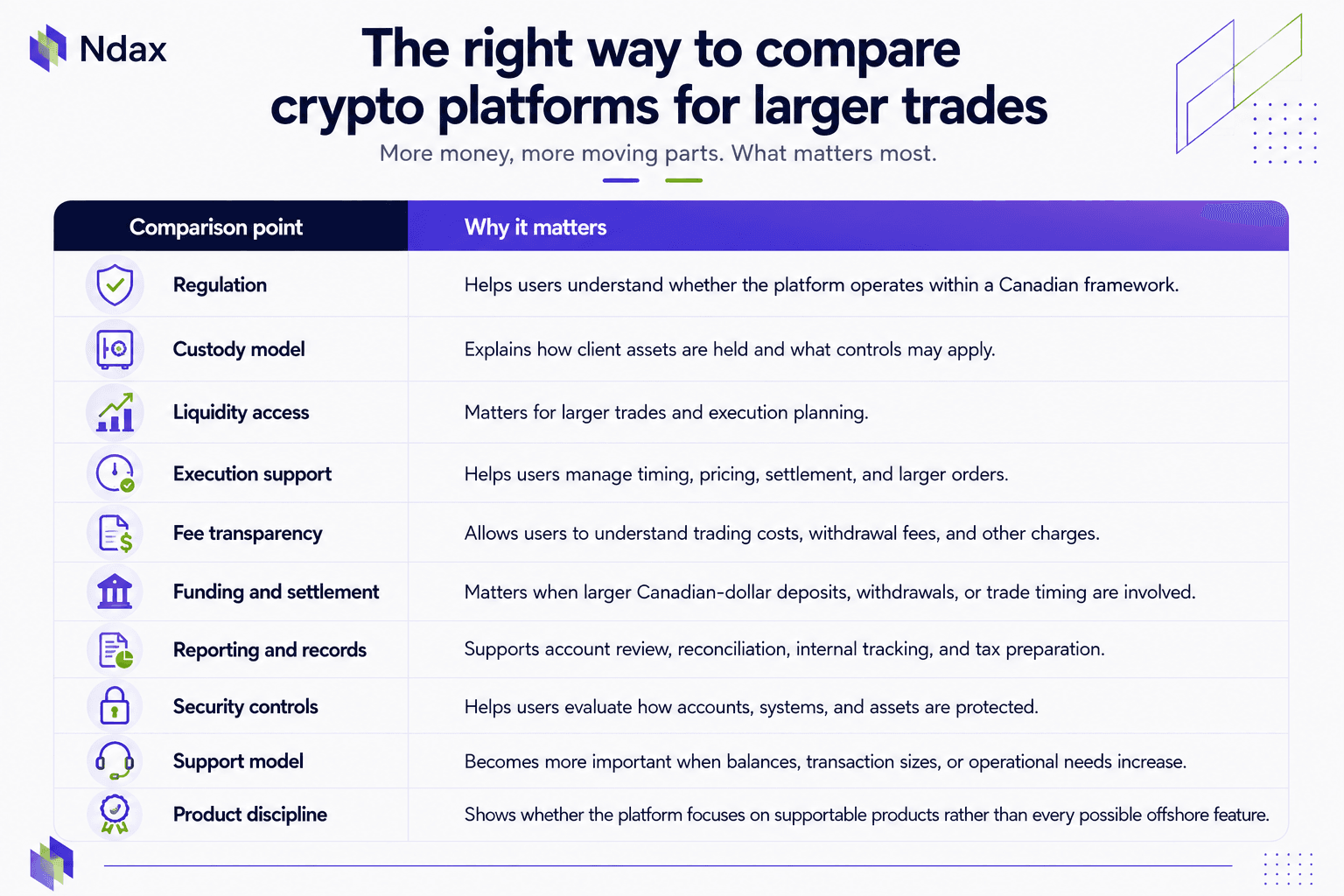
Where Ndax fits in
Ndax may appeal to Canadian users who want a regulated crypto trading platform with more depth than a basic retail app.
Ndax supports Canadian-dollar funding, CAD trading pairs, a flat trading fee, advanced order types, charting tools, staking for supported assets, crypto withdrawals, and larger-trade services through Ndax Wealth.
Institutional-grade crypto trading is not only about one feature. It is about bringing multiple platform standards together: access, regulation, custody, liquidity, execution, records, support, and operational controls.
A user may start with a simple trade, then later need better tools, clearer records, larger-transaction support, or a more structured execution process. Ndax is built to support that progression inside a Canadian regulatory framework.
Bottom line
Institutional-grade crypto trading in Canada should mean more than a fancy-looking interface or the ability to place a large order. It should mean the platform has the structure to support the serious activity that happens beyond the trade itself.
That includes regulation, custody practices, liquidity access, execution support, reporting, account records, security controls, operational discipline, and clear risk disclosures.
Ndax is built for Canadians who want more than basic crypto access. It combines self-directed trading, Canadian-dollar funding, advanced order types, custody disclosures, staking for supported assets, and Ndax Wealth for larger crypto transactions inside a regulated Canadian platform.
Institutional-grade should not mean more complicated; it should mean accountable, structured, and ready for serious use from day one.
Don't forget to follow us on social media for more updates and join the conversation on our forums.
Disclaimer: This article is not intended to provide investment, legal, accounting, tax or any other advice and should not be relied on in that or any other regard. The information contained herein is for information purposes only and is not to be construed as an offer or solicitation for the sale or purchase of cryptocurrencies or otherwise.