Blackmail Emails

Blackmail emails are designed to make you panic and act before you think. They claim to have compromising information about you and demand cryptocurrency to keep it private. In the vast majority of cases, these threats are completely fabricated. Knowing how to respond — and how not to — can save you significant money and stress.
Blackmail Emails

What Is a Blackmail Email Scam?

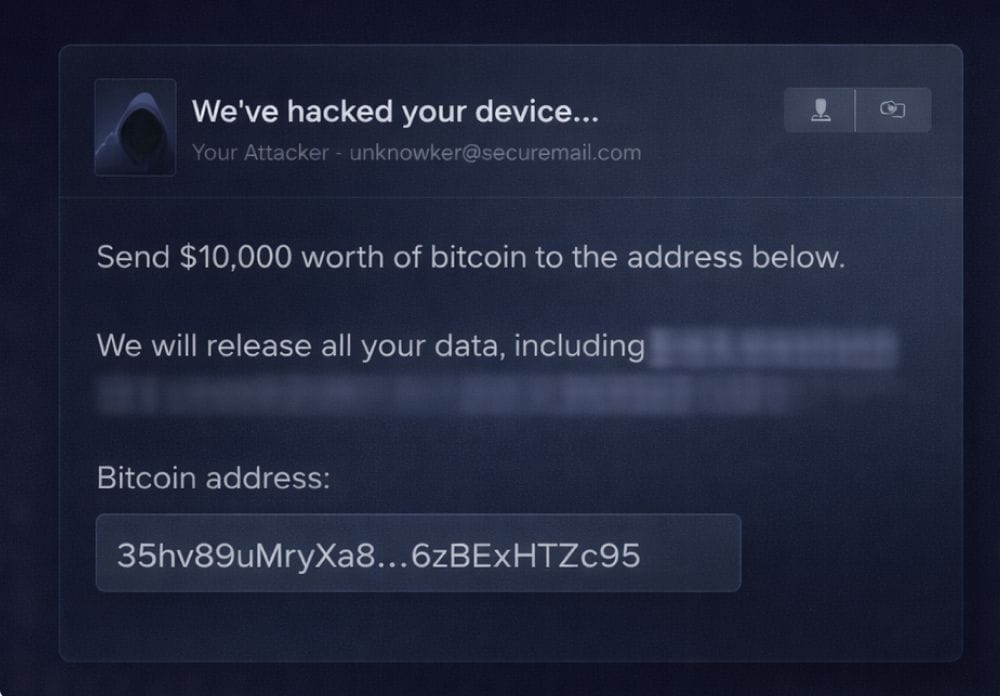
A blackmail email scam is a fraudulent scheme in which an attacker sends an unsolicited email claiming to possess compromising information about you — recordings made through your webcam, your browsing history, personal photographs, or messages. Payment is demanded in cryptocurrency, almost always Bitcoin, in exchange for keeping the information private. A deadline is imposed to create urgency.

In the vast majority of cases, the attacker has no compromising information whatsoever. These emails are sent in bulk to thousands of recipients simultaneously, with the expectation that enough people will panic and pay. Any personal details included — such as an old password — are obtained from publicly available data breaches and used purely to make the threat seem credible.

Types of Blackmail Email Scams

Webcam Sextortion — The attacker claims to have recorded you through your webcam while you visited adult websites and threatens to send the footage to your contacts unless you pay.

Password Exposure Scams — The email includes a real password from a data breach as supposed proof of access to your device or accounts.

Personal Information Threats — The attacker claims to have access to your files, messages, or photographs and threatens to release them or send them to people in your life.

Business Email Blackmail — Targeting business owners or professionals with claims of evidence of illegal activity, tax evasion, or misconduct.

Fake Law Enforcement Emails — Emails appearing to come from law enforcement claiming you've been caught engaging in illegal online activity and demanding payment to avoid prosecution.

Warning Signs

  • The email claims to have compromising recordings, photographs, or information about you
  • Payment is demanded in cryptocurrency to a specific wallet address
  • A tight deadline is given — often 24 to 72 hours — to create panic
  • The email includes a password you recognise or have used in the past
  • The sender claims to have installed malware or spyware on your device
  • The email threatens to contact your employer, contacts, or family members
  • The sender claims to be law enforcement demanding payment to avoid arrest

Example: You receive an email stating the sender has been monitoring your activity and has recorded you through your webcam. It includes a password you used several years ago as supposed proof. You're told to send Bitcoin to a wallet address within 48 hours or the footage will be sent to your contacts. The password came from a data breach. There is no footage. The email was sent to thousands of people simultaneously.

What to Do If You Receive a Blackmail Email

The most important thing to know: in the vast majority of cases, these threats are entirely fabricated.

  • Do not pay under any circumstances. Payment doesn't end the threat and often results in further demands.
  • Do not respond. Any reply confirms your email address is active and may result in more contact.
  • Do not panic. These are bulk emails with no specific knowledge of you or your activity.
  • Change the password included in the email if it's one you still use anywhere.
  • Check if your email has been involved in a data breach at haveibeenpwned.com.
  • Document the email — sender address, wallet address, and full message content — and report it.

How to Protect Yourself

  • Use unique passwords for every account — a breach of one won't expose others
  • Use a password manager to generate and store strong, unique passwords
  • Enable 2FA on all accounts
  • Check haveibeenpwned.com regularly to find out if your email has been involved in known breaches
  • Never pay a blackmail demand — payment rarely ends the threat and almost always leads to further demands

Already Paid?

Stop all further payments immediately. Do not respond to additional threats, and do not send more crypto if the scammer claims another payment will make the issue go away. Paying rarely ends the threat and often leads to more demands.

Document everything, including the full email, sender address, wallet address, payment records, screenshots, and any further communications.

If you transferred crypto from your Ndax account, contact [email protected] right away. Cryptocurrency transfers are generally irreversible, but your report may help us review the activity and protect other users.

If fiat funds, bank transfers, credit cards, debit cards, or payment services were used, notify the financial institution where the funds originated. Because blackmail and extortion are criminal offences, contact local law enforcement as well.

How to Report

  • Report to Ndax at [email protected] if your Ndax account was involved or crypto was transferred from your Ndax account
  • Report to the CAFC at antifraudcentre.ca
  • Report to the RCMP at reportcyberandfraud.canada.ca
  • Notify the financial institution where the funds originated, such as your bank, card provider, or payment service provider
  • Report fake profiles directly through the relevant social media, messaging, or dating platform

Don't forget to follow us on social media for more updates and join the conversation on our forums.

Disclaimer: This article is not intended to provide investment, legal, accounting, tax or any other advice and should not be relied on in that or any other regard. The information contained herein is for information purposes only and is not to be construed as an offer or solicitation for the sale or purchase of cryptocurrencies or otherwise.