Crypto execution for family offices: What to review before capital can move
Learn what family offices, business owners, and high-balance households may want to review before executing larger crypto transactions in Canada, including governance, funding, custody, settlement, records, and operational controls.
Key takeaways
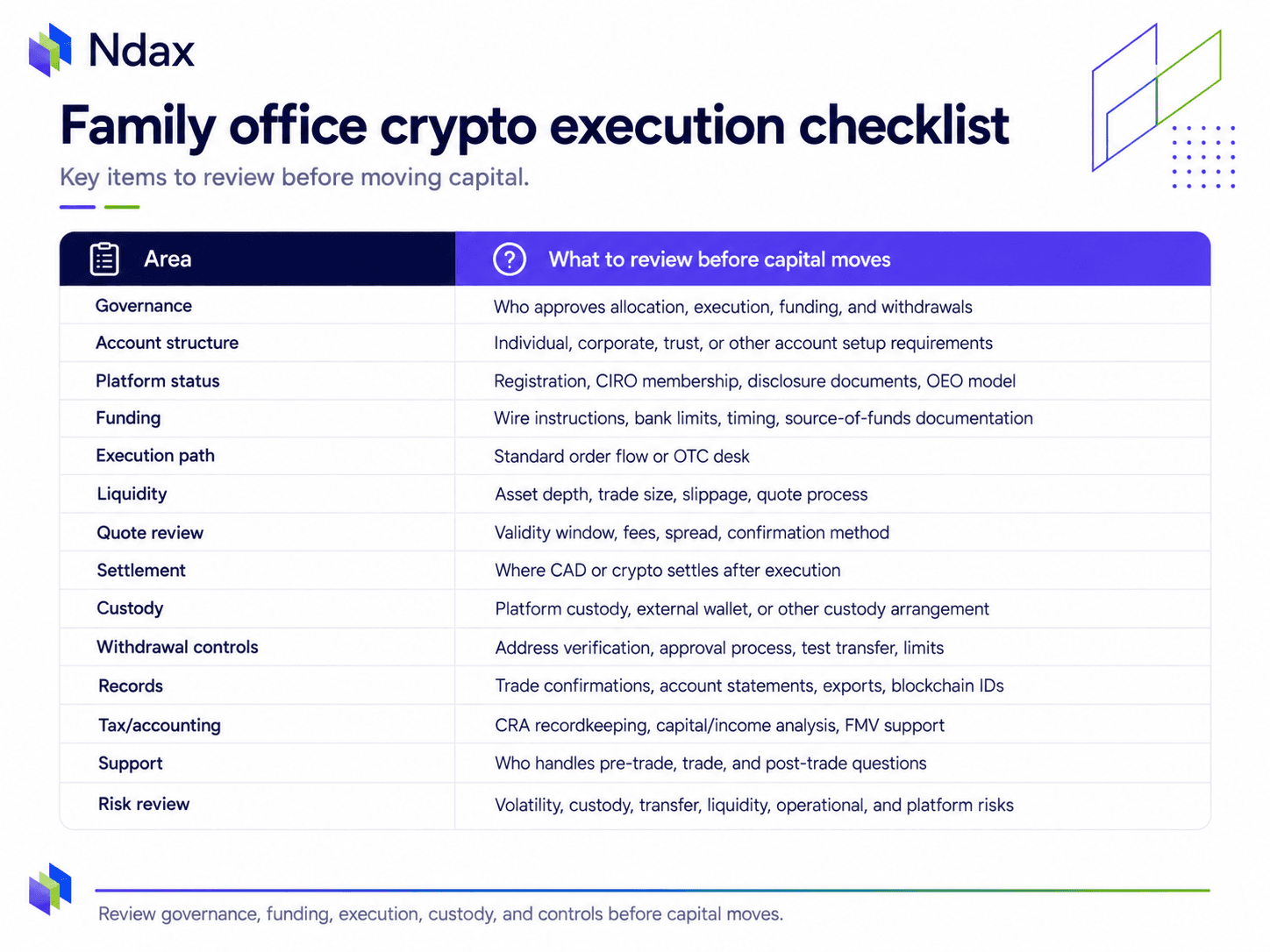
- Family offices may want to review governance, authorization, funding, custody, settlement, records, and operational controls before executing a larger crypto transaction.
- The execution venue can affect funding, liquidity access, trade process, custody, withdrawals, documentation, and post-trade support.
- OTC execution may be relevant when transaction size, timing, settlement, or documentation requirements make a standard exchange order flow less practical.
- Custody may be easier to manage when the intended destination is considered before execution.
- A family office may want to confirm internally whether assets will remain on-platform, move to an external wallet, or use a mix of the two.
- According to the CRA, individuals and businesses engaged in crypto-asset transactions must keep adequate books and records to support each transaction.
- According to CIPF, crypto assets held by a member firm on behalf of users are not eligible for CIPF coverage.
Introduction
Family offices may need to treat crypto execution as both an investment decision and an operational process. Key questions can extend far beyond which assets to buy or sell. The decision process may include reviewing who is authorized to approve transactions, how the account is funded, how the trade is executed, where the asset will be held after settlement, what records are required, what tax and accounting documentation may be required, and what controls apply around withdrawals.
Why family offices need a different crypto execution standard
A family office may approach buying and selling crypto differently from a retail user making a first purchase. The decision may include multiple stakeholders, including a principal, investment committee, CFO, controller, external consultants and accountants, tax counsel, estate-planning advisors, or an operations lead. The transaction may also need to fit within a broader policy around liquidity, risk limits, custody, reporting, and approval authority.
A family office may need to document why the transaction was approved, who approved it, how funds moved, how the quote was reviewed, how settlement occurred, where the crypto asset was held, and how the transaction will be reflected in internal records.
The fact that crypto assets are digital does not make the operational process around them informal.
Start with governance and authorization
Before funds are sent, a family office may want to define who has authority to make decisions and who has authority to execute instructions. That may include:
- Who can approve a crypto allocation
- Who can open or manage the platform account
- Who can request an OTC quote
- Who can approve the final trade
- Who can initiate CAD funding
- Who can approve crypto withdrawals
- Who can access transaction records
- Who receives confirmations or account documentation
This is important because larger crypto transactions often involve both investment approval and operational execution. Those roles may not always be held by the same person. A clear governance process helps reduce confusion before the trade. It also gives the family office’s accountants, auditors, or internal stakeholders a cleaner record of how the transaction was authorized.
Understand the platform’s role
Family offices may want to understand what a platform does and does not do. Ndax provides an Order Execution Only service. Ndax executes clients’ instructions but does not provide investment advice. Clients decide when and what to trade.
Ndax Wealth may support family offices through the operational parts of a transaction, including account access, funding, trade execution, settlement, custody disclosures, withdrawals, and records. It does not replace the family office’s investment policy, risk framework, tax advice, legal advice, or internal approval process.
Prior to using any platform or OTC desk, family offices may want to ask:
- Is the platform providing execution only?
- Does the platform provide advice or recommendations?
- Who inside the family office is responsible for the investment decision?
- Who is responsible for tax and accounting treatment?
- Who is responsible for the custody policy?
- Who is responsible for post-trade controls?
Plan funding before requesting execution
Funding may need to be planned before the intended trade date. For larger crypto transactions, the funding method can affect timing, quote coordination, settlement, and execution readiness. A family office may need to use a wire transfer, coordinate with a bank, confirm account-name matching, review transfer limits, and ensure funds are available when required by the execution process.
Prior to moving funds, a family office may want to confirm:
- Funding method
- Account name and source of funds
- Bank processing time
- Transfer limits
- Platform deposit instructions
- Required receipts or documentation
- Expected arrival time
- Who confirms when funds are available
- Whether the trade is standard platform execution or OTC
Decide whether exchange trading or OTC execution fits the transaction
A family office may need to determine whether the transaction can take place within a standard exchange workflow or an OTC workflow. Standard exchange trading may work when the trade size is modest, the asset has sufficient visible liquidity, and the user is comfortable managing order type, timing, and execution parameters directly.
OTC execution may be relevant when the trade is larger, more time-sensitive, more discreet, or more dependent on quote review, settlement planning, and direct support.
Review liquidity, slippage, and quote process
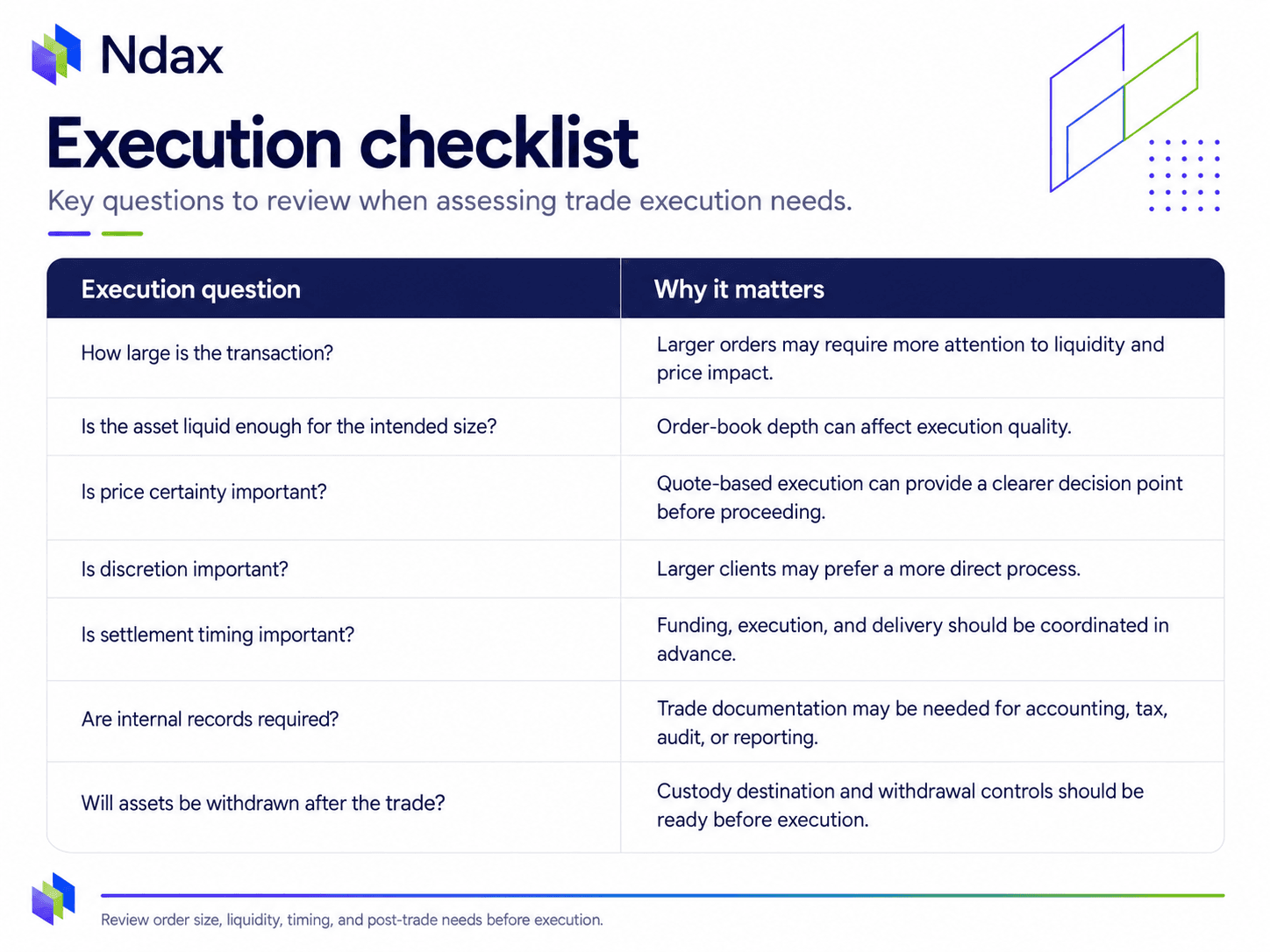
Larger trades can be affected by market depth. If a large order is placed directly into a standard order book, it may fill across several different price levels. That can create a different average execution price than the first price the user saw. Limit orders can help control the price at which the user is willing to trade, but they may not fill immediately or completely.
For family offices, these execution variables may be worth reviewing prior to execution. Some of the relevant questions to discuss with the OTC desk include:
- Will the trade be handled through an order book or OTC quote?
- How is the price determined?
- How long is the quote valid?
- What fees or spread apply?
- What happens if the quote expires?
- What happens if market conditions change before the trade is accepted?
- How is the trade confirmed?
While an OTC service itself does not guarantee better pricing or remove market risk, it can provide a more structured process for reviewing quoted pricing and execution terms before agreeing to proceed. Ndax Wealth currently offers firm pricing for eligible OTC transactions starting at C$25,000.
Decide the custody destination before the trade
Custody can be considered before execution rather than left entirely to the post-trade stage, regardless of trade size. Before execution, the family office may want to decide whether the purchased crypto asset will remain on-platform, be withdrawn to an external wallet, or be managed through another custody arrangement. That decision can affect operational risk, wallet controls, signer authority, transfer review, recordkeeping, and coverage considerations.
A custody review may include:
- Whether assets will remain with the platform
- Whether an external wallet will be used
- Who controls wallet access
- Whether multi-signature controls are needed
- Who can approve withdrawals
- Whether test transfers are required
- Which blockchain network will be used
- Whether the receiving address has been verified
- What internal approval is required before assets move
- What records are kept after withdrawal
Ndax’s risk disclosure states that users are allowed and encouraged to withdraw virtual assets purchased on the platform to their own private wallets, while also recognizing that some users may choose to rely on Ndax’s custodial solutions.
If assets remain on-platform, the custody model may warrant review. Ndax’s current disclosures state that at least 80% of client virtual assets are held in cold and warm storage with acceptable third-party custodians regulated as trust companies. The exact allocation may vary, with up to 20% held temporarily through Ndax’s own custody solution to support deposits, withdrawals, settlement with liquidity providers, and certain staked assets.
Understand what protections do and do not apply
Family offices may want to distinguish between platform registration, custody practices, insurance language, and investor protection coverage. While those are related topics, they are not the same.
CIPF states that crypto assets held by a member firm on behalf of a client are not eligible for CIPF coverage. Ndax’s regulatory disclosure confirms that CIPF coverage does not extend to virtual assets held in user accounts and that crypto assets are not eligible for CDIC or CIPF protection.
Family offices may therefore want to understand which property may be eligible for protection, which property is excluded, and how crypto assets are treated differently from eligible cash or securities.
Settlement planning should happen before execution
A family office may want to understand what happens after the trade is agreed. This includes whether settlement occurs inside the platform account, whether assets are delivered to an external wallet, whether CAD remains in the account, and what confirmations or records are available.
Prior to execution, it would be ideal to confirm internally:
- How the trade will settle
- When the trade will settle
- Where the asset will be held
- Whether external withdrawal is planned
- Whether withdrawal addresses are ready
- Who approves withdrawals
- Whether there are withdrawal limits or review steps
- What documentation will be available after settlement
- Who receives trade and account records
Records, tax, and accounting documentation
Family offices need clean and relevant records.
Taxpayers who engage in crypto-asset transactions must keep adequate books and records to support each transaction, according to the Canada Revenue Agency. The CRA encourages electronic recordkeeping and recommends regularly exporting transaction history from exchanges and custodial platforms so records remain available if a platform stops operating, stops serving Canada, or account access is lost.
The CRA also states that when a taxpayer disposes of a crypto asset, the income or loss may be considered business income or loss, or a capital gain or loss, depending on the circumstances. That determination is fact-specific. Maintaining complete execution records can give the family office’s tax and accounting professionals the information needed for later analysis and reporting.
For a family office, relevant records may include:
- Account opening documents
- Approval records
- Funding records
- Wire receipts
- Quote details
- Date and time of execution
- Asset bought or sold
- Quantity
- CAD value
- Fees or spread
- Settlement record
- Withdrawal record
- Blockchain transaction ID, if withdrawn
- Custody destination
- Account statements
- Transaction exports
- Internal memos or investment committee approvals
Operational controls before capital moves
Operational controls are the practical rules that govern how a transaction is authorized, executed, and recorded. For crypto, those controls may cover both platform access and wallet movement.
A family office may consider controls around:
- account permissions
- 2FA and security settings
- internal approval thresholds
- authorized users
- communication channels with the OTC desk
- quote approval process
- funding approval
- withdrawal approval
- wallet address verification
- test transfers
- transaction record storage
- segregation of duties
- incident response
- account monitoring after execution
For example, a financial analyst may be authorized to request a quote, while a member of the investment committee or the Chief Financial Officer may be required to approve execution. One person may prepare a withdrawal address, while another verifies it before funds move. One person may download records, while another reconciles them against bank and accounting systems.
Where Ndax Wealth fits in
Ndax Wealth supports OTC crypto execution for larger Canadian transactions starting at C$25,000, with a focus on price certainty, discretion, and control.
A larger client may need direct support around funding, quote review, execution, settlement, custody decisions, and post-trade records. Those are the areas where an OTC workflow may offer a more structured process than a standard self-directed order flow.
For a family office, that creates a clearer framework for reviewing the platform before capital moves.
Common mistakes to avoid
Moving funds before the process is clear
Capital should not move before the family office understands account setup, funding instructions, execution process, settlement, and custody destination.
Treating custody as a post-trade decision
Custody should be decided before the trade. Waiting until after the trade can create delays, unclear approval authority, or rushed withdrawal decisions.
Comparing only trading fees
For larger transactions, the relevant cost review includes spread, quote process, funding, settlement, withdrawal fees, custody implications, and operational workload.
Assuming registration removes crypto risk
Registration helps define the platform’s operating framework, but it does not make crypto assets risk-free. Crypto prices can be volatile, and users can lose money. The CSA notes that registration helps protect investors through requirements such as risk management and disclosure, but it does not mean a crypto platform is without risk.
Leaving records until tax season
The CRA encourages users of crypto-asset exchanges and custodial platforms to regularly export their activity to maintain adequate books and records.
Bottom line
For family offices, the complexity of a larger crypto transaction often sits around the trade rather than in the trade itself.
Funding, authorization, settlement, custody, recordkeeping, and withdrawal controls all need to work together before capital moves. When those pieces are clear in advance, execution can become a much more defined process.
For larger transactions, Ndax’s OTC service is built to provide a structured way to review pricing, coordinate execution, and plan settlement before the trade is placed. The value offered to users extends beyond access to a larger trade size, but having the operational process around that trade clearly defined.
Don't forget to follow us on social media for more updates and join the conversation on our forums.
Disclaimer: This article is not intended to provide investment, legal, accounting, tax or any other advice and should not be relied on in that or any other regard. The information contained herein is for information purposes only and is not to be construed as an offer or solicitation for the sale or purchase of cryptocurrencies or otherwise.