How to dollar-cost average into Bitcoin in Canada
Learn how dollar-cost averaging works for Bitcoin, why Canadians use recurring buys, what fees to check, and how to set up a recurring buying schedule without trying to time the market.

Key takeaways
- Dollar-cost averaging means buying a fixed dollar amount of Bitcoin on a recurring schedule.
- DCA spreads purchases across multiple dates instead of relying on one purchase date or entry price.
- DCA does not guarantee better returns than a one-time purchase.
- Bitcoin can still lose value when using a DCA strategy.
- Fees also matter when purchases happen frequently.
- Ndax supports recurring purchases, which allow users to buy Bitcoin and crypto automatically on a predefined basis.
- Users may want to review funding, trading fees, custody, withdrawals, and tax records before setting up a Bitcoin buying routine.
Introduction
Dollar-cost averaging, or DCA, refers to a way of buying Bitcoin by purchasing a fixed Canadian-dollar amount on a regular schedule, such as daily, weekly, biweekly, or monthly. Instead of trying to pick one “ideal” entry price, the user can spread purchases across multiple market prices over time. A recurring buying plan can make the process more consistent, especially for users who want exposure to Bitcoin but do not want every purchase to depend on short-term market timing. Ndax users can set up recurring purchases for crypto assets, including Bitcoin, by choosing a schedule, currency, and Canadian-dollar amount.
What is dollar-cost averaging?
Dollar-cost averaging is a buying method where a user buys the same dollar amount at regular intervals. For example, instead of buying $1,200 of Bitcoin all at once, a user can instead buy:
- $100 every month for 12 months
- $50 every two weeks
- $25 every week
- $10 every day
The idea is to spread purchases across different market conditions. Sometimes the scheduled purchase happens when Bitcoin is higher; sometimes it happens when Bitcoin is lower.
Over time, the user’s average entry price reflects multiple purchases rather than a single trade. The concept of multiple purchases over time is not unique to crypto. It is commonly used across other asset classes, especially stocks, because it creates a repeatable routine. For Bitcoin, the approach may be particularly relevant to users who want to spread purchases across a volatile market.
How DCA works with Bitcoin
Bitcoin DCA works by turning a Bitcoin purchase into a schedule. A user typically needs to decide in advance:
- The amount of Canadian dollars they want to spend
- The asset they want to buy
- How often the purchase should happen
- How long they want to keep the schedule active
- Whether they want to hold Bitcoin on-platform or withdraw later
Once all factors are decided, purchases can begin according to the selected cadence.
On Ndax, users can set up a recurring purchase by signing in, selecting Recurring Purchases, selecting the green plus sign (+), and entering the purchase name, period, currency, and Canadian-dollar amount. The user then selects Create to confirm the recurring purchase. Users can stop, edit, or delete the subscription at any time.
DCA vs. lump-sum buying
DCA and lump-sum buying are different buying approaches, and neither approach is automatically better in every market condition. A lump-sum purchase means buying the full amount at once. DCA means dividing that amount into smaller purchases over time.
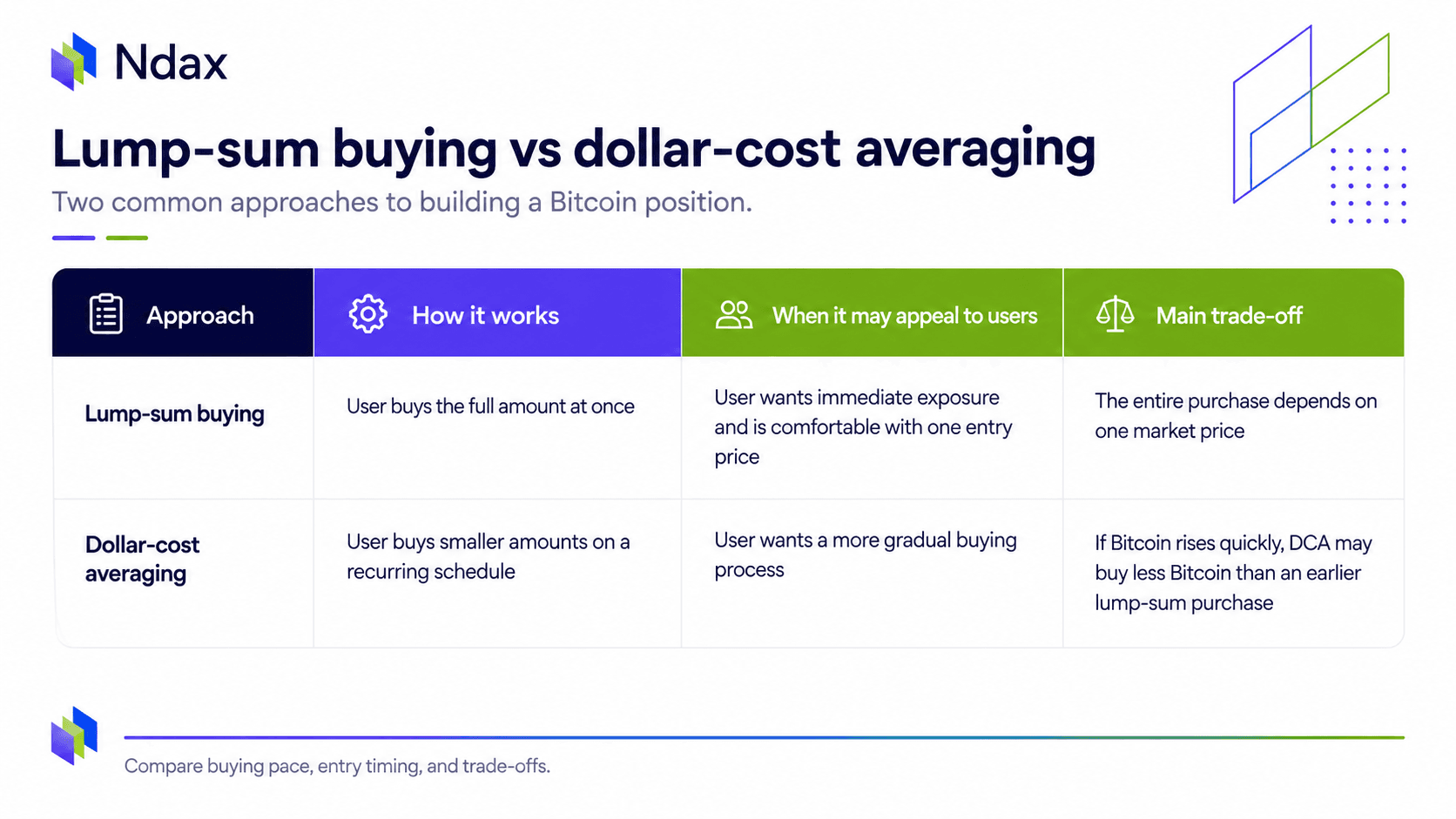
DCA is designed to avoid committing all of the planned amount at one price. But if Bitcoin rises steadily after the first planned purchase date, a lump-sum purchase could produce a better result than spreading the purchases over that period. That is why DCA should not be viewed as a way to guarantee or improve returns. Rather, it is a way to make the buying process more consistent.
Example: Buying Bitcoin weekly
Below is a simple example. A user decides to buy $50 worth of Bitcoin every week for four weeks.
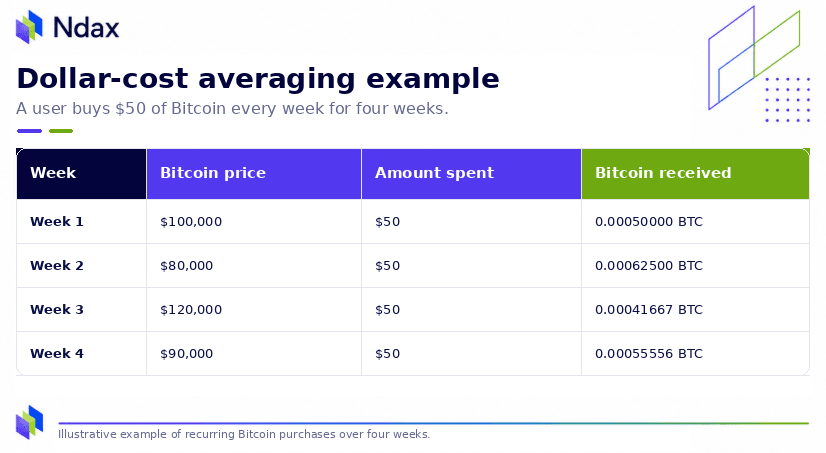
In this example, the user accumulates more Bitcoin when the price is lower and less Bitcoin when the price is higher. The user spends the same Canadian-dollar amount each week, but the BTC amount changes with the market price.
To date, the user has accumulated Bitcoin at an average cost of $97,500.
Why some Canadians use recurring Bitcoin buys
Canadians may use recurring Bitcoin purchases for several reasons. Some users want to start small. Others want to make purchases over time. Some want to align purchases with payday. Others want to avoid reacting to every market headline.
Recurring buys can reduce the need to make a new timing decision for every purchase. Essentially, DCA means the user buys a set amount on a schedule they have chosen in advance.
That can be useful for people who want Bitcoin exposure but do not want to actively trade or try to time individual purchases around short-term price movements. It may also be useful for users who want to separate long-term accumulation from short-term market noise.
Common Bitcoin DCA schedules
There is no single correct DCA schedule. Common schedules include weekly, biweekly, monthly, or payday-aligned purchases. A user’s chosen schedule may depend on cash flow, comfort level, fees, and ability to maintain the plan.
A weekly schedule may appeal to users who want more frequent purchases across more price points. A monthly schedule may appeal to users who prefer fewer transactions and simpler recordkeeping. A payday-aligned schedule may appeal to users who want purchases to happen shortly after income arrives.
A schedule or amount may be harder to maintain if it does not fit the user’s cash flow.
Fees matter when buying regularly
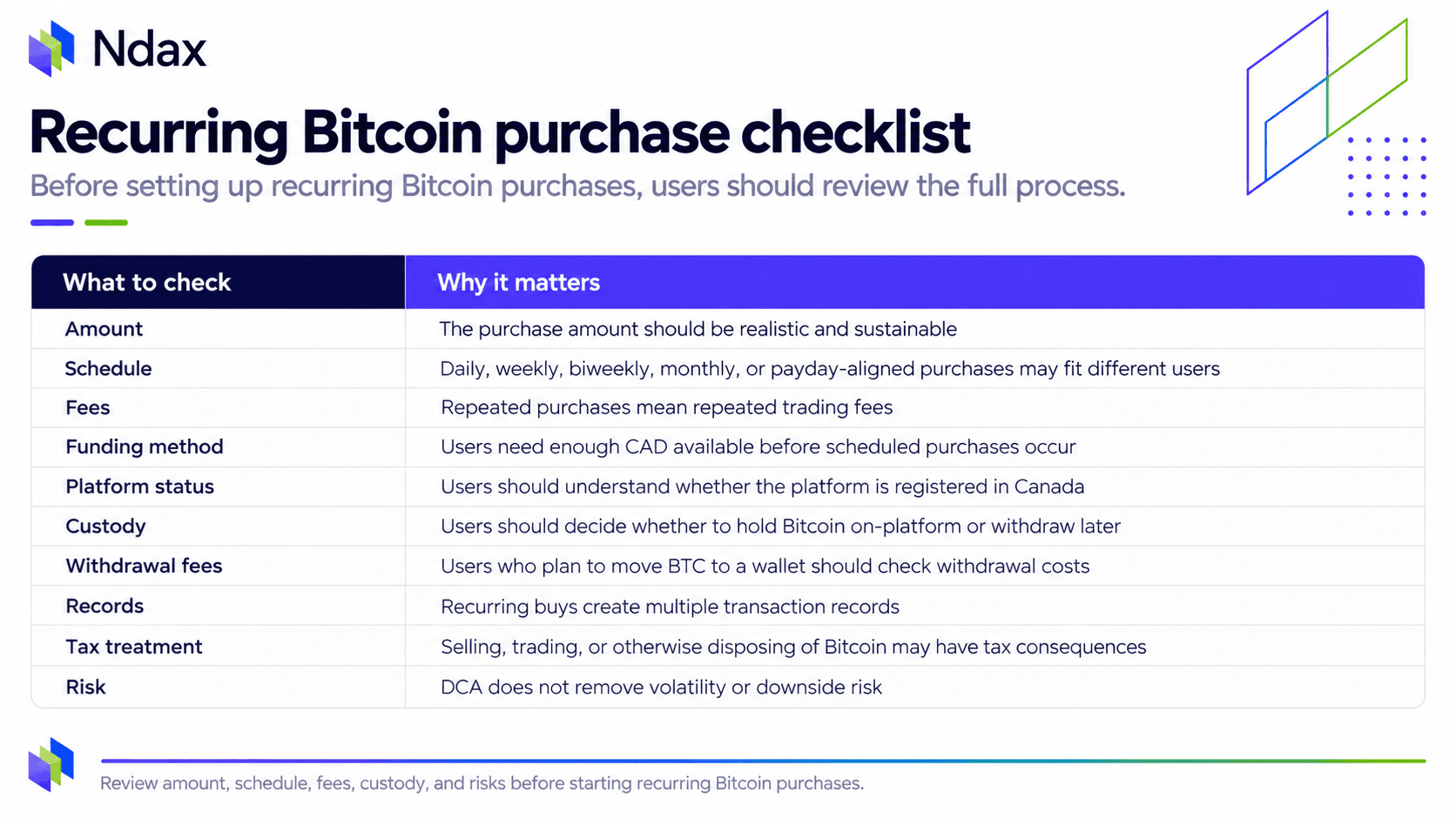
Fees are an important consideration when using a DCA strategy because the user is making repeated purchases. A single fee on a single purchase may look small, but recurring purchases can create many fee events over time.
This is also where the type of fee model matters. Some crypto platforms use trading tiers where the rate changes based on monthly trading volume, account level, or whether an order is classified as a maker or taker. That can make it harder for someone making smaller recurring purchases to know which rate will apply.
Ndax charges a flat 0.20% trading fee on every buy and sell order, regardless of trade size, with no volume tiers and no maker/taker split. The trading fee is also shown before an order is confirmed.
For example, someone purchasing $25 of Bitcoin every week would make $1,300 in purchases over 52 weeks. At a 0.20% trading fee, the trading commissions would total $2.60, assuming the fee remains unchanged.
A flat rate can make the explicit trading fee easier to calculate in advance. Unlike platforms with volume-based tiers, the user does not need to reach a certain trading-volume threshold to qualify for the 0.20% rate on Ndax. A smaller recurring purchase is also not placed into a higher fee tier simply because the account trades less frequently.
Funding a Bitcoin DCA plan in Canada
A DCA plan only works if the account has Canadian dollars available when the recurring purchase is scheduled. Users may want to check:
- Whether the platform supports Canadian-dollar funding
- Whether Interac e-Transfer or wire transfer is available
- Whether deposits are free
- How long deposits usually take
- Whether their bank has daily, weekly, or monthly limits
- Whether the funding method fits the purchase schedule
Interac e-Transfer, bank wire, and crypto deposits are free to receive on Ndax. Ndax’s fee page also states that Interac e-Transfer deposits are processed within 0–30 minutes, while wire transfers are processed within 0–1 business days, subject to bank hours.
For smaller recurring Bitcoin purchases, Interac e-Transfer may be a practical funding method. For larger planned deposits, a wire transfer may also be considered, depending on bank limits, timing, and the amount being transferred.
Manual buying vs. recurring purchases
A user can DCA manually or through recurring purchases. Manual DCA means the user places each Bitcoin order themselves. Automated DCA means the user sets the schedule once and the platform places recurring purchases according to that schedule.
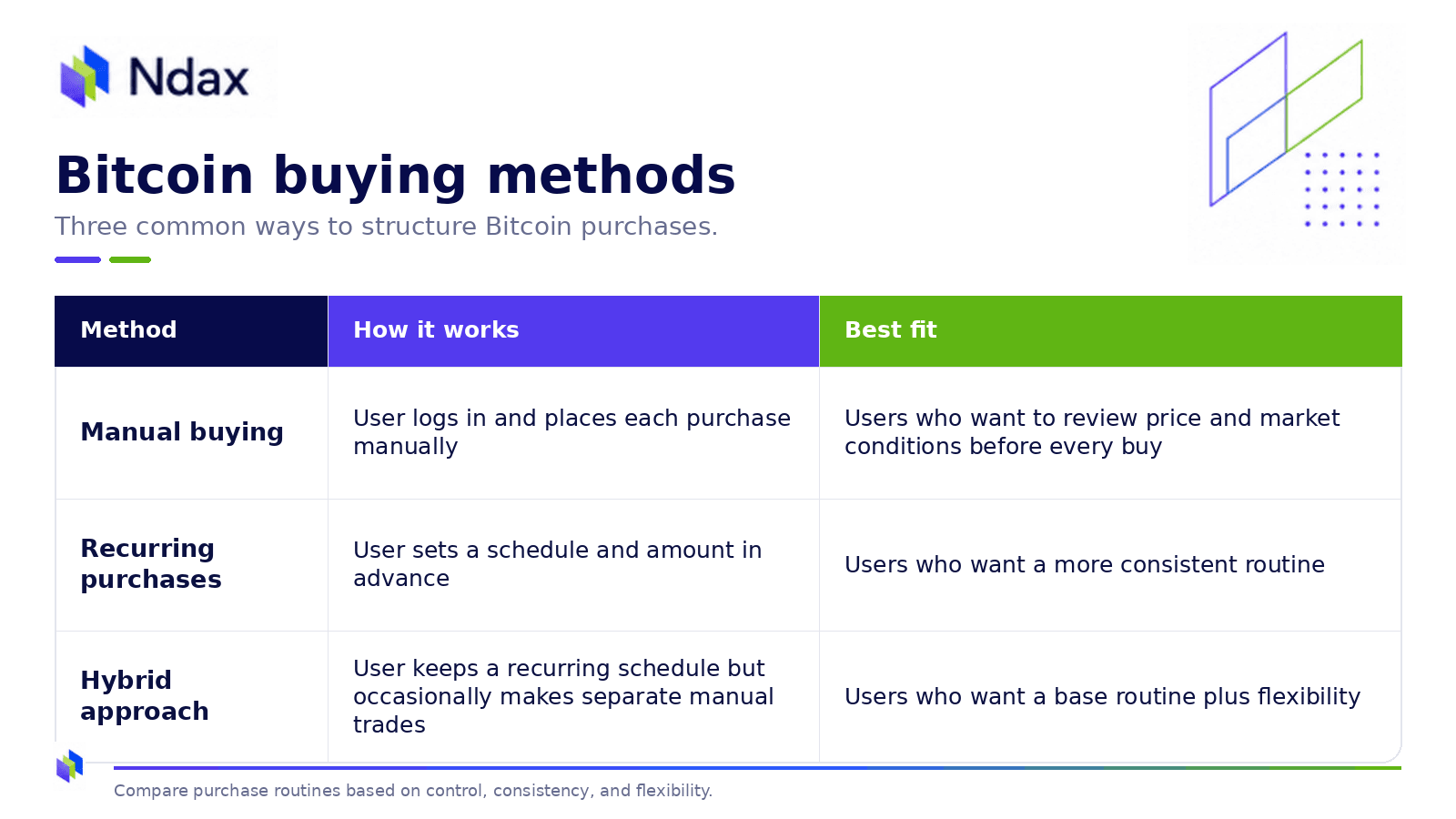
Automated recurring purchases can be used to follow a set schedule. Manual buying may appeal to users who want more control over timing and order placement.
Holding Bitcoin vs. withdrawing Bitcoin
DCA is a buying approach, but it does not answer the separate question of where to hold Bitcoin after buying it. After recurring purchases, users may choose to:
- Keep Bitcoin on the platform
- Withdraw Bitcoin to a self-custody wallet
- Use a hardware wallet
- Hold some on-platform and some off-platform
Holding Bitcoin on a platform may offer conveniences such as account access, transaction records, and the ability to sell through the platform. Withdrawing Bitcoin to a self-custody wallet gives the user more direct control, but it also introduces responsibility for wallet security, private keys, seed phrases, address accuracy, and irreversible transfers.
Users should make the custody decision separately from the DCA decision.
Tax and recordkeeping considerations
Recurring Bitcoin purchases will create recurring records. Users may need those records later for tax reporting or to calculate the cost of their holdings when Bitcoin is sold, traded, gifted, used to purchase goods or services, or otherwise disposed of. Transfers between wallets owned by the same person generally do not themselves constitute a taxable disposition, but records of those transfers should still be maintained. For a Bitcoin DCA plan, useful records may include:
- Purchase date
- Purchase time
- CAD amount
- BTC amount
- Price at execution
- Trading fee
- Funding records
- Withdrawal records, if applicable
- Transaction exports
- Wallet addresses, if Bitcoin is withdrawn
Where Ndax fits in
Ndax supports recurring purchases for users who want to dollar-cost average into crypto assets such as Bitcoin. Ndax support materials state that users can schedule recurring purchases on a daily, weekly, or monthly basis and can stop, edit, or delete the subscription at any time.
Ndax also supports Bitcoin trading directly against the Canadian dollar. Ndax’s Bitcoin guide states that users can set Bitcoin recurring purchases to automatically buy BTC with CAD each day, week, or month.
Ndax is a regulated crypto trading platform registered as an Investment Dealer under Canadian securities legislation in all provinces and territories. Ndax is also a CIRO and CIPF member firm and operates on an Order Execution Only basis. CIPF coverage does not include crypto assets . Ndax does not provide investment advice or recommendations. Clients decide when and what to trade.
Common mistakes to avoid
Choosing an amount that is too high
A recurring purchase amount may be easier to maintain when it fits the user’s budget and cash flow. If the recurring amount is too high, the user may stop the plan quickly or feel pressure during normal expenses.
Treating DCA as a guarantee
DCA does not guarantee profit. It does not prevent losses. It does not make Bitcoin less volatile.
Ignoring fees
Recurring purchases mean recurring fees. Users should understand the fee model before setting up the schedule.
Changing the schedule after every headline
DCA is meant to be rules-based. Constantly changing the schedule based on short-term market news can defeat the purpose.
Forgetting to fund the account
If the account does not have enough CAD available, a scheduled purchase may not work as expected. Users should understand funding timing and account balances.
Ignoring custody
Buying Bitcoin regularly does not automatically solve storage. Users should decide whether they want to hold Bitcoin on-platform, withdraw to self-custody, or use a combination.
Leaving records until tax season
Recurring purchases can create many transactions. Users should keep records as they go.
Bottom line
Dollar-cost averaging into Bitcoin is a way to turn purchases into a recurring schedule. Instead of trying to time each purchase, users buy a fixed Canadian-dollar amount at regular intervals. This can make the process more consistent, especially for Canadians who want to build Bitcoin exposure gradually.
Bitcoin can be volatile, prices can fall, and users can lose money. A recurring buying plan does not remove those risks, and users should consider fees, custody, withdrawals, records, and tax reporting. DCA does not guarantee higher returns or reduce Bitcoin’s underlying market risk.
Ndax supports recurring Bitcoin purchases, Canadian-dollar funding, and a flat 0.20% trading fee. Ndax is a regulated crypto trading platform. Ndax provides an Order Execution Only (OEO) service. Ndax executes clients’ instructions but does not provide investment advice. Clients decide when and what to trade.
Don't forget to follow us on social media for more updates and join the conversation on our forums.
Disclaimer: This article is not intended to provide investment, legal, accounting, tax or any other advice and should not be relied on in that or any other regard. The information contained herein is for information purposes only and is not to be construed as an offer or solicitation for the sale or purchase of cryptocurrencies or otherwise.