Limit orders: What is it and how do they work?
Learn what a limit order is, how buy and sell limit orders work, and why Canadian crypto users may use them for price control instead of speed.
Key takeaways
- A limit order helps users set a price condition before placing a crypto trade.
- A buy limit order sets the highest price a user is willing to pay.
- A sell limit order sets the lowest price a user is willing to accept.
- Limit orders can be useful when price control is prioritized over speed.
- Limit orders do not guarantee execution.
- A limit order may not fill if the market does not reach the selected price.
- A limit order may hit the desired price but may not fill if there is not enough liquidity, or if other orders at the same price are ahead in the queue.
Introduction
A user opens their Ndax crypto trading account and sees Bitcoin trading at C$100,000.
They are interested in buying Bitcoin, but do not want to buy at that price, but don’t want to buy at that price. They would feel more comfortable buying if the price moved to C$98,000. They do not want to watch the market all day, and they do not want to place a market order that executes immediately at the current available price.
In other words, they want to set a price condition before placing an order. They want to be in control and trade on their own terms.
This is one scenario where a limit order may be used.
A limit order lets the user set the price they are willing to pay or accept before the trade happens. If the market reaches that price (or better) and sufficient liquidity is available, the order may execute. If the market does not reach that price, the order will not fill.
This guide is part of Ndax’s advanced trading education series. Limit orders are one of the core order types available to users who want more control over price conditions, price conditions, and order-book activity. They can be useful for beginners learning how order types work, but they are also part of the broader toolkit used by more active traders.
For a full guide on how limit orders compare with market orders, read this blog: Market Orders vs Limit Orders and Why Should Canadians Care?
What Is a Limit Order in Crypto Trading?
A limit order is a trading instruction to buy or sell crypto at a specific price or better. Instead of accepting the current market price immediately, the user sets the price they are willing to pay or accept. The order only executes if the market reaches that price and enough liquidity is available.
A limit order can fill fully, fill partially, remain open, be changed, or be canceled before it fills.
For Canadian crypto users, a limit order can be useful when they want to trade a CAD crypto pair while setting a clear price condition in advance. On Ndax, users can place limit orders through the trading screen or app for supported crypto assets and CAD trading pairs.
Ndax is a regulated crypto trading platform and provides an Order Execution Only service. Ndax executes clients’ instructions but does not provide investment advice. Clients decide when and what to trade.
Limit orders are one part of a broader set of order types available on Ndax. Users can also learn about other order types, including stop orders, stop-limit orders, trailing stop orders, and fill-or-kill orders. Each order type uses different conditions, and each can behave differently depending on price movement, liquidity, and the order book.
What does a limit order mean?
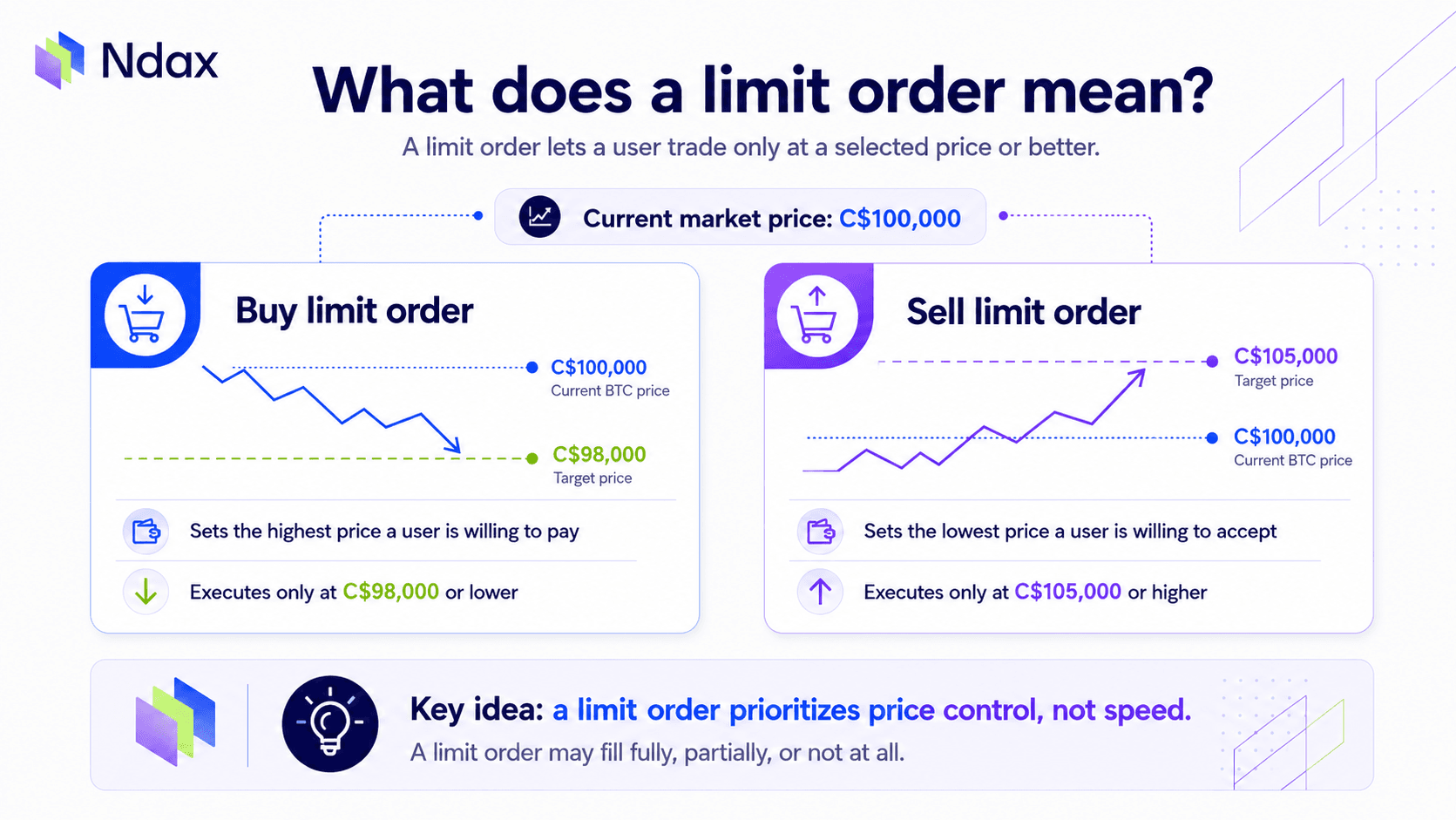
A limit order means the user is willing to trade only at a selected price or better.
For a buy limit order, the limit price is the highest price the user is willing to pay. If the user places a buy limit order at C$98,000, the order can only execute at C$98,000 or lower.
For a sell limit order, the limit price is the lowest price the user is willing to accept. If the user places a sell limit order at C$105,000, the order can only execute at C$105,000 or higher.
A simple way to think about limit orders is: “I want to trade, I am willing to trade, I have the capital available to trade, but only if the price meets my condition.”
That is different from a market order, where the user is prioritizing immediate execution based on the available price and liquidity at the time the order is placed.
Why a beginner may use a limit order
Many new crypto users don’t fully understand the answer to the question: “Do I want to trade at the price I see right now?”
Sometimes the answer is yes. In that case, a market order prioritizes execution at the best available prices, subject to available liquidity.
Other times, the answer is no. The user may want to buy only if the price falls, or sell only if the price rises. In that case, a limit order may be useful because it allows the user to set a price condition in advance.
These are examples of when users may consider placing limit orders:
- They believe a crypto asset is having a temporary down day and want to place a buy limit order below the current price instead of buying immediately.
- They expect upcoming news, a product update, or a market event will create movement and want to place a sell limit order above the current price in advance.
- They see the market rising quickly but only want to buy if the price returns to a level they are comfortable paying.
- They already hold crypto and want to place a sell limit order at a price where they would be comfortable selling at a selected price level.
- They do not want to watch the market all day and would rather set their preferred buy or sell price ahead of time.
For more active users, limit orders can be used as part of a more structured trading plan. For example, a user may decide in advance that they only want to enter a trade at a specific price level, or that they only want to sell if the market reaches their desired price target.
The limit order itself does not dictate whether the trade is appropriate. Rather, it only applies the price condition selected by the user.
How limit orders work on an order book
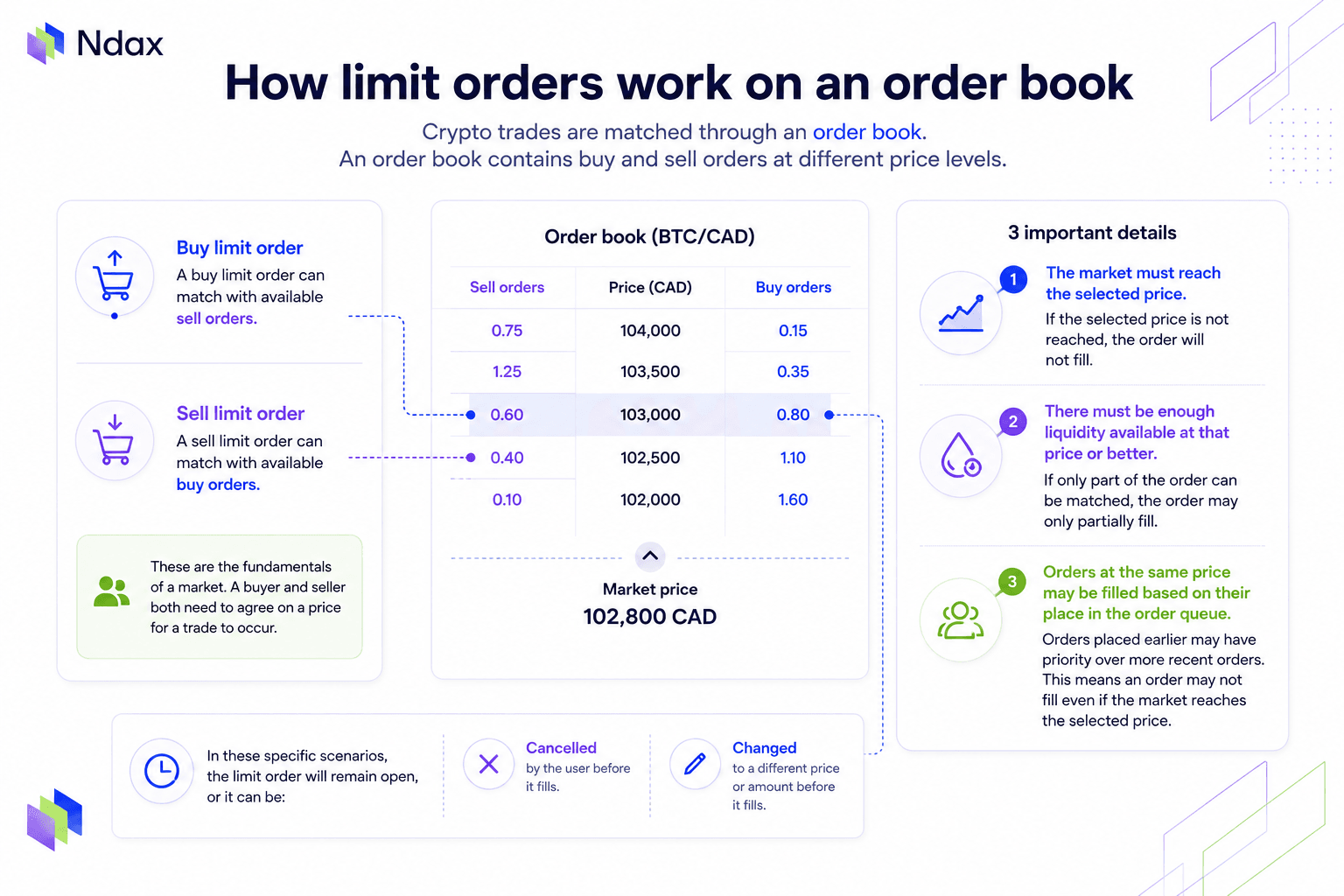
Crypto trades are matched through an order book. An order book contains buy and sell orders at different price levels.
When a user places a limit order, the order can match with another order on the opposite side of the trade. A buy limit order can match with available sell orders. A sell limit order can match with available buy orders.
These are the fundamentals of a market. A buyer and seller both need to agree on a price for a trade to occur.
- There are three important details to understand when looking at why a limit order can remain open, partially fill, or not fill at all.
- The market must reach the selected price. If the selected price is not reached, the order will not fill.
- There must be enough liquidity available at that price or better. If only part of the order can be matched, the order may only partially fill.
- Orders at the same price may be filled based on their place in the order queue. Orders placed earlier may have priority over more recent orders. This means an order may not fill even if the market reaches the selected price.
In these specific scenarios, the limit order will remain open, or it can be canceled by the user before it fills. Alternatively, the order can also be changed to a different price or amount before it fills. A limit order also depends on whether there are matching orders available, how much liquidity exists at that price, and where the user’s order sits in the queue.
Market order vs. limit order: what is the difference?
A market order is generally used when the user wants the trade to execute as soon as possible, assuming liquidity is available. The user does not set a specific price condition, so the final execution price depends on available liquidity when the order reaches the market.
For a full guide on how to use market orders, read this blog.
Neither order type is better by default. A market order may be more appropriate when immediate execution matters. A limit order may be used when the user wants to wait for a specific price.
In simple terms, a market order prioritizes execution, while a limit order prioritizes price. That trade-off is one of the first concepts users should understand before moving on to other order types, such as stop, stop-limit, trailing stop, or fill-or-kill orders.
Where limit orders fit in advanced trading
Limit orders are often one of the first order types users learn after market orders. They are also an important building block for more advanced trading tools because they introduce the idea of conditional execution. Specifically, the user dictates their own price conditions, but the order will only execute if the market and available liquidity allow it.
On Ndax, a limit order is one part of a broader set of advanced order types, including stop orders, stop-limit orders, trailing stop orders, and fill-or-kill orders. These order types are built for different trading scenarios, but they all require the user to understand how price, liquidity, timing, and order conditions can affect execution.
For example, a limit order lets a user set the price they are willing to pay or accept. A stop order is generally tied to a trigger price. A stop-limit order blends a stop trigger with a limit price. A trailing stop order adjusts based on market movement. A fill-or-kill order is used when the user wants the full order to execute immediately or not execute at all.
Each order type has its own benefits and trade-offs. None of them guarantee a profitable outcome, and some may not execute at all. Users should understand how each order type works before placing a trade.
How limit orders can fit into a trading strategy
A limit order can support a trading strategy when the user wants to define the price before entering or exiting a position. For example, a user may decide they only want to buy if the price returns to a level they have identified in advance, or only sell if the price reaches a level where they are comfortable exiting.
Some users may prefer reviewing charts, recent price movement, order-book depth, volatility, or technical indicators before choosing a limit price. These tools do not guarantee that a limit order will be profitable or even fill. They simply provide information the user may consider before placing an order.
Because Ndax provides an Order Execution Only service, users remain responsible for deciding whether to place a limit order, which asset to trade, what price to select, and whether to change or cancel the order before it fills.
Common beginner mistakes with limit orders
The most common mistake is setting the limit price too far away from the current market price. This order may remain open for a long time or never fill at all.
Another mistake is assuming the order will fill just because the market briefly touched the selected price. If there is not enough liquidity, or if many other orders are ahead in the queue, the user may be disappointed that the order remains unfilled or only partially fills.
A third mistake is forgetting that the order is still open. Market conditions can change quickly, and the user may want to review, update, or cancel the order before it fills.
A fourth mistake is using a limit order without understanding how it fits into the user’s broader trading plan. A limit order can control the price condition, but it does not control market direction, liquidity, volatility, or the outcome of the trade.
How limit orders work on Ndax
On Ndax, the order ticket appears on the right side of the trading screen. This is where users can choose whether they want to buy or sell, select the order type, enter the order size, and review the trade before placing the order.
To place a limit order, the user first selects the crypto trading pair they want to trade. The user then selects the Limit tab in the order ticket.
This is different from the Market tab, which is used when the user wants the order to execute immediately at the best available price, and the Stop tab, which is used when the user wants to set a trigger price.
After selecting Limit, the user enters the required order details. These may include:
- Order size: the amount of crypto the user wants to buy or sell.
- Limit price: the price at which the user is willing to buy or sell, or better.
As a reminder, for a buy limit order, the limit price is the highest price the user is willing to pay. For a sell limit order, the limit price is the lowest price the user is willing to accept.
Before placing the order, the user should review the order details, including the order value, estimated total, fees, and amount expected to be received. Once the user is comfortable with the details, they can place the order.
Before selecting a limit price, users may also review the trading screen, charting tools, indicators, recent price movement, buy and sell depth, order-book information, and recent trades to better understand the market context around their order.
Because a limit order is based on the user’s selected price, it can be useful for Canadians who want more control over how they trade supported crypto assets against Canadian dollars. However, the user is still responsible for reviewing the trade details before submitting the order.
FAQ
Is a limit order better than a market order?
Not by default. A limit order may be useful when price control matters more than speed. A market order may be more appropriate when immediate execution matters more than setting a specific price condition.
Can a limit order partially fill?
Yes. A limit order will partially fill if only part of the order can be matched at the selected price or better.
Why did my limit order not fill even though the price reached my limit?
A limit order may not fill if there was not enough liquidity available, if the market only briefly reached the selected price, or if other orders at the same price were ahead in the order queue.
Can a limit order be canceled?
Yes. A limit order can be canceled if it has not been filled. If the order has been partially filled, only the unfilled portion can be canceled.
Does a limit order guarantee a specific price?
No. A limit order sets the user’s desired price condition for the trade, but it does not guarantee that the trade will execute.
Do all Canadian crypto trading platforms offer limit orders?
Many Canadian crypto trading platforms offer limit orders. Availability can depend on the platform, supported asset, trading pair, account type, and user location. Users should always review details before opening an account and placing a trade.
Is a limit order an advanced trading tool?
A limit order is one of the most common order types in crypto trading. It can be useful for beginners learning price control, but it is also part of the broader set of tools used by more active traders.
What other order types are available on Ndax?
Ndax users can use several order types, including market orders, limit orders, stop orders, stop-limit orders, trailing stop orders, and fill-or-kill orders.
Can charting tools help with limit orders?
Charting tools can provide context before a user selects a limit price. However, charts and indicators do not guarantee execution, price movement, or trading outcomes.
Bottom line
A limit order gives users more control over the price of a crypto trade. The easiest way to remember it is this: a market order prioritizes speed, while a limit order prioritizes price. A user generally cannot maximize immediate execution and price certainty at the same time.
A limit order can be useful when a user wants to buy only at or below a selected price, or sell only at or above a selected price. But a limit order may not fill at all.
A limit order can fill fully, fill partially, remain open, be changed, or be canceled. The main trade-off is simple: more control over price, less certainty of execution.
For users exploring Ndax’s advanced trading tools, limit orders are an important starting point. They help explain how price conditions, liquidity, order-book priority, and execution uncertainty work before users move on to more conditional order types.
Don't forget to follow us on social media for more updates and join the conversation on our forums.
Disclaimer: This article is not intended to provide investment, legal, accounting, tax or any other advice and should not be relied on in that or any other regard. The information contained herein is for information purposes only and is not to be construed as an offer or solicitation for the sale or purchase of cryptocurrencies or otherwise.