OTC crypto trading in Canada: What larger-trade clients can expect?
Learn how OTC differs from standard exchange trading for larger transactions , and what to review before placing a larger crypto trade.
Key takeaways
- OTC crypto trading is often used for higher-value transactions.
- On Ndax, OTC crypto execution services are available for transactions starting at C$25,000.
- OTC crypto trading provides a different workflow when transaction size makes liquidity, slippage, or execution process more relevant.
- Users may want to review funding, liquidity, the quote process, settlement, custody, withdrawals, records, and support before placing a trade.
- OTC does not remove crypto market risk, as prices can still move, liquidity can change, and execution outcomes are not guaranteed.
- Users may want to review and understand the quote, timing, terms, fees, and settlement process carefully.
- Eligible OTC transactions can also settle in USD. Subject to approval, Ndax Wealth may also facilitate the sale of certain crypto assets that are not listed for standard trading on the Ndax exchange, such as EURC.
- Ndax’s Order Execution Only model means Ndax executes client instructions and does not provide investment advice or recommendations.
Introduction
Over-the-counter (OTC) crypto trading refers to a process for handling larger crypto transactions through a dedicated trading desk rather than placing the full order directly through a standard self-directed exchange order flow. Ndax Wealth provides OTC crypto execution for Canadian crypto transactions starting at C$25,000. The service is available to high-net-worth individuals, institutional clients, and other eligible users placing transactions that meet the minimum size. The OTC service provides a quote-based execution process with dedicated desk support. Clients comparing OTC with standard trading can review liquidity, order-book depth, slippage, quoted pricing, funding, settlement, custody, documentation, and support.
What OTC crypto trading means
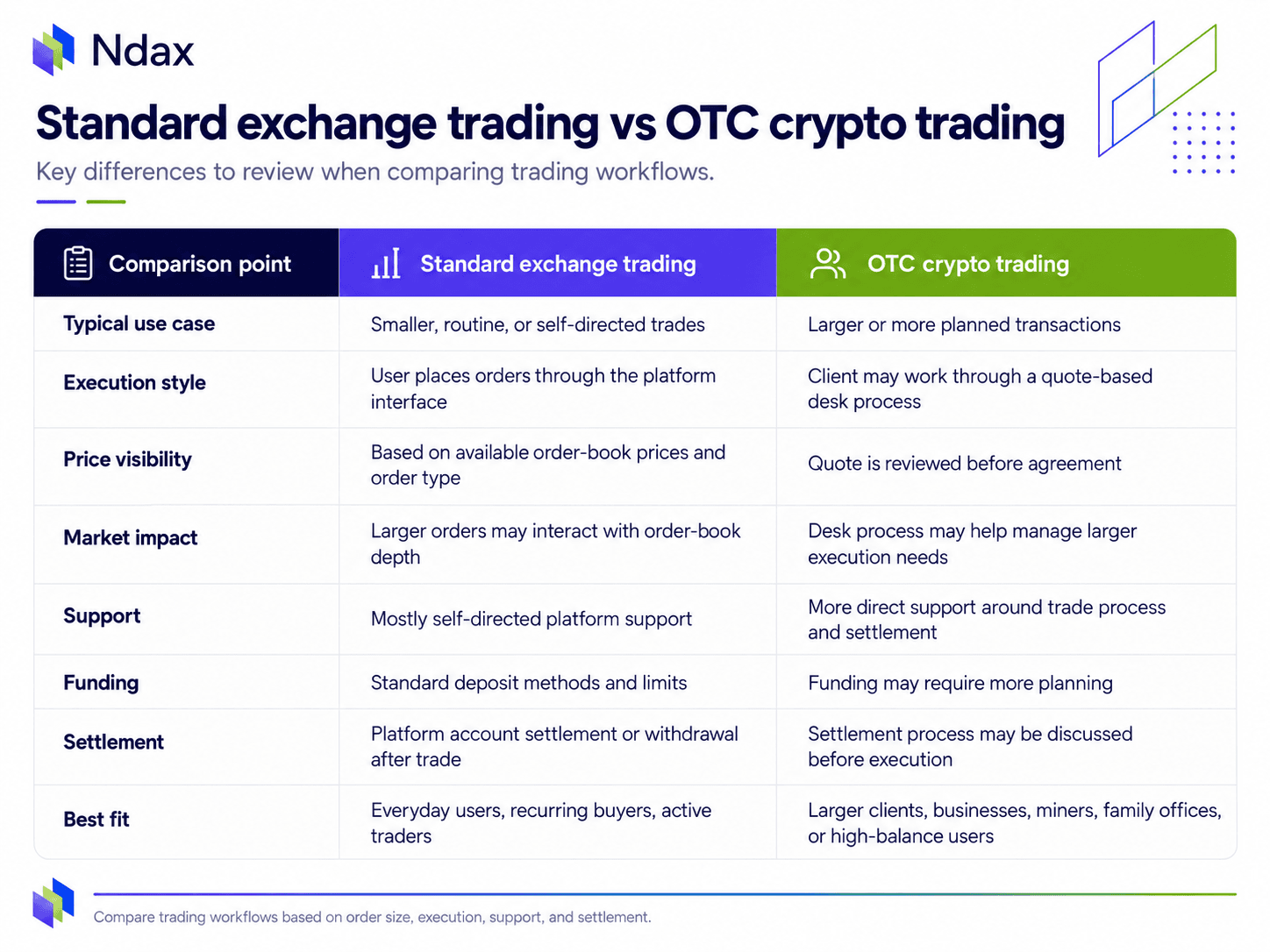
OTC stands for “over-the-counter.” In crypto, OTC trading usually refers to larger transactions handled through a desk or quote-based process instead of being placed entirely through a public order book by the user. A standard exchange order is often self-directed, meaning the user chooses the asset, order type, amount, and price parameters, then submits the order themselves through the platform.
By contrast, OTC transactions involve the user working with a trading desk to discuss the asset, approximate size, timing, funding, quote, and settlement process. Once the user and trading desk agree on the quote and required instructions, the trade can be executed according to that process.
The goal of an OTC trading desk is to provide a more structured execution path for transactions where trade size, liquidity, timing, documentation, and other factors require more attention.
Why larger crypto trades get a different process
A larger crypto order can interact differently with market liquidity than a smaller trade. When a large market order is placed through a standard exchange interface, it may fill across multiple price levels, which can increase slippage and cause the final average execution price to differ from the price initially displayed.
An OTC desk offers a different approach. Instead of sending the full order directly into the public order book, the client can request and review a quote before deciding whether to proceed. This can reduce uncertainty around execution price and help limit the impact that a larger order may otherwise have when trading through available market depth.
The OTC process can also provide additional coordination around funding, settlement, custody, and transaction records.
When OTC crypto trading may make sense
OTC may be worth considering when the transaction is large enough that the user wants a more structured process around quoting, timing, execution, or settlement .OTC services may be used by:
- High-balance individuals placing larger trades
- Businesses adding crypto to a treasury process
- Miners selling crypto proceeds
- Family offices reviewing direct crypto exposure
- Institutions that need documentation and settlement planning
- Users who want support around a large single transaction
- Users who prefer a quote-based process rather than manually executing a larger transaction through a public order book
Ndax’s Relationship Disclosure Document describes OTC services for institutional and high-net-worth individual users, as well as other users that want to trade C$25,000 or more worth of crypto assets in one transaction.
How standard exchange trading differs
Ndax’s standard crypto trading platform may still be used by larger users when:
- The trade size is modest
- The user is comfortable placing market or limit orders
- The asset has sufficient visible liquidity for the user’s order size
- The user does not need a quote-based process
- The user is making routine purchases or sales
- The user does not need additional settlement coordination
For many users, Ndax’s regular trading interface may be sufficient. The user can review the order book, choose their order type, confirm the fee, and place the trade themselves. This means that OTC is not necessarily the default option for larger users.
Price impact, slippage, and order-book depth
Larger trades can be more sensitive to order-book depth. If a user places a large market order through a standard trading interface, the order may fill across multiple price levels. That can produce a different average execution price than the first price the user saw before placing the order. This is commonly discussed as slippage or price impact.
Limit orders allow users to set a limit price, although the order may not fill immediately or fully. Breaking an order into smaller pieces is another execution approach, although it can require more time and active management.
An OTC desk can provide a different workflow. Instead of manually working through the order book, the client can request and review a quote for a larger transaction before agreeing to proceed. That does not mean OTC eliminates all cost, spread, or market risk. It means the client has a clearer execution process before confirming the trade.
Funding and settlement should be planned before the trade
For larger trades, funding may need to be coordinated before execution. The user may want to know:
- How much CAD or crypto needs to be transferred
- Which funding method will be used
- Whether wire transfer or another method is more appropriate
- Whether the account name matches the funding source
- Whether the bank may apply limits, fees, or cut-off times
- When funds are expected to arrive
- Whether the trade will settle in the platform account or be withdrawn
- What documentation may be needed after the trade
For OTC users, the funding process may need to be discussed and confirmed because timing can affect execution planning. A user may need to coordinate a quote process, internal approval, bank transfer, settlement instruction, and custody destination. Depending on the transaction, eligible OTC clients can also settle in USD.
Custody and withdrawal planning matter
Larger users may want to decide before execution whether they expect to keep assets on-platform or withdraw them to an external wallet. That decision may affect custody review, withdrawal planning, transfer risk, and operational steps after the trade.
Ndax’s Risk Statement notes that users can transfer virtual assets from their Ndax account to supported external wallets, subject to applicable platform functionality and requirements.
Ndax’s custody disclosures state that at least 80% of client virtual assets are held with acceptable third-party custodians, with the remainder held through Ndax’s custody infrastructure to support operational needs including deposits, withdrawals, settlement, and certain staked assets.
Ndax’s security page also states that client digital assets are maintained separately from Ndax’s own assets and that at least 80% of client crypto assets are held in segregated omnibus accounts with acceptable third-party custodians.
Records and documentation become more important
A small personal crypto purchase may only require basic transaction history, including date, time, the crypto asset’s price at the time of the transaction, and the equivalent dollar amount.
However, a larger transaction may require more complete records. A business, family office, high-balance household, or institutional client may need documentation for accounting, tax, internal reporting, audit review, investment committee records, treasury reporting, or future reconciliation.
Before using an OTC desk, clients may want to understand what information will be available after the transaction. This may include:
- Date and time of transaction
- Asset purchased or sold
- CAD value
- Crypto amount
- Quoted price
- Fees or spread, where applicable
- Funding method
- Settlement details
- Withdrawal records, if assets are moved off-platform
- Account statements or transaction exports
How the Ndax OTC process works
For high-net-worth individuals and institutional clients, the OTC process can provide a more direct workflow for coordinating larger transactions, while other eligible users trading C$25,000 or more may also access the service.
- Initial contact
The client contacts the OTC desk or requests a consultation. - Account onboarding or review
Ndax may need to verify the client, account type, funding source, and trading eligibility. - Trade discussion
The client discusses asset, size, timing, and whether the trade is a buy or sell. - Quote review
The desk provides a quote or price indication based on market conditions and available liquidity. - Client instruction
The client reviews the quote and decides whether to proceed. - Execution
The trade is executed according to the agreed process and client instructions. - Settlement
The assets or funds settle according to the platform’s process. - Custody or withdrawal
The client decides whether assets remain on-platform or are withdrawn to an external wallet. - Post-trade records
The client receives or accesses the records needed for review, accounting, tax, or internal reporting.
Subject to approval, clients may also be able to sell certain crypto assets through the OTC desk that are not available for standard trading on the Ndax exchange, such as Circle’s euro-backed stablecoin, EURC.
Where Ndax Wealth fits in
Ndax Wealth is the Ndax business offering OTC services for larger crypto transactions. Its OTC clients include high-net-worth individuals and institutions, as well as other eligible users placing transactions of C$25,000 or more. Ndax’s role should be understood clearly. Ndax provides an Order Execution Only (OEO) service. Ndax executes clients’ instructions but does not provide investment advice. Clients decide when and what to trade.
The platform can support execution, but the user remains responsible for deciding whether to trade, what to trade, when to trade, and how the transaction fits within their own risk framework.
Ndax’s OTC service is marketed as an institutional-grade crypto execution for large trades, with quoted pricing, discretion, and direct desk support, and makes it available for transactions starting at C$25,000. Eligible transactions can also settle in USD, while certain assets that are not listed for standard exchange trading may be sold through the OTC desk subject to approval.
Common considerations for larger transactions
Waiting until the trade date to think about funding
Funding can take time, especially for larger deposits or wire transfers. Clients may want to understand bank limits, transfer timing, platform instructions, and any required verification before trying to trade.
Assuming OTC removes market risk
OTC can provide a more structured execution process, but it does not remove crypto price volatility, liquidity risk, transfer risk, custody risk, or operational risk.
Comparing only the trading fee
For larger trades, users may want to evaluate the full cost and process, including spread, quote terms, funding, settlement, withdrawal fees, and custody destination.
Ignoring custody before execution
Clients may want to consider in advance whether they plan to leave assets on-platform or withdraw them to an external wallet.
Treating support as an afterthought
For larger trades, support can matter before execution, during settlement, and after the trade when records or withdrawal questions arise.
Bottom line
OTC crypto trading in Canada is not just a larger version of a standard self-directed trade. The process can involve funding, quote review, execution, settlement, custody planning, withdrawal decisions, documentation, and support. That makes the execution process an important consideration before the trade is placed.
Standard exchange trading may be enough for smaller or routine transactions. OTC may be worth considering when the transaction is large enough that liquidity, slippage, timing, funding, settlement, or documentation calls for a more structured workflow.
Ndax Wealth supports OTC crypto execution for larger Canadian transactions starting at C$25,000. Ndax is a regulated crypto trading platform. Ndax provides an Order Execution Only (OEO) service. Ndax executes clients’ instructions but does not provide investment advice. Clients decide when and what to trade.
Don't forget to follow us on social media for more updates and join the conversation on our forums.
Disclaimer: This article is not intended to provide investment, legal, accounting, tax or any other advice and should not be relied on in that or any other regard. The information contained herein is for information purposes only and is not to be construed as an offer or solicitation for the sale or purchase of cryptocurrencies or otherwise.