Registered vs. unregistered crypto platforms in Canada: What users should know
Learn what registration means for crypto trading platforms in Canada, how registered and unregistered platforms differ, and what users should check before opening an account.
Key takeaways
- Registered and unregistered crypto platforms are not operating under the same Canadian securities framework.
- Canadian users should check official sources and directories, where applicable, to confirm registration status.
- CIRO says crypto asset trading platforms that facilitate trading in crypto-related securities, derivatives, instruments, or contracts are expected to be registered as Investment Dealers and approved as CIRO Dealer Members.
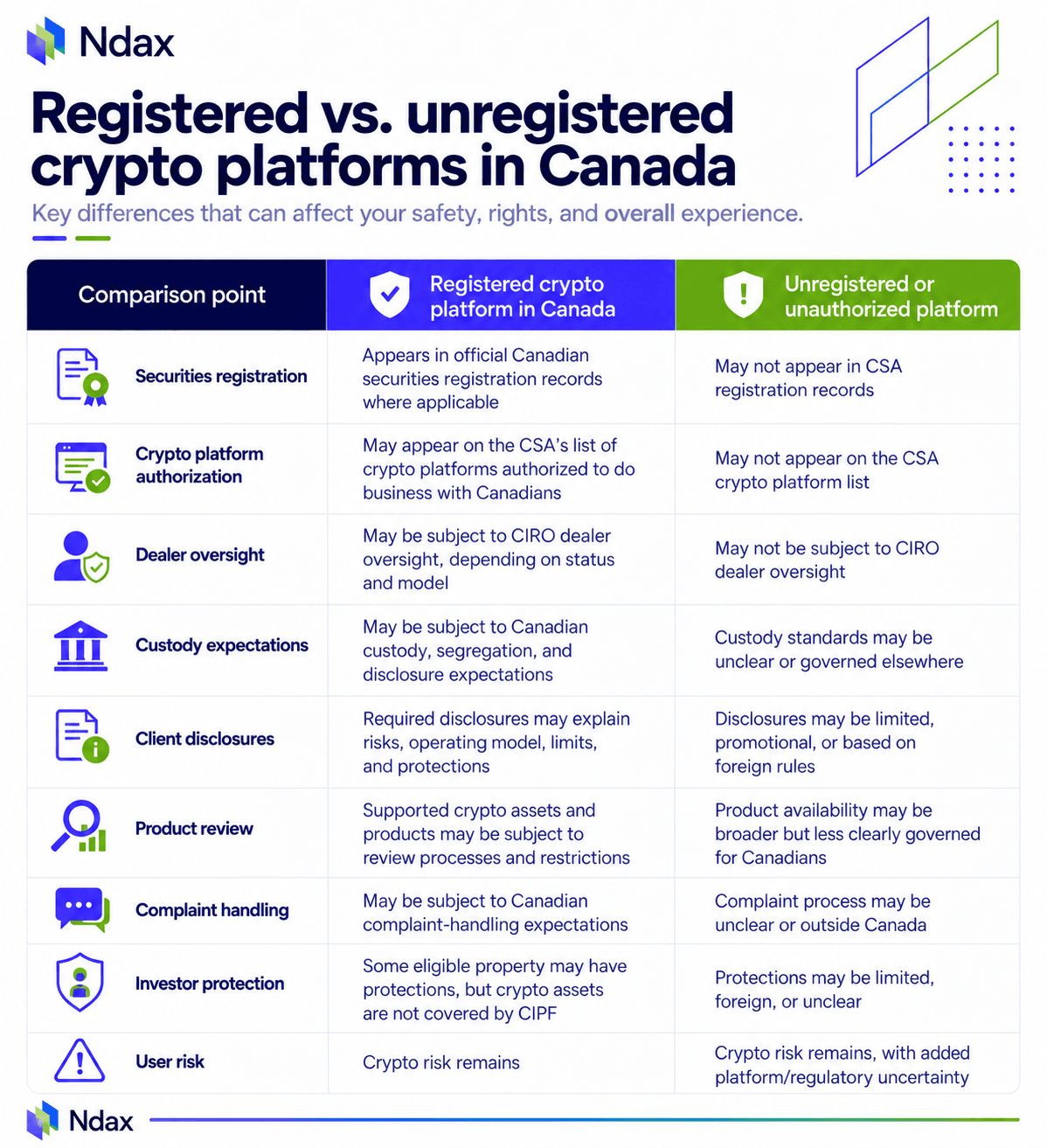
- Registration may affect custody expectations, client-asset segregation, disclosures, product review, complaint handling, reporting, and supervision.
- CIPF membership does not mean crypto assets are covered. CIPF excludes crypto assets from coverage.
- FINTRAC registration as a Money Services Business is not the same as securities registration.
Introduction
A registered crypto platform in Canada operates under a Canadian securities regulatory framework. Depending on the platform’s model, this may include registration with provincial and territorial securities regulators, authorization to offer crypto asset trading services to Canadians, CIRO dealer membership, specific terms and conditions, custody requirements, risk disclosures, and ongoing oversight.
The Financial Consumer Agency of Canada specifically warns that some crypto platforms may claim to be registered businesses, but that this is not the same as registration with a securities regulator. An unregistered crypto platform may still have an app, website, marketing campaign, offshore licence, or FINTRAC registration. But that is not the same as being registered with Canadian securities regulators or appearing on the CSA’s list of crypto asset trading platforms authorized to do business with Canadians.
Why this comparison matters
Many crypto platforms use similar language. They may advertise themselves as secure, compliant, trusted, licensed, regulated, or readily available for Canadian users. In some cases, these are simply marketing claims.
Some platforms may also have one type of registration without being registered under Canadian securities laws. For example, a platform can be registered with FINTRAC as a Money Services Business but not be registered with Canadian securities regulators. A platform can be licensed in another country but not authorized to serve Canadian users under Canadian securities rules. A platform can use compliance language in marketing without appearing in the official Canadian databases users should check.
This is why users are encouraged to verify claims on a platform’s homepage against official records.
What ‘registered’ really means in Canada
Registration means the firm has gone through a Canadian regulatory process that applies to its business activities.
The Canadian Securities Administrators state that anyone or any company in the business of trading securities or advising clients on securities must be registered with the securities regulator in each province or territory where they do business, unless an exemption applies.
According to the CSA, registration helps protect investors because regulators only register firms and individuals that meet applicable qualifications.
Crypto adds another layer because many platforms do not simply deliver crypto assets immediately to a user’s own wallet. They may hold crypto assets for users, maintain account balances, provide custody arrangements, enable deposits and withdrawals, support staking, or offer users contractual rights connected to crypto assets.
The CSA further notes that a crypto asset trading platform may be subject to securities legislation depending on how it operates. That is why registration status should be reviewed carefully. Users should not assume that every platform offering crypto access in Canada is operating under the same framework.
What ‘unregistered’ can mean
Unregistered is not a blanket term that means the same thing in every case. It may mean the platform:
- Does not appear in the CSA National Registration Search
- Does not appear on the CSA’s crypto asset trading platform list
- Is registered only with FINTRAC as a Money Services Business
- Is licensed in another country but not registered with Canadian securities regulators
- Previously served Canadians but is subject to restrictions, wind-down obligations, or access limits
- Is misusing regulatory language or logos
- Is falsely implying that it is registered
The CSA’s crypto platform list is particularly important because it gives users a crypto-specific place to check whether a platform is authorized to do business with Canadians. The CSA’s current list includes platforms, decision dates, and related regulator links.
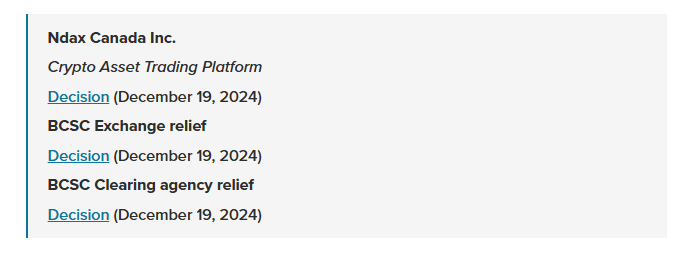
If a platform is not listed, that may warrant additional diligence. Users may want to check official registration records, review provincial regulator warnings, and contact their local securities regulator if the result is unclear.
Why FINTRAC registration is not enough
FINTRAC registration is not the same thing as securities registration. This is one of the most common points of confusion. FINTRAC registration relates to anti-money laundering and financial transaction reporting obligations.
A crypto platform may say it is registered as a Money Services Business. That may be true. But users should not treat that as proof that the platform is registered as a crypto asset trading platform with Canadian securities regulators.
The Financial Consumer Agency of Canada warns that some crypto asset trading platforms may claim to be registered businesses, but that this is not the same as being registered with a securities regulator. The FCAC tells users to check the CSA National Registration Search and the CSA list of crypto platforms authorized to do business with Canadians.
Essentially, FINTRAC registration relates to money-services and anti-money laundering obligations. Securities registration relates to the platform’s regulatory status under Canadian securities laws. One does not replace the other.
How registration changes the platform standard
Registration can change the expectations around how a platform operates.
Custody and segregation
When a platform holds crypto assets on behalf of users, the user is relying on the platform’s custody arrangements, operational controls, third-party providers, wallet infrastructure, and internal procedures.
The CSA has emphasized enhanced expectations around custody and segregation of crypto assets held on behalf of Canadian users. Canadian securities regulators have also stated that pre-registration undertakings include expectations around custody, segregation, and a prohibition on offering margin, credit, or other forms of leverage to Canadian users.
CIRO’s digital asset custody framework also describes segregation as a core investor-protection concept because it helps ensure client assets are identifiable, traceable, and not available to satisfy claims of general creditors.
This does not eliminate custody risk. What it does is give users a clearer framework for asking how assets are held and what controls apply.
Disclosures and risk acknowledgments
Registered platforms are expected to provide disclosures to their users that clearly explain the nature of the account relationship, the risks of crypto assets, the platform’s operating model, and the limits of investor protection.
This is important because crypto users should understand what they are actually using. For example, are users trading through an Order Execution Only platform? Does the platform provide advice? Are crypto assets covered by CIPF? Are there account limits? What are the custody arrangements? What happens if a crypto asset is no longer supported? Are staking services separate from ordinary trading?
Unregistered platforms may also choose to provide risk disclosures, but users should not assume those disclosures are consistent with a regulated Canadian framework.
Product and asset review
Registration can impact how platforms review crypto assets and products before making them available. A registered Canadian crypto platform may have obligations or conditions around product review, crypto asset statements, risk disclosures, stablecoins, custody support, liquidity, legal analysis, and platform controls.
This is one reason why registered platforms may not always offer the same number of assets for trading as some global platforms. A broader product list is not automatically better if the platform cannot clearly explain the risk, custody, liquidity, or regulatory treatment.
Supervision and accountability
Registered platforms are part of a system that includes securities regulators, CIRO oversight where applicable, required filings, compliance expectations, complaint processes, and terms and conditions. That does not mean every issue will be avoided.
What it does mean is that there is a recognized regulatory framework for supervision and accountability. This is particularly important if something goes wrong. A platform’s regulatory status can affect where users can verify information, what disclosures are available, what obligations apply, and which Canadian authorities may have oversight.
How Ndax discloses its registration status
Ndax is a regulated crypto trading platform.
Ndax states that it is registered as an Investment Dealer under securities legislation in all provinces and territories of Canada, and is a member of CIRO and CIPF. Ndax also states that it offers services to Canadian residents only and operates under an Order Execution Only model, providing no investment advice or recommendations.
Ndax’s custody disclosure states that the platform is registered in the category of Investment Dealer and approved to operate an alternative trading system. It also states that virtual assets not withdrawn from the platform are held by Ndax or an acceptable third-party custodian in accordance with the December 19, 2024 decision document. Under that decision, not less than 80% of client virtual assets are held in cold and warm storage with acceptable third-party custodians regulated as trust companies.
Ndax’s regulatory disclosure also states the limits of investor protection. It states that CIPF coverage does not extend to virtual assets held in user accounts and that those assets are not eligible for CDIC or CIPF protection.
That is the level of disclosure users should look for when comparing platforms: legal entity, registration category, CIRO status, CIPF status, OEO model, custody framework, and limits on coverage.
That is an example of the type of disclosure users may want to review when comparing platforms: legal entity, registration category, CIRO status, CIPF status, OEO model, custody framework, and limits on coverage.
Questions users should ask before opening an account
Before choosing a crypto platform in Canada, users may consider asking the following questions and conducting additional research before depositing funds if an answer is unclear.
- What is the platform’s legal entity name?
- Does the firm appear in the CSA National Registration Search?
- Does the platform appear on the CSA’s crypto asset trading platform list?
- Is the firm listed by CIRO?
- What registration category applies?
- Is the firm listed by CIPF?
- Does the platform clearly disclose that crypto assets are not covered by CIPF?
- Is the platform only FINTRAC-registered, or is it also registered with Canadian securities regulators?
- Does the platform explain its custody model?
- Are client assets segregated from the platform’s own assets?
- Does the platform provide clear risk disclosures?
- Are fees, spreads, withdrawal costs, and funding methods clearly explained?
- Does the platform offer products that may be restricted or unavailable under the Canadian framework?
- Is there an accessible complaint process?
- Are there investor alerts, disciplinary actions, or warnings connected to the firm or
Bottom line
Registered and unregistered crypto platforms are not the same from a Canadian user’s perspective. A registered platform operates within a Canadian regulatory framework that may include securities registration, custody expectations, client disclosures, CIRO oversight where applicable, and other requirements.
An unregistered platform may still operate professionally and provide a high level of service. But this is not a substitute for Canadian securities registration or crypto platform authorization.
Still, a registered platform does not make crypto or trading risk-free. Registration does not remove crypto market risk, guarantee performance, prevent losses, or mean that crypto assets are suitable for every user. It does, however, give Canadian users a clearer way to assess the platform, the operating framework, and the risks associated with using the venue.
Don't forget to follow us on social media for more updates and join the conversation on our forums.
Disclaimer: This article is not intended to provide investment, legal, accounting, tax or any other advice and should not be relied on in that or any other regard. The information contained herein is for information purposes only and is not to be construed as an offer or solicitation for the sale or purchase of cryptocurrencies or otherwise.