The Canadian crypto platform checklist: regulation, fees, custody & support
Use this checklist to compare crypto platforms in Canada by regulatory status, total cost, custody practices, and support before opening an account or moving funds.
Key takeaways
Introduction
The four-part Canadian crypto platform checklist
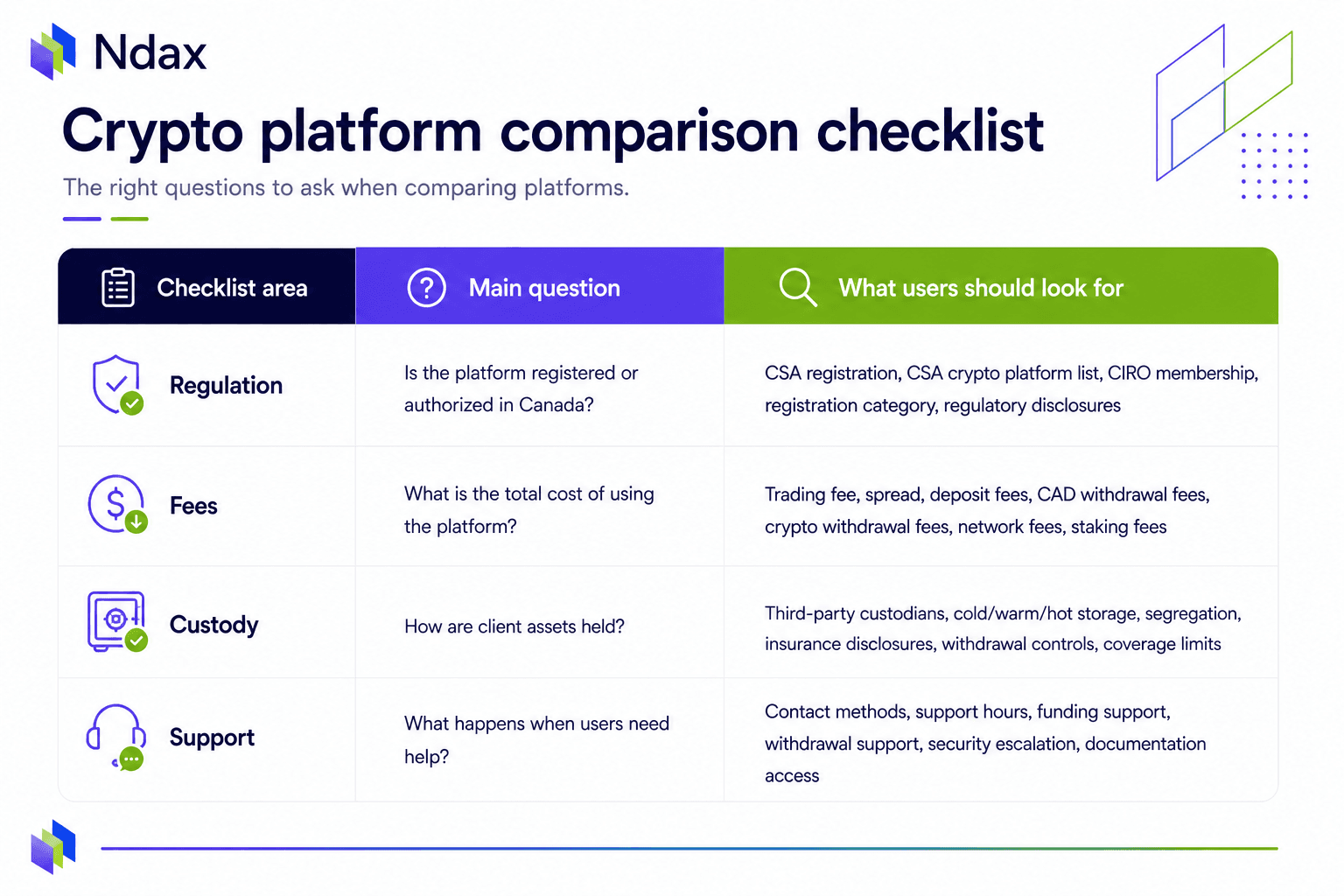
This is one practical way to compare platforms without getting distracted by one feature at a time.
A platform may offer many assets, but its custody procedures are unclear. Another may advertise low or even “zero-fee” costs but use a spread-based model that is harder to compare. Another may have a slick app but limited public disclosure about regulatory status. The checklist helps users compare the parts of the platform that affect the full account experience.
1. Regulation: Check the platform’s Canadian status
Regulation can be an important starting point because it tells users what framework applies to the company behind the trading platform. Users should be cautious if a platform says it is “regulated” without naming the regulator, relies only on offshore licenses, or makes other claims that can’t be easily verified.
The Canadian Securities Administrators say anyone in the business of trading securities or advising clients on securities must be registered with the securities regulator in each province or territory where they do business, unless an exemption applies. The CSA also says the National Registration Search provides information about firms and individuals registered with Canadian securities regulators.
For crypto platforms, users should also check the CSA’s list of crypto asset trading platforms authorized to do business with Canadians. That list is crypto-specific and helps users confirm whether a platform appears in the Canadian crypto platform framework.
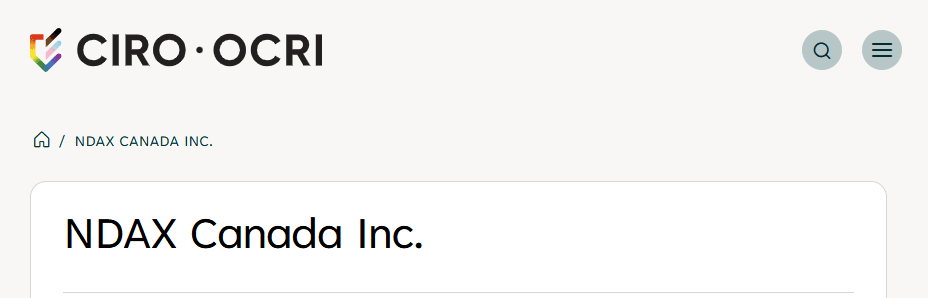
CIRO is also important. CIRO says crypto asset trading platforms that facilitate trading in securities, derivatives, instruments, or contracts involving crypto assets are expected to be registered as Investment Dealers and approved as CIRO Dealer Members.
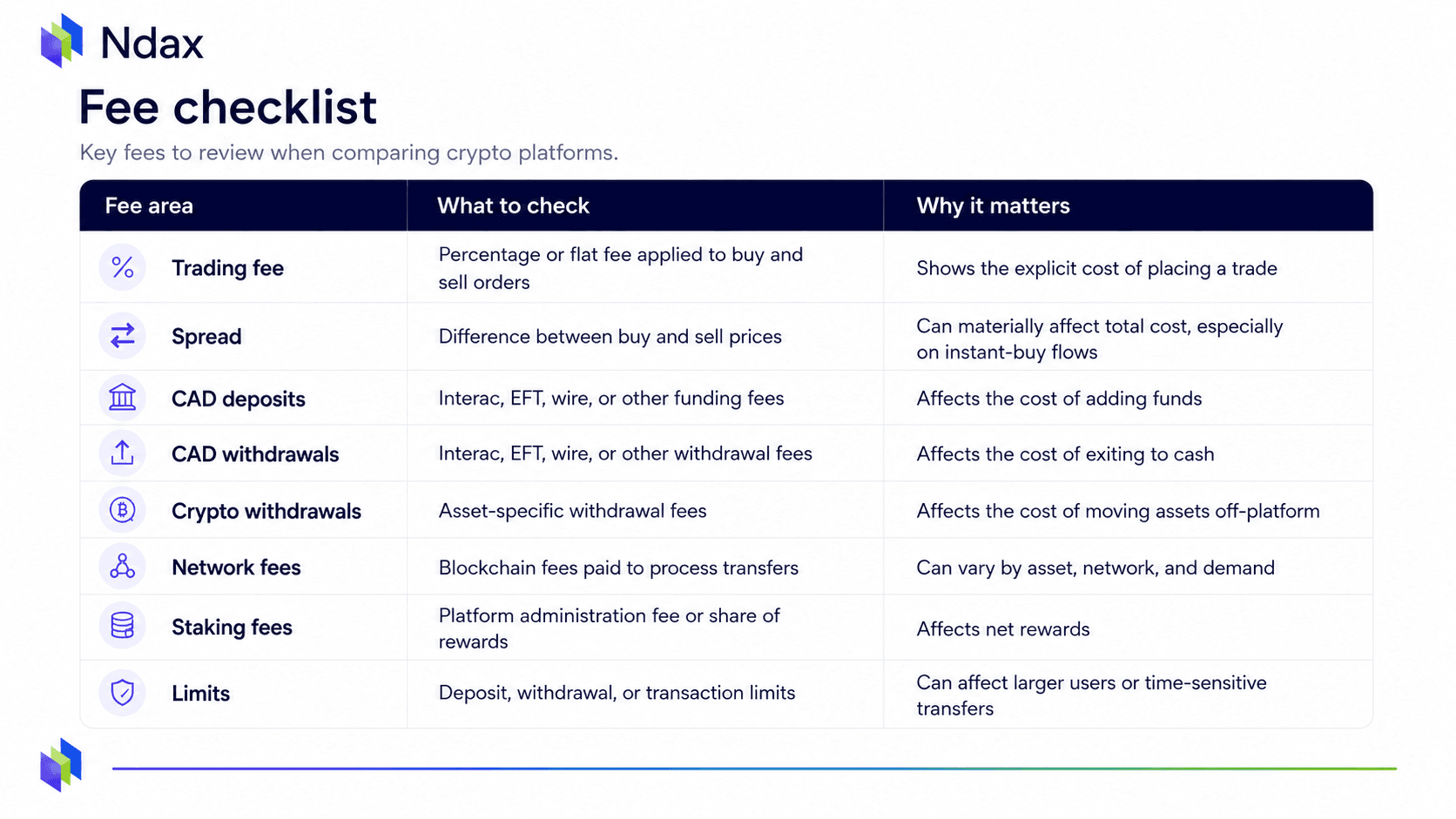
2. Fees: Compare total cost, not just the headline fee
Fees are one of the easiest areas to compare poorly. Many users look at the advertised trading fee without any additional context. The advertised trading fee is a useful starting point, but it does not represent the full cost.
A better fee review should include:
- Trading fee
- Spread
- Deposit fees
- CAD withdrawal fees
- Crypto withdrawal fees
- Blockchain network fees
- Staking or rewards fees
- Minimums and limits
- Execution quality and liquidity
A platform that advertises “zero-commission” trading may incorporate some of its cost into the spread between the buy and sell price. Another platform may advertise low trading fees but add other withdrawal or transaction costs.
A good question to ask is: What will it cost to fund the account, place the trade, hold or stake assets, and withdraw CAD or crypto later?
Ndax charges a flat 0.20% trading fee on buy and sell orders, while Interac e-Transfer, bank wire, and crypto deposits are free, as of September 2026. Ndax’s crypto withdrawal fees are flat amounts based on the asset and network rather than percentage-based fees. Users can review Ndax’s up-to-date fee schedule here.
3. Custody: Understand how client assets are held
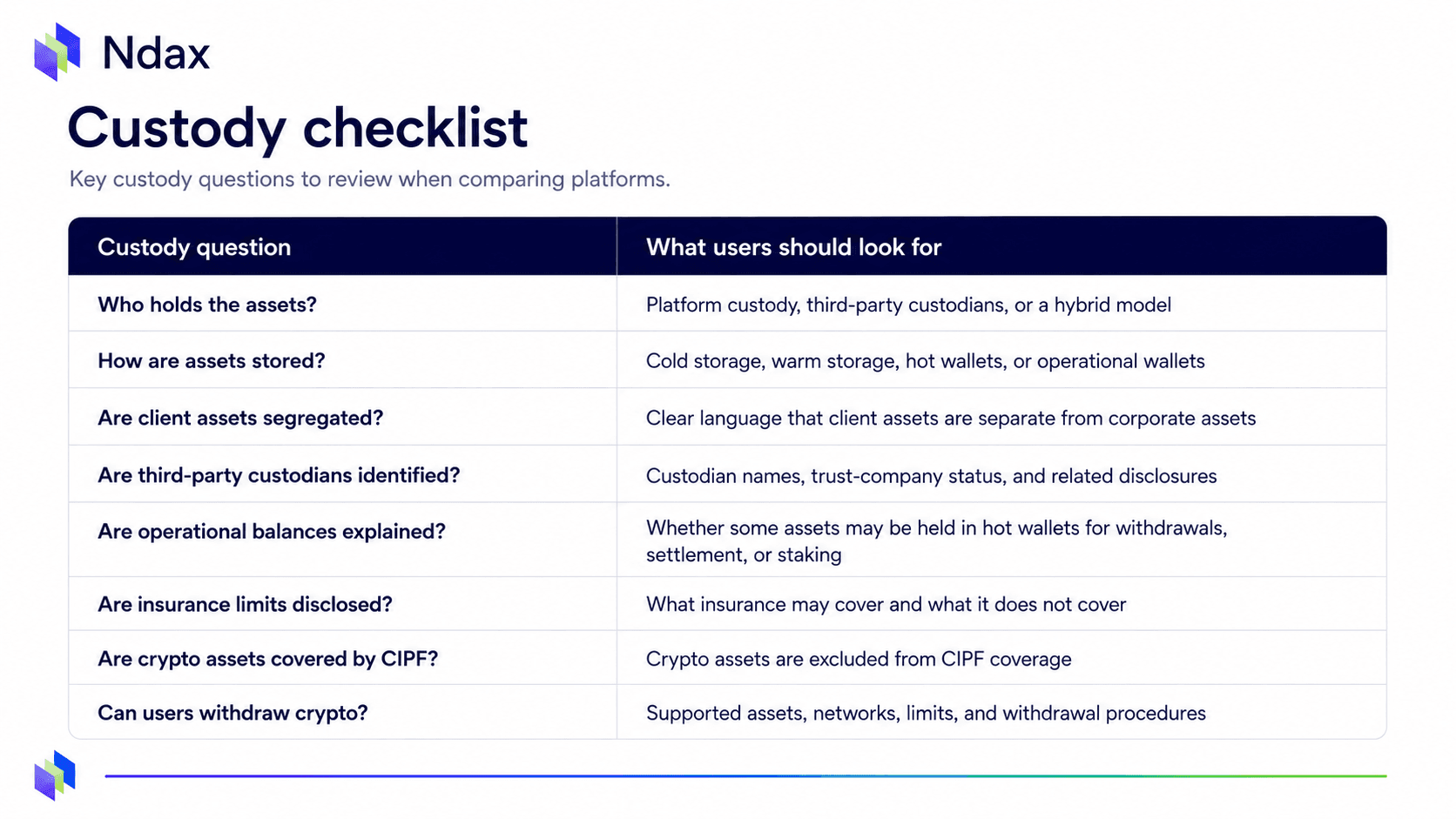
Custody is one of the most important and overlooked parts of choosing a crypto platform. When users leave their crypto on a platform, they are relying on that platform’s custody model. That includes how assets are stored, whether third-party custodians are used, how client assets are segregated, what portion may be held in hot wallets for operations, what controls apply, and what protections do not apply.
Custody is often confused with insurance. CIPF coverage can help return eligible client property if a member firm becomes insolvent and fails to return that property, subject to CIPF policy and limits. But CIPF states that eligible property excludes crypto assets.
That means users should not assume that a platform’s CIPF membership protects their crypto assets. For crypto, custody review should focus on how assets are held, how client assets are separated, what custodians are used, what operational controls exist, and what exclusions apply.
According to the CSA, registration helps protect investors. Registered firms are subject to requirements including risk management, disclosure, and dealing honestly, fairly, and in good faith with clients. The CSA also cautions that registration itself does not eliminate platform risk.
CIRO has also published a digital asset custody framework for Dealer Members operating crypto asset trading platforms in Canada. CIRO describes custody expectations for digital assets and notes that different custody arrangements may involve different control expectations depending on the nature, scale, and risk profile of the platform’s crypto-asset activities.
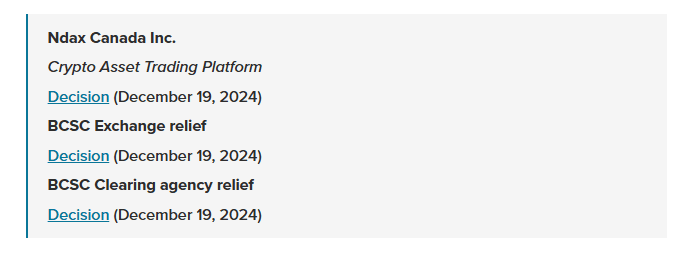
Ndax’s custody disclosure states that virtual assets not withdrawn from the platform are held by Ndax or an acceptable third-party custodian in accordance with the December 19, 2024 decision document. It also states that not less than 80% of client virtual assets are held in cold and warm storage with acceptable third-party custodians regulated as trust companies.
Ndax’s security page also states that client digital assets are kept separate from Ndax, its affiliates, and custodians’ other clients, and that at least 80% of client crypto assets are held in segregated omnibus accounts in the name of Ndax in trust for or for the benefit of Ndax clients.
4. Support: Check what happens when help is needed
Questions to ask before opening a crypto account in Canada
Bottom line
Don't forget to follow us on social media for more updates and join the conversation on our forums.
Disclaimer: This article is not intended to provide investment, legal, accounting, tax or any other advice and should not be relied on in that or any other regard. The information contained herein is for information purposes only and is not to be construed as an offer or solicitation for the sale or purchase of cryptocurrencies or otherwise.