Why a Regulated Platform May Not Offer Every Type of Staking Product
Compare why some staking or yield products available on offshore platforms may not be available on Canadian crypto trading platforms, and how proof-of-stake staking, stablecoin rewards, lending, liquidity products, disclosures, custody, and regulatory obligations can affect what users can access.
Key takeaways
- Not every product called “staking” works the same way. Proof-of-stake staking is different from lending, liquidity provision, stablecoin yield, or promotional rewards programs.
- A stablecoin can operate within a proof-of-stake network, but holding or earning yield on a stablecoin is not the same as staking the network’s native token to support validation.
- A regulated platform may avoid certain staking or yield products because of custody, liquidity, counterparty, disclosure, operational, tax, or regulatory considerations.
- A missing product should not automatically be treated as a negative attribute for the platform. It may be due to risk controls, product due diligence, or a business decision not to offer yield products that do not comply within Canadian regulatory framework.
- Users comparing staking products should look beyond the advertised reward rate and consider how rewards are generated, what risks apply, whether rewards are guaranteed, what fees apply, whether assets are locked, and what protections do and do not apply.
Introduction
A regulated crypto platform may not offer every type of staking product because not all “staking” products are the same. Most staking products are connected to proof-of-stake blockchain networks in which eligible assets are used to help secure the network and generate protocol-based rewards. Other products that are often marketed as staking actually involve lending, borrowing, liquidity provision, stablecoin yield, promotional rewards, or other yield-style arrangements.
A platform may decide against offering certain staking or yield products because they carry different risk profiles, require different disclosures, involve different custody or counterparty arrangements, or may receive different regulatory treatment. A missing staking product should not by default be treated as a platform weakness. In some cases, a platform may simply decide to focus solely on products and services it can support responsibility and legally for Canadian users.
Ndax is a regulated crypto trading platform and provides an Order Execution Only service. Ndax executes clients’ instructions but does not provide investment advice. Clients decide when and what to trade.
Why staking products get misunderstood
Some users may assume the platform which offers the highest staking reward rate is the superior choice. At first glance, the logic is simple. If one platform offers higher yields, more staking products, and more ways to earn, it looks like the stronger platform.
But this comparison is incomplete. A higher reward rate does not explain how the reward is generated, what risks are involved, who controls the assets, whether the return depends on a blockchain protocol, whether assets are being lent out, whether liquidity is being provided to a third-party protocol, whether there is counterparty exposure, or whether the product fits the platform’s regulatory model.
A platform that offers fewer staking products may be making a deliberate decision to focus on products that are easier to explain, support, disclose, monitor, and operate within a Canadian framework. More yield products are not automatically better in the same way that fewer yield products are not automatically worse.
Proof-of-stake staking is different from yield-style products
Proof-of-stake staking generally refers to participating in a blockchain network’s security and validation process. A user holds an eligible proof-of-stake asset and either delegates it to a validator or uses a platform that handles the staking process on the user’s behalf.
Rewards, if generated, usually come from the network’s rules. They can vary based on factors such as validator performance, network participation, inflation mechanics, transaction activity, slashing conditions, bonding periods, and unbonding periods.
This is different from products that use the word “staking” as a marketing gimmick.
Some platforms may describe stablecoin rewards, lending programs, liquidity pools, borrowing markets, DeFi strategies, or promotional earn products as staking. But these products may not involve the same proof-of-stake process. They may instead depend on lending activity, third-party borrowers, liquidity demand, smart contracts, market makers, incentive programs, or other sources of yield.
Protocol-based staking risk is not the same as lending risk. Validator risk is not the same as counterparty risk. Unbonding risk is not the same as liquidity-pool risk. A staking reward is not the same as bank interest. A stablecoin reward is not the same as staking a native proof-of-stake asset.
Using one word for all of these products can make the risks harder to understand.
Why stablecoin staking is different
Stablecoins are typically designed to track the value of another asset, often a fiat currency such as the U.S. dollar. They may be issued on networks that use proof-of-stake, but the stablecoin itself is usually not the native token used to secure that network. Earning a return on a stablecoin may involve lending, liquidity provision, promotional rewards, issuer arrangements, DeFi protocols, or other yield sources.
A stablecoin yield product may depend on the credit quality of a borrower, the reliability of a third-party protocol, reserve disclosures, redemption terms, smart-contract security, liquidity conditions, or the platform’s ability to manage operational and legal obligations.
That is different from staking an eligible proof-of-stake asset under the rules of its own network.
Why Canadian platforms may be more selective
Canadian crypto trading platforms operate within a more specific regulatory environment. They need to consider how products fit within securities regulation, dealer obligations, custody standards, risk disclosure expectations, account appropriateness processes, and operational controls.
A platform may need to assess whether the staking product is tied to a proof-of-stake network or whether it functions more like lending, borrowing, yield, or another investment-style arrangement. It may need to consider whether assets are locked, whether they can be withdrawn, whether third parties are involved, what happens if a validator is slashed, whether rewards are variable, and how risks are disclosed before the user opts in.
This process is unfamiliar or even invisible to the user. From the outside, it may look like a staking product is missing. Behind the scenes, the decision may involve compliance review, legal analysis, custody due diligence, validator review, liquidity planning, operational testing, risk disclosure updates, and ongoing monitoring.
That is why a smaller staking menu should not automatically be described as a product gap.
Reward rates are often half the story
A higher advertised rate may come with longer lockups, higher validator risk, higher slashing risk, lower liquidity, higher platform fees, more complex terms, or greater dependence on third parties. In other cases, the reward rate may be variable and can change based on network conditions. As such, advertised staking or yield rates can be a useful starting point, but they should not be the only factor users compare.
Users should understand whether the rate is shown before or after platform fees. For proof-of-stake products, rewards may depend on network rules and validator performance. For yield-style products, rewards may depend on lending demand, liquidity incentives, borrower activity, or other market conditions. For promotional rewards, the rate may be temporary or subject to conditions.
Custody and liquidity matter
Staking affects how assets are held and how quickly users may be able to access them.
Some proof-of-stake networks have bonding and unbonding periods. A user may be able to request to unstake at any time, but the asset may not become available immediately. Other products may offer faster redemption, but that may depend on platform liquidity, product terms, or whether instant redemption is available.
Yield-style products tend to bring in more complexity.
If assets are lent out, placed into a liquidity pool, used in a third-party protocol, or connected to a structured product, the platform needs to understand what happens if market conditions change. Can users exit? Are assets locked? Is there a liquidity provider? Is there counterparty exposure? What happens if a borrower defaults, a protocol fails, or a smart contract is exploited?
These are not minor details that can be overlooked. Rather, they impact whether the product can be supported responsibly and used appropriately by the user.
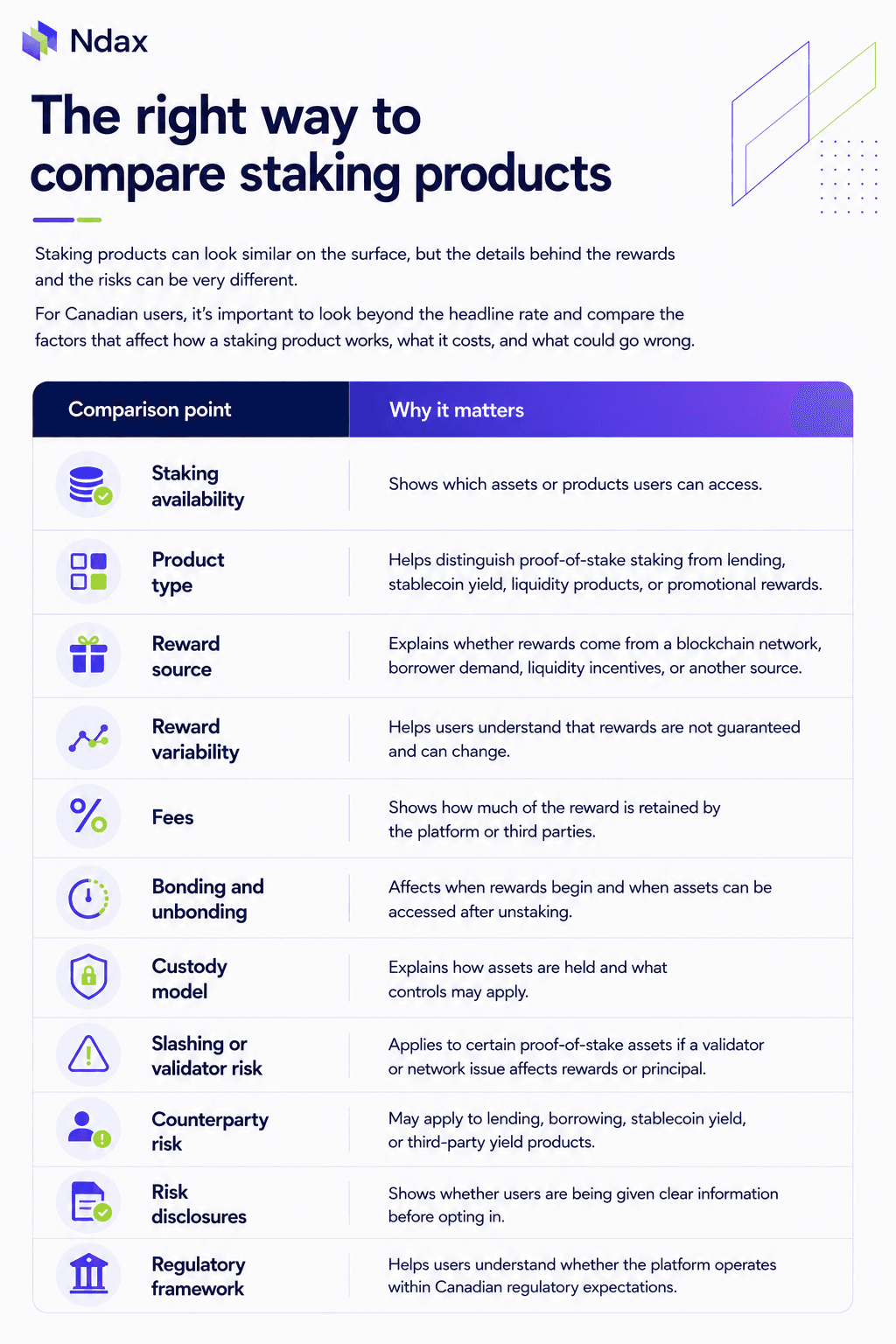
The right way to compare staking products
A simple platform comparison might say one platform offers more staking products than another.
That fact may be accurate, but it is incomplete. For Canadian users, staking availability should be considered alongside product structure, reward source, custody, liquidity, fees, disclosures, lockups, platform registration, and what risks apply.
Where Ndax fits in
Ndax is a regulated crypto trading platform built for Canadians. Ndax is registered as an Investment Dealer under Canadian securities legislation in all provinces and territories, is a CIRO member firm, and operates within the Canadian regulatory framework.
Ndax offers staking for supported crypto assets and provides a calculator to estimate expected rewards. Ndax applies a 20% administration fee to rewards generated through staking, and the fee is deducted from rewards, not from the assets staked.
Ndax’s staking offering is focused on eligible proof-of-stake assets available through the platform. Users can review the asset, APY, reward schedule, fees, bonding period, and unbonding period before confirming a staking plan.
Ndax is not trying to offer every product that offshore platforms may describe as staking or yield. Its role is to provide Canadian users with access to crypto and supported staking features inside a structured and regulated environment.
This means staking availability should be viewed through more than the number of products on the platform. It should also be viewed through risk disclosures, custody, validator review, operational support, platform terms, fees, bonding and unbonding rules, and whether the product can be supported responsibly for Canadian users.
The goal is not to offer every possible yield product, rather the goal is to offer staking in a responsible way that complies with the regulatory conditions and is wanted by Canadian users.
What users should ask before choosing a staking product
Before choosing a staking or yield product, users should look beyond the headline APY and ask practical questions:
- Is this proof-of-stake staking, or is it a lending, liquidity, stablecoin yield, or promotional rewards product?
- Where do the rewards come from?
- Are rewards guaranteed?
- What fees apply?
- Is there a bonding period?
- Is there an unbonding period?
- Can the asset be withdrawn while it is staked?
- What happens if the validator is slashed?
- Are any third parties involved?
- Does the product involve counterparty, liquidity, smart-contract, or credit risk?
- Does the platform clearly explain the risks before the user opts in?
- Does the platform operate within a Canadian regulatory framework?
Final thoughts
A regulated platform may not offer every type of staking or yield product available offshore, but that does not automatically make it weaker.
Staking availability is only one part of platform comparison.
For Canadian users, the more useful comparison looks at the full picture: product structure, reward source, custody, fees, lockups, liquidity, risk disclosures, platform registration, and whether the product can be supported responsibly.
Offshore platforms may offer broader earn menus, including stablecoin yield, lending, liquidity products, promotional rewards, and higher advertised rates. Some users may value that access. But those products can also introduce different risks and different regulatory considerations.
A Canadian-regulated platform may take a more focused approach because it is operating within a different framework that balances legal and regulatory obligations with user experience.
Don't forget to follow us on social media for more updates and join the conversation on our forums.
Disclaimer: This article is not intended to provide investment, legal, accounting, tax or any other advice and should not be relied on in that or any other regard. The information contained herein is for information purposes only and is not to be construed as an offer or solicitation for the sale or purchase of cryptocurrencies or otherwise.