Why Canadian crypto platforms may not offer every product available offshore
Compare why some crypto products available on global or offshore platforms may not be available on Canadian crypto trading platforms, and how regulation, product risk, leverage restrictions, asset selection, custody, disclosures, and platform standards can affect what users can access.
Key takeaways
- Canadian crypto platforms may not offer every offshore product because Canada has a different regulatory framework for crypto trading platforms.
- Some products, including margin, leverage, futures, perpetual contracts, certain stablecoins, proprietary exchange tokens, lending products, and high-risk assets, may require additional approvals, restrictions, disclosures, or may not fit a platform’s current operating model.
- A missing product should not automatically be treated as a platform weakness. It may be the result of regulatory obligations, product due diligence, custody limitations, liquidity concerns, technical risk concerns, or a deliberate product or marketing decision not to support a feature for Canadian users.
- Users comparing crypto platforms should look beyond product count and consider registration status, custody model, fees, funding methods, withdrawal support, risk disclosures, trading tools, customer support, and how the platform fits their actual needs.
Introduction
Canadian crypto platforms may not offer every product available on global or offshore exchanges because product availability is not only a business decision. In Canada, crypto trading platforms must consider regulatory obligations, client protection expectations, custody requirements, product risk, asset selection, disclosures, operational controls, and whether a product can be supported responsibly for Canadian clients.
This can impact access to certain crypto assets, stablecoins, margin trading, futures, perpetual contracts, lending products, yield products, staking options, and other features that may be available elsewhere.
A platform with fewer products is not by default a weaker option for users. In some cases, a more focused product lineup reflects a platform’s decision to operate within Canadian rules and avoid products that may not fit its regulatory, custody, liquidity, disclosure, or risk-control framework.
Ndax is a regulated crypto trading platform and provides an Order Execution Only service. Ndax executes clients’ instructions but does not provide investment advice. Clients decide when and what to trade.
Why product availability can be misunderstood
Crypto users typically compare platforms by looking at which one offers the most products.
At first glance, the logic seems straightforward. If one exchange offers hundreds of tokens, dozens of ancillary products, and features while another platform offers fewer products and fewer features, the larger platform may look stronger.
But that comparison is not the full story.
More products can be useful for some experienced traders. But more products can also mean more complexity, more risk, more difficult disclosures, more technical requirements, more custody considerations, and more regulatory questions.
A product that is available offshore may also not be available in Canada for a reason. It may involve leverage or may be a derivative. It may rely on a token structure that raises securities or derivatives concerns. It may require custody arrangements the platform is not prepared to support. It may involve liquidity, settlement, counterparty, or smart-contract risks that are difficult for everyday users to evaluate.
This is why product count should not be judged in isolation. A Canadian platform may look more limited than a global exchange, but the difference may reflect a different set of rules and responsibilities.
Offshore platforms are built for a different market
Global exchanges often serve users across many countries, with different rules, risk tolerances, and product expectations. Some compete by offering as many assets, products, and services as possible. A typical list may include early-stage tokens, leverage, futures, perpetual contracts, margin, lending, structured products, and more.
That breadth can appeal to large investors and traders who need access to complex products that are not available on Canadian platforms. But a global product menu does not automatically mean every product is suitable, appropriate, available, or legal for Canadian users.
Some offshore products are designed for markets where users can take on more leverage, trade complex derivatives, borrow against crypto assets, or access tokens that may not meet Canadian platform standards.
Other products may be available because the platform operates under a different regulatory model, or because the platform has decided not to serve Canadian users through the same framework that applies to registered Canadian firms.
Why Canadian platforms may be more selective
Canadian crypto trading platforms operate within a more specific regulatory environment. They need to think about how products fit within securities regulation, dealer obligations, custody requirements, disclosure expectations, account appropriateness processes, and operational controls.
That impacts platform design. A Canadian platform may need to assess whether a crypto asset can be supported through its custody model. It may need to consider whether there is enough liquidity. It may need to decide whether deposits and withdrawals can be supported safely. It may need to explain risks clearly. It may need to consider whether a product creates leverage, credit exposure, counterparty exposure, market-integrity concerns, or conflicts of interest.
This is not always visible to the user, or part of their thought process.
From the outside, it may look like a product is simply missing. But behind the scenes, the decision may involve compliance reviews, legal analysis, custody due diligence, technical testing, liquidity assessment, vendor review, risk disclosures, operational planning, and ongoing monitoring.
That is why fewer products should not automatically be described as a product gap. In some cases, it is a platform standard.
Margin, futures, and perpetuals are not the same as spot trading.
One of the most notable differences between Canadian crypto platforms and many offshore exchanges is access to leverage, futures, and perpetual contracts.
Spot trading means the user buys or sells a crypto asset directly. Futures and perpetual contracts are different. They are derivative-style products that allow users to trade exposure to an asset without necessarily owning the underlying crypto. These products often involve leverage, liquidation risk, funding rates, margin requirements, and more complex risk management.
For many professional traders, futures and perpetuals are vital tools. But for many retail users, they can also magnify losses quickly. A leveraged position can be liquidated even if the user is correct about the longer-term direction of the asset. Small price movements can create large account impacts.
Canadian regulators have placed significant focus on margin, credit, leverage, custody, segregation, and investor protection in the crypto trading platform market. As a result, Canadian platforms may not offer the same leverage or derivatives products that users see on offshore exchanges.
A platform that does not offer perpetual futures may be choosing, or may be required, to operate within a framework focused on spot access, custody, funding, disclosures, and risk controls for Canadian clients.
Stablecoins are more complicated than they look
Stablecoins are another topic where product availability can differ between Canadian and offshore platforms. Many users associate stablecoins with being a digital equivalent of a dollar or another asset like gold. In practice, stablecoins can raise important questions around reserves, redemption rights, issuer structure, disclosures, custody, liquidity, and regulatory treatment.
Canadian regulators often use the term value-referenced crypto assets, or VRCAs, when discussing these products. That wording matters because it reflects a more specific regulatory lens. A stablecoin being widely used globally does not automatically mean every Canadian platform can offer it in the same way.
A platform may need to consider who issued the stablecoin, what assets back it, what disclosures are available, how redemption works, whether the asset meets applicable conditions, and whether the platform has approval or comfort to support it for Canadian clients.
That is why users may see certain stablecoins available offshore but not available, restricted, or handled differently on Canadian platforms.
Asset selection is part of the product design
The same logic applies to supported crypto assets. A global exchange may list hundreds of tokens, including newer assets, memecoins, gaming tokens, decentralized finance tokens, artificial intelligence tokens, privacy-focused assets, bridge tokens, ecosystem tokens, and early-stage projects.
A Canadian platform may take a more selective approach. That does not mean asset selection does not matter. Users should be able to compare which assets are available and whether the platform supports the specific assets they want to trade, deposit, withdraw, or stake.
Each asset may bring its own liquidity profile, custody requirements, network risks, wallet infrastructure, tokenomics, governance process, smart-contract exposure, regulatory questions, and disclosure needs. Some assets may be popular online but difficult to support responsibly. Others may have limited liquidity, concentrated ownership, unclear utility, or complex network risks.
A more focused asset list may reflect a platform’s assessment of which assets it is prepared to support operationally and from a compliance perspective. More coins by default are not automatically better. Similarly, fewer coins are not automatically worse.
Lending, borrowing, and yield products require additional scrutiny
Some offshore platforms offer lending, borrowing, high-yield accounts, structured products, or promotional rewards programs. These features can be attractive because they make crypto appear more productive than simply holding or trading.
But they may also introduce additional risks.
A lending product may involve counterparty risk. A yield product may depend on third-party protocols, rehypothecation, staking mechanics, liquidity pools, market makers, or other sources of return that are not always obvious to users.
A borrowing product may create liquidation risk if the value of collateral falls. A promotional rewards program may depend on terms that can change quickly and without notice.
For a Canadian platform, offering these products extends beyond a marketing decision. It may require product due diligence, legal review, risk disclosures, custody analysis, operational controls, and an assessment of whether the product fits the platform’s regulatory model.
A better way to compare product availability
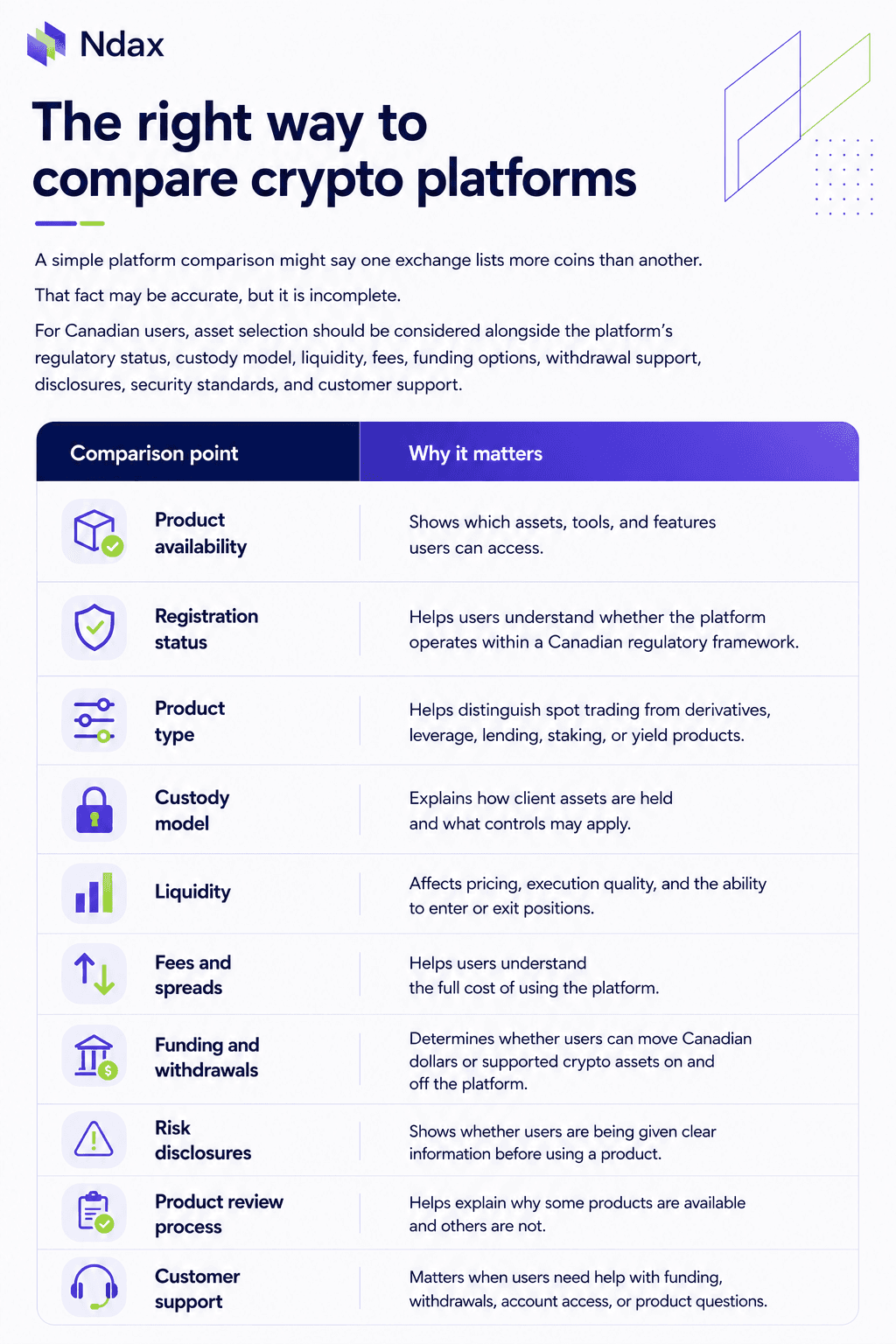
A simple platform comparison might conclude that one exchange offers more products than another. That fact may be accurate, but it is incomplete.
For Canadian users, product availability should be considered alongside regulation, custody, liquidity, fees, funding options, withdrawal support, disclosures, security standards, and customer support.
Where Ndax fits in
Ndax is a regulated crypto trading platform built for Canadians. Ndax is registered as an Investment Dealer under Canadian securities legislation in all provinces and territories, is a CIRO member firm, and operates within the Canadian regulatory framework.
Ndax offers access to more than 65 supported crypto assets, CAD trading pairs, staking for supported assets, advanced order types, charting tools, recurring buys, and Ndax Wealth for larger crypto transactions.
Ndax’s goal is not to mirror every product available on offshore exchanges.
Ndax’s role is to provide Canadian users with crypto access inside a structured and regulated environment. That means product decisions need to be viewed through more than user demand. They also need to consider compliance, custody, risk disclosures, liquidity, platform controls, funding, withdrawals, and whether the product can be supported responsibly.
For users, this creates a different type of platform experience. Ndax may not offer every offshore feature, but it provides access to crypto through a Canadian-focused platform with flat trading fees, Canadian-dollar funding, trading tools, staking, and larger-trade services.
What users should ask before choosing a platform
Before choosing a crypto platform, users should look beyond the product list and ask practical questions:
- Is the platform registered in Canada?
- Does the platform clearly explain its custody model?
- Does it support Canadian-dollar deposits and withdrawals?
- Are fees clearly disclosed?
- Can users withdraw supported crypto assets to an external wallet?
- Does the platform offer spot trading, derivatives, leverage, lending, staking, or yield products?
- Does the user understand how each product works?
- Does the platform provide risk disclosures before the user trades or uses a product?
- Does the platform explain what protections apply and what protections do not?
- Does the platform offer the products the user actually needs, or simply the longest possible list?
FAQ
Why do offshore crypto exchanges offer more products?
Offshore exchanges may serve users across many jurisdictions and may operate under different regulatory requirements. Some compete by offering a broad product menu, including more crypto assets, futures, perpetual contracts, margin, lending, borrowing, staking, rewards, and other products. That broader access can appeal to some users, but it may also involve more complexity and risk.
Why do Canadian crypto platforms offer fewer products?
Canadian crypto platforms may offer fewer products because they need to consider Canadian securities regulation, dealer obligations, custody standards, risk disclosures, account appropriateness, liquidity, funding, withdrawals, and operational controls. A missing product may reflect regulatory constraints or platform standards rather than a simple lack of capability.
Can Canadian crypto platforms offer futures or perpetual contracts?
Crypto futures and perpetual contracts are derivative-style products and may involve leverage, margin, liquidation risk, and additional regulatory requirements. A Canadian platform may not offer these products because they may not fit its current registration, risk-control framework, product permissions, or client offering.
Why are some stablecoins not available in Canada?
Stablecoins may be treated as value-referenced crypto assets in Canadian regulatory guidance. A platform may need to consider the issuer, reserve structure, redemption rights, disclosures, custody, and applicable terms or conditions before supporting a stablecoin for Canadian clients. As a result, stablecoin availability can differ from one platform to another.
Does regulation remove crypto risk?
No. Regulation does not remove crypto market risk. Crypto assets remain volatile, prices can move quickly, and users can lose money. Registration also does not mean a crypto asset is suitable for every user. Users should review risk disclosures and understand what protections apply and what protections do not.
Is Ndax regulated in Canada?
Yes. Ndax is a regulated crypto trading platform. Ndax is registered as an Investment Dealer under Canadian securities legislation in all provinces and territories, is a CIRO member firm, and operates within the Canadian regulatory framework.
Bottom line
Canadian crypto platforms may not offer every product available offshore, but that does not automatically make them inferior.
Product available should be one part of the platform comparison process.
For Canadian users, the more useful comparison looks at the full picture: regulation, custody, fees, funding, withdrawals, product risk, trading tools, disclosures, support, and how the platform fits the user’s needs.
Offshore platforms may offer broader product lineups, including a large list of early-stage tokens, leverage, futures, perpetual contracts, lending, borrowing, and yield products. Some users, such as professional traders, may require those specific products and services.
A Canadian-regulated platform may take a more focused approach because it is operating within a different framework.
Don't forget to follow us on social media for more updates and join the conversation on our forums.
Disclaimer: This article is not intended to provide investment, legal, accounting, tax or any other advice and should not be relied on in that or any other regard. The information contained herein is for information purposes only and is not to be construed as an offer or solicitation for the sale or purchase of cryptocurrencies or otherwise.