Why some crypto platforms list fewer coins than global exchanges
Learn why Canadian crypto platforms may list fewer coins than global exchanges, and how regulation, custody, liquidity, disclosures, and risk controls impact asset availability.
If you only read one thing
- A crypto platform with fewer listed assets is not by default weaker than a global exchange with hundreds of coins.
- Asset availability should be compared alongside regulation, custody, liquidity, fees, and other factors.
- More choice may be useful for some experienced traders, but a focused asset list reflects a platform’s listing standards and regulatory obligations.
Introduction
Some crypto platforms list fewer coins than global exchanges because asset availability depends on many factors beyond demand. In Canada, regulated crypto trading platforms must also consider regulatory obligations, custody support, liquidity, disclosures, technical risks, and whether an asset can be supported responsibly for Canadian users. A large coin list does offer more choice, but it does not automatically mean a platform is safer, stronger, or more suitable for every user.
Ndax is a regulated crypto trading platform and provides an Order Execution Only service. Ndax executes clients’ instructions but does not provide investment advice. Clients decide when and what to trade.
Why coin selection is often misunderstood
Many crypto investors compare platforms by looking at how many coins they list. At first glance, this seems understandable: more coins mean more choice, and more choice means a better platform.
But this is not always the right conclusion.
A larger asset list can be valuable for advanced traders who require access to newer, smaller, or more speculative tokens. Global exchanges compete heavily on breadth and target this cohort by offering hundreds of assets across many networks, sectors, and jurisdictions.
But the number of listed coins is only one part of the platform comparison process. It does not explain how each asset was reviewed, whether the asset has enough liquidity, whether deposits and withdrawals are supported, how the asset is custodied, what risks are disclosed, or whether the platform is operating within a Canadian regulatory framework.
A platform with fewer listed assets may be making a deliberate choice to focus on assets it can support more responsibly. That does not mean every user will want a smaller list, but it does mean asset count should not be the main factor in platform selection.
Listing a crypto asset is more than just adding a new ticker
In traditional investing, users are familiar with long lists of stocks, funds, and market data. But in crypto, making an asset available for trading often involves additional layers of technical, operational, regulatory, and custody risk.
Each crypto asset may have its own blockchain, smart contract, token design, governance process, liquidity profile, custody requirements, network upgrade schedule, wallet infrastructure, and withdrawal process.
Some assets can operate across multiple networks. Others rely on bridges, while some have staking or governance features. A select group of coins may have limited liquidity or concentrated ownership. Others are likely to raise specific regulatory, disclosure, market integrity, or investor protection concerns.
This means a platform needs to consider more than popularity before making an asset available. Some of the useful questions happening behind the scenes and away from the user experience include:
- Can the platform support reliable trading?
- Is there enough liquidity?
- Can the asset be supported through the platform’s custody model?
- Are deposits and withdrawals available?
- What network risks should users understand?
- Are there special risks related to staking, governance, supply, bridges, forks, or upgrades?
- Can the platform provide clear risk disclosures?
- Are there legal or regulatory concerns around making the asset available to Canadian clients?
Why global exchanges often list more coins
Global exchanges tend to operate at a different scale and under different market assumptions. A global exchange may list a wider range of tokens because it is trying to serve a broad international audience. It may also move quickly when a new category becomes popular in a particular region, such as gaming tokens, decentralized finance tokens, or early-stage ecosystem assets.
That broader access can appeal to some global users, but it also comes with trade-offs. Some listed assets may be highly volatile, thinly traded, newly launched, technically complex, or difficult for beginners to evaluate. In some cases, assets that are popular in one region may not be appropriate, available, or supported for Canadian users under the same conditions.
As such, more assets does mean opportunity, but it can also mean more risk.
Why Canadian-registered platforms may be selective
Canadian-registered crypto trading platforms operate in a unique environment. They need to consider how asset availability fits within Canadian securities regulation, dealer obligations, custody standards, risk disclosure expectations, account appropriateness processes, and operational controls.
That does not mean Canadian platforms cannot offer meaningful asset choices that rival those of global peers. It does mean that asset selection is balanced with platform responsibility.
A focused asset list may reflect questions such as whether the platform can support trading, custody, deposits, withdrawals, recordkeeping, risk disclosures, and ongoing monitoring for that asset.
It may also reflect whether the asset fits within the platform’s current regulatory and operating framework. This is why fewer listed coins should not be treated by default as a competitive disadvantage.
How Ndax approaches asset availability
Ndax offers access to 65+ cryptocurrencies. That gives Canadian users access to a broad range of digital assets without trying to list every token that appears on global exchanges.
Ndax is a Canada-based regulated crypto trading platform. Ndax is registered as an Investment Dealer under Canadian securities legislation in all provinces and territories, is a CIRO member firm, and operates within the Canadian regulatory framework.
For users, this means asset availability is part of a broader platform model. Ndax needs to consider not only whether users want access to an asset, but whether that asset can be supported through the platform’s trading infrastructure, custody processes, compliance workflows, disclosure standards, and Canadian-dollar funding environment.
Ndax’s Relationship Disclosure Document explains that before offering a crypto asset, Ndax performs a product assessment. This includes reviewing publicly available information about the asset’s creation, governance, usage, design, supply, demand, maturity, utility, liquidity, technical risks, and legal and regulatory risks.
As such, Ndax’s role is not to mirror every global exchange. Its role is to provide Canadian users with access to crypto inside a more structured and regulated environment.
A global platform may think that its largest competitive advantage is the longest possible asset list. A regulated Canadian platform’s competitive advantage is a respectable asset list, alongside trust, oversight, custody, transparency, pricing, support, and reliability.
The right way to compare crypto platforms
A simple platform comparison might say one exchange lists more coins than another.
That fact may be accurate, but it is not the full story.
For Canadian users, asset selection should be considered alongside the platform’s regulatory status, custody model, liquidity, fees, funding options, withdrawal support, disclosures, security standards, and customer support.
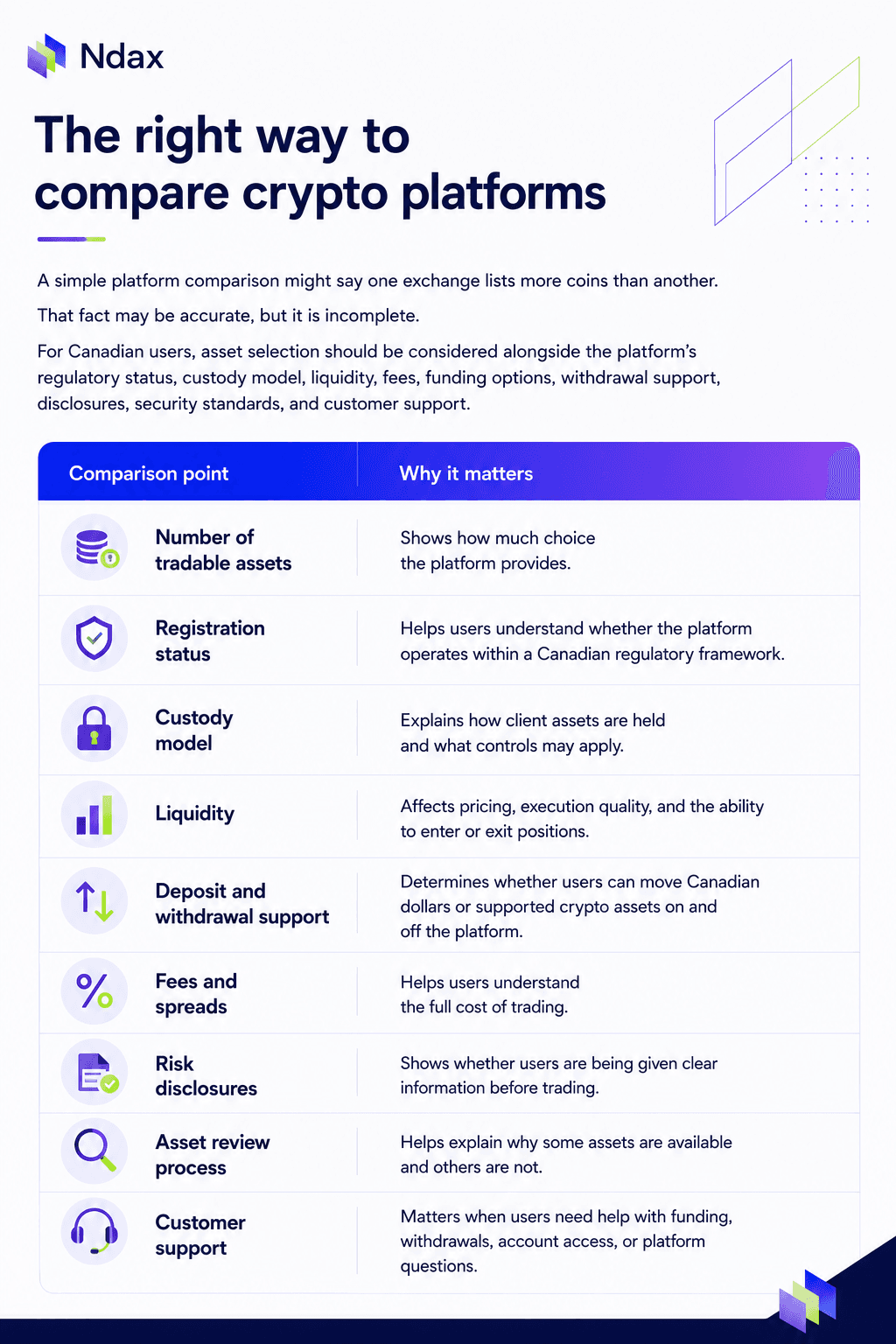
A global exchange with hundreds of assets may be useful for certain experienced traders. A Canadian-registered platform with a more focused list may be a better fit for users who value local oversight, Canadian-dollar funding, custody processes, clearer disclosures, and a more structured trading experience.
What users should ask before choosing a platform
Before choosing a crypto platform, users should ask practical questions, including:
- Is the platform registered in Canada?
- Does the platform clearly explain its custody model?
- Does it support Canadian-dollar deposits and withdrawals?
- Are fees clearly disclosed?
- Can users withdraw supported crypto assets to an external wallet?
- Does the platform provide risk disclosures for listed assets?
- Does the platform explain what happens if an asset is no longer supported?
- Does the platform provide transaction records and account statements?
- Does the platform offer the assets the user actually needs, or simply the longest possible list?
A user who wants access to Bitcoin, Ethereum, major crypto assets, Canadian-dollar funding, transparent fees, and a regulated Canadian platform may not necessarily want the same asset list as a global trader who prioritizes early access to every new token.
Final thoughts
Coin selection certainly matters, and users should include this when comparing platforms. Users need to perform their due diligence to choose a platform that fits their needs.
But the number of listed coins alone is not the whole story. In crypto, every listed asset brings responsibilities around trading, custody, liquidity, disclosures, technology, monitoring, and user support. For Canadian platforms operating within a regulated framework, those responsibilities can shape which assets are made available.
That is why a smaller asset list should not automatically be treated as a weakness.
For some users, a global exchange with hundreds of coins may feel appealing. But for others, a Canadian-registered and Canadian-based platform with a focused list, Canadian-dollar funding options, custody processes, clear disclosures, and Canadian regulatory accountability may be the better fit.
Don't forget to follow us on social media for more updates and join the conversation on our forums.
Disclaimer: This article is not intended to provide investment, legal, accounting, tax or any other advice and should not be relied on in that or any other regard. The information contained herein is for information purposes only and is not to be construed as an offer or solicitation for the sale or purchase of cryptocurrencies or otherwise.