Ndax vs Shakepay: Fees, features, trading tools, and platform differences
Compare Ndax and Shakepay across fees, supported assets, CAD funding, regulation, trading tools, staking, rewards, large-trade services, and overall platform fit in Canada.
Answer
Ndax and Shakepay are both Canadian crypto platforms, but they target different user needs. Shakepay is known for offering a simple crypto app experience with a smaller supported-asset lineup. Ndax is a regulated crypto trading platform with CAD trading pairs, a flat trading fee, staking, advanced order types, charting tools, and broader platform features.
For Canadians comparing Ndax and Shakepay, the ultimate decision should not come down to which platform is “better.” It depends on what the user values most: simplicity, supported assets, trading fees, spread-based pricing, funding options, order types, staking, rewards, large-trade services, or a platform that can support both beginner and more active crypto users.
Ndax provides an Order Execution Only service. Ndax executes clients’ instructions but does not provide investment advice. Clients decide when and what to trade.
Key takeaways
- Ndax and Shakepay both serve Canadian crypto users, but they are not built around the same experience.
- Shakepay may appeal to users who want a simple app focused on buying and selling BTC and ETH, sending and receiving BTC, ETH and USDC, and earning Bitcoin rewards through eligible features.
- Ndax may appeal to users who want a regulated crypto trading platform that can support both first-time buyers and more active traders, with more supported assets, CAD trading pairs, a flat trading fee, staking, advanced order types, charting tools, and access to services such as Ndax Wealth for larger transactions.
- Both platforms can be compared based on total cost, regulation, custody disclosures, funding methods, supported assets, order types, and how the user plans to use the platform.
Direct Comparison
| Category | Ndax | Shakepay |
| Platform type | Canadian crypto exchange | Canadian crypto app |
| Main user fit | Users who want a platform that can support both beginner and more active trading needs | Users who want a simple app experience focused on a smaller crypto lineup |
| Regulation | CIRO-registered Investment Dealer and operator of an alternative trading system (ATS) | CIRO member registered as an Investment Dealer |
| Pricing model | Flat trading fee model | Commission-free model with spread-based pricing |
| Trading fee | Flat 0.20% trading fee on all buy and sell orders | Markup on trading spreads |
| CAD funding | Canadian dollar deposits and withdrawals | Canadian dollar deposits and withdrawals |
| Supported assets | More than 65 supported crypto assets and a broader selection of CAD trading pairs | Smaller supported-asset lineup, including BTC, ETH, and USDC |
| Trading tools | Market, limit, stop, stop-limit, trailing stop, fill-or-kill, charting tools, and indicators | Simpler experience for buying, selling, sending, and receiving supported crypto assets |
| Staking | Available for 18 supported crypto assets | Not positioned as a core staking platform |
| Rewards/extras | Staking, recurring buys, trading tools, Ndax Wealth | Bitcoin rewards, cash account features, card-related rewards, recurring Bitcoin buys |
| Large-trade service | Ndax Wealth for larger crypto transactions | Shakepay Private for large or high-volume BTC, ETH, and USDC transactions, with dedicated account support |
| Platform focus | Users who want more crypto platform depth as their needs evolve | Users who want a simpler Bitcoin-forward app experience |
Ndax’s fees page lists a flat 0.20% trading fee and free CAD deposits, while Shakepay’s fees page says it applies a spread rather than fixed trading commissions.
Shakepay’s help center lists Bitcoin, Ethereum, and USDC support, while Ndax’s platform and markets pages confirm a broader trading platform experience across multiple crypto assets and CAD pairs.
Fees and total cost
Fees can be one of the most important differentiating factors between Ndax and Shakepay, but users should look beyond a single headline fee.
Ndax uses a flat trading fee model at 0.20%, along with free Canadian dollar deposits. Users should still consider withdrawal fees, crypto network fees, and any asset-specific costs before placing or withdrawing a trade.
Shakepay markets a different pricing model. Shakepay describes itself as “a commission-free service.” Instead, it makes money by applying a spread, meaning the cost to the user is reflected in the price shown rather than appearing as a separate trading commission.
That distinction matters because a flat trading fee and a spread-based model are not the same thing. A user comparing total cost should consider:
- Spread
- Deposit fees
- Withdrawal fees
- Crypto network fees
- Funding method
- Order size
- Whether the price is shown before confirmation
For a deeper explanation, read: Crypto fees explained: trading fees vs. spreads vs. withdrawal fees
Supported assets and CAD trading pairs
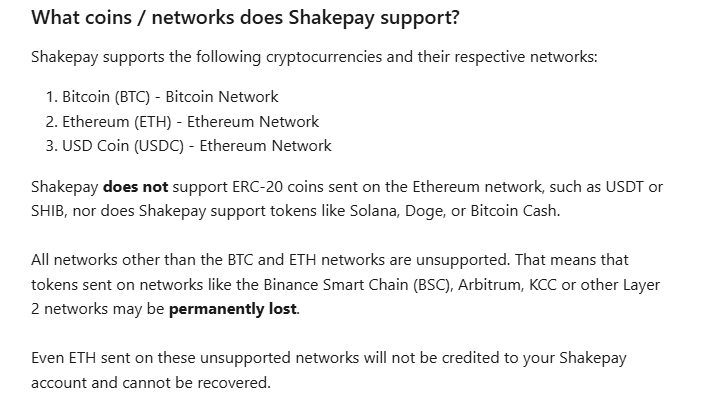
Shakepay is more focused on a smaller supported group of cryptoassets. Its help page lists support for Bitcoin, Ethereum, and USDC, although specific network support and product availability should be confirmed directly before sending or receiving crypto.
Ndax offers a broader crypto trading platform experience with more supported crypto assets and CAD trading pairs. This can be a selling point for users who want to trade beyond Bitcoin, Ethereum, and USDC, compare more assets, or use one platform as their crypto needs evolve over time.
A smaller asset lineup like what Shakepay offers can make an app feel simpler. For some users, this is ideal. But a broader asset lineup can give users more flexibility. The right fit depends on whether the user wants a focused app experience or access to a wider range of crypto markets.
Trading tools and order types
Trading tools is one of the clearest differences between Ndax and Shakepay.
Shakepay is built to provide a simpler experience for buying, selling, sending, and receiving supported crypto assets. Its app may appeal to those who want a streamlined interface and do not want a more advanced trading screen.
Ndax offers more trading tools for users who want additional control over how they place orders. These include market orders, limit orders, stop orders, stop-limit orders, trailing stop orders, and fill-or-kill orders. Ndax users can also review charting tools, indicators, recent price movement, and order-book information before placing trades.
This does not mean every user needs advanced order types. Many beginners may only need a simple buy or sell experience. But users who want to move beyond basic trading may want access to more order types and market context in the same platform.
Staking and rewards
Ndax and Shakepay also differ in how they market earning and reward features.
Ndax offers staking for supported crypto assets and offers a calculator to estimate the expected rewards. Ndax charges a 20% administrative fee on all earned rewards. Staking allows users to earn rewards on eligible crypto assets. Users should always be reminded that rewards are not guaranteed and staking involves risks, including lockup rules, validator risk, asset price volatility, and protocol-specific conditions.
Shakepay is more Bitcoin-reward focused. Its public materials emphasize Bitcoin rewards, card-related features, cash account features, and the ability to earn Bitcoin through certain activities or eligible account features.
For users comparing the two, the question is not simply which platform has “more rewards.” A better question is whether the user wants staking on supported crypto assets, Bitcoin-focused rewards, recurring purchases, or a simpler app experience.
For more information, read: Crypto staking in Canada: rewards, risks, taxes, and lockups explained
Regulation and investor protection
Both Ndax and Shakepay have publicly disclosed regulatory status in Canada. CIRO lists Shakepay as admitted to membership as an Investment Dealer Member effective January 8, 2025. Ndax is a CIRO member firm registered under the Investment Dealer category and is also registered as the operator of an alternative trading system across Canadian provinces and territories.
Users should also consider:
- Registration status
- Marketplace or dealer model
- Custody disclosures
- Account protection details
- Risk disclosures
- Security controls
- How fiat and crypto assets are handled
- What investor protections do and do not cover
Large trades and private-client services
Ndax offers Ndax Wealth for users who want dedicated support and OTC execution for larger crypto trades. Ndax’s OTC service is available for transactions starting at C$25,000.
Shakepay offers Shakepay Private, which is positioned for high-net-worth investors, businesses, treasuries, and high-volume traders.
Users comparing Ndax Wealth and Shakepay Private should look at minimum transaction size, supported assets, pricing model, liquidity, funding and settlement options, custody preferences, and whether they want a broader trading platform or a more focused private-client service before making any decision.
When Ndax may be the better fit
Ndax may fit users who want access to a regulated crypto trading platform with broader crypto asset access, CAD trading pairs, a flat trading fee, staking, advanced order types, charting tools, and large-trade services through Ndax Wealth.
Ndax may also fit users who want a platform that can support different stages of their crypto journey. For example, a beginner who decides to trade crypto may start with a simple buy or sell order. Over time, the user’s needs may change, and they may want access to a broader range of supported crypto assets. They may also prefer using advanced trading tools that require limit orders, stop orders, stop-limit orders, trailing stop orders, fill-or-kill orders, charting tools, staking, OTC execution, or API access.
This “grows with you” structure is one of the main differences between a simple crypto app and a broader crypto trading platform.
When Shakepay may be the better fit
Shakepay may fit users who want a simple app experience focused on a smaller supported-asset lineup. It may appeal to users who mainly want to buy, sell, send, receive, or earn Bitcoin, with access to Ethereum and USDC.
Shakepay may also fit users who value Bitcoin-focused rewards, recurring Bitcoin buys, card-related features, and a more streamlined interface.
That simplicity may be useful for users who do not need a broader range of crypto assets, staking options, advanced order types, charting tools, or a more detailed trading interface over time.
Is Ndax or Shakepay better for beginners?
Neither platform is necessarily a better default option for beginners.
Shakepay may appeal to beginners who want a simple app experience and a smaller set of supported crypto assets. Ndax may appeal to beginners who want a platform that starts with basic buying and selling but also offers more tools as their needs change.
A beginner comparing Ndax and Shakepay should consider:
- Which crypto assets are supported and whether those assets meet their needs
- Whether they understand the fee model
- Whether they want simple buying only or more trading tools
- Whether staking matters
- Whether they want to learn order types over time
- How they plan to deposit, withdraw, and store crypto
- Whether they may need larger-trade services later
Is Ndax or Shakepay better for active trading?
Users interested in active trading may care more about order types, charts, CAD pairs, liquidity, execution tools, and total cost.
Ndax offers advanced order types and charting tools that may be useful for users who want more control over how trades are placed. Shakepay is more focused on a simple buy, sell, send, and receive experience.
Active users should compare:
- Available order types
- Charting tools
- Supported trading pairs
- Trading fee and spread model
- Withdrawal costs
- Order execution process
- Large-trade services
- Tax and transaction reporting tools
- API access, if relevant
FAQ
Is Ndax or Shakepay cheaper?
The answer depends on multiple factors, including trade size, asset, spread, withdrawal method, and how the user measures total cost. Ndax uses a flat trading fee model, while Shakepay uses a commission-free model with spread-based pricing. Users should compare trading fees, spreads, deposit fees, withdrawal fees, and crypto network fees before deciding which platform has the lower total cost for their specific use case.
Is Ndax regulated in Canada?
Yes. Ndax is a regulated crypto trading platform. Ndax is a CIRO member firm registered under the Investment Dealer category and is also registered as the operator of an alternative trading system across Canadian provinces and territories.
Is Shakepay regulated in Canada?
Yes. CIRO says Shakepay was admitted as an Investment Dealer Member effective January 8, 2025. Users should still review Shakepay’s current legal, risk, custody, and fee disclosures before using the platform.
Does Shakepay support only Bitcoin?
No. Shakepay lists Bitcoin, Ethereum, and USDC support.
Does Ndax offer more crypto assets than Shakepay?
Yes. Ndax offers more supported assets and CAD trading pairs than Shakepay’s supported-asset lineup.
Does Shakepay or Ndax offer advanced order types?
Shakepay is primarily designed around a simpler app experience. Ndax offers more advanced order types, including limit, stop, stop-limit, trailing stop, and fill-or-kill orders.
Does Ndax offer OTC trading?
Yes. Ndax offers Ndax Wealth for larger crypto transactions. Ndax’s OTC service is available for transactions starting at C$25,000.
Does Shakepay offer a private-client service?
Yes. Shakepay offers Shakepay Private, which is positioned for high-net-worth investors, businesses, treasuries, and high-volume traders.
Bottom line
Ndax and Shakepay are both Canadian crypto platforms, but they market their services around different user experiences. Shakepay may fit users who want a simple, Bitcoin-focused app experience with a smaller supported-asset lineup. Ndax may fit users who want a regulated crypto trading platform with CAD trading pairs, a flat trading fee, staking, advanced order types, charting tools, OTC services, and broader platform depth.
For Canadians comparing Ndax and Shakepay, users should consider the full picture: fees, spreads, funding methods, supported assets, trading tools, staking, private-client services, custody disclosures, regulation, and how the platform may fit their needs over time.
Crypto trading involves risk. Prices can move quickly, crypto assets can be volatile, and trading tools do not guarantee execution quality, profit, or protection from losses. This content is for general educational purposes only and is not investment advice, a recommendation, research, or a solicitation to buy or sell crypto assets.
Don't forget to follow us on social media for more updates and join the conversation on our forums.
Disclaimer: This article is not intended to provide investment, legal, accounting, tax or any other advice and should not be relied on in that or any other regard. The information contained herein is for information purposes only and is not to be construed as an offer or solicitation for the sale or purchase of cryptocurrencies or otherwise.