Wire transfers vs. Interac e-Transfer for funding crypto accounts in Canada
Learn how Interac e-Transfer and wire transfers compare when funding a Canadian crypto account, including speed, limits, cost, convenience, larger deposits, and when each method may make sense.
Key takeaways
- Interac e-Transfer is often used for smaller, faster, everyday crypto account funding.
- Wire transfers may be relevant for larger deposits, business accounts, OTC-size trades, or planned transactions.
- Funding methods can affect timing, available limits, trade planning, and how quickly a user can act once funds arrive.
- Ndax does not charge deposit fees for Interac e-Transfer or wire transfer deposits.
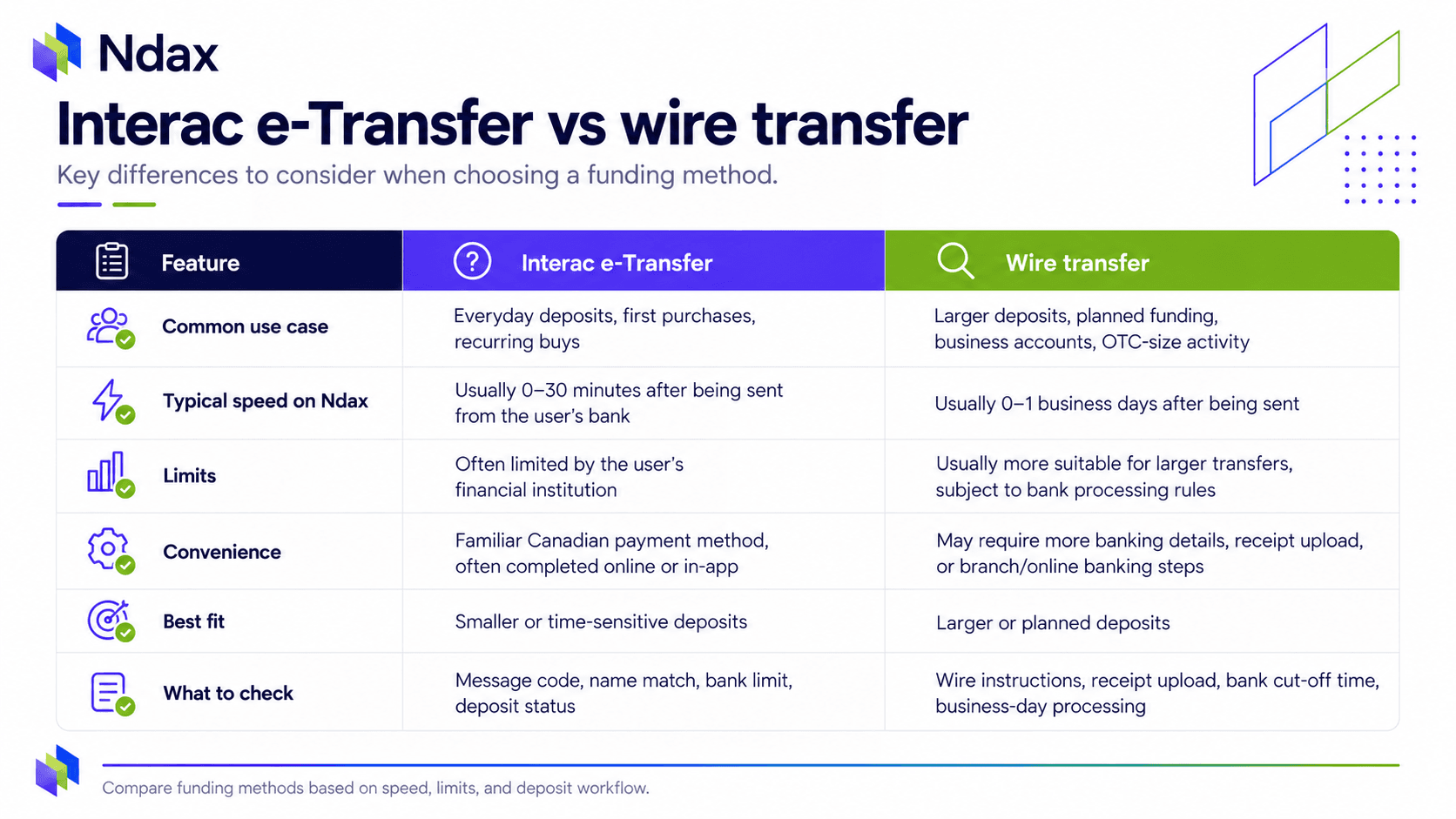
- On Ndax, Interac e-Transfer deposits typically arrive within 0–30 minutes, while wire transfers typically arrive within 0–1 business days after being sent.
- Users should always confirm deposit instructions inside their account before sending funds.
Introduction
Interac e-Transfer and wire transfers are both common ways to fund crypto accounts in Canada, but they are not the same. Interac e-Transfer is often the simpler choice for everyday deposits, first purchases, recurring buys, and users who prioritize a familiar Canadian payment method. Wire transfers are often used for larger deposits, business accounts, planned transactions, or users coordinating a larger trade. The right choice depends on the amount being deposited, bank limits, and other factors. Ndax supports both Interac e-Transfer and wire transfer deposits. Ndax does not charge deposit fees for either method, but users should still check their own financial institution’s limits, processing times, and any bank-side fees before sending funds.
Interac e-Transfer vs. wire transfer: quick comparison
Why funding method matters before placing the first trade
Funding is a key component of the account setup process. Newly deposited funds generally need to arrive and become available before they can be used to place a trade. For larger purchases, funding methods can affect timing, trade execution, settlement planning, and whether a more structured process is required.
For example, a user making a small first Bitcoin purchase may prioritize speed and convenience. In this case, Interac e-Transfer may be a practical option.
But a user planning a much larger purchase may need to consider a different approach. They may need to confirm bank limits for Interac e-Transfers, account name matching, source-of-funds documentation, internal approvals, and whether to coordinate the trade before funds arrive.
When Interac e-Transfers on Ndax may make sense
Interac e-Transfer is often the more practical funding method for everyday crypto users in Canada. It may make sense when a user is:
- Making a first crypto purchase
- Funding a smaller amount
- Setting up recurring buys
- Adding funds from a personal Canadian bank account
- Looking for a familiar Canadian payment method
- Trying to fund quickly during normal account use
- Not moving an OTC-size amount of at least $25,000.
Interac e-Transfer deposits typically become available within 0–30 minutes after being sent from the user’s bank. Transaction limits are set by each financial institution and are typically around C$2,000 to C$3,000 per transaction for consumers. Users should contact their financial institution before planning a deposit.
Interac e-Transfer can be convenient, but transfer limits still apply.
When wire transfers on Ndax may make sense
Wire transfers may be more appropriate when the funding need is larger, more planned, or more formal. They may make sense for:
- Larger deposits
- Business accounts
- High-balance users
- OTC-size transactions
- Planned accumulation
- Users coordinating with a bank
- Users who need a clearer record of a larger transfer
- Users moving funds as part of a broader financial or treasury process
Wire transfers typically arrive within 0–1 business days after being sent. Wire transfers are subject to the user’s financial institution’s processing times and are sent and received during business days, Monday to Friday, excluding holidays.
A wire sent late in the day, over a weekend, or before a holiday may be delayed due to standard banking hours. Users should plan ahead, confirm bank cut-off times, and follow wire instructions and guidelines carefully.
Why larger deposits need more planning
For a larger transaction, the process may involve more steps, including:
- Confirming bank transfer limits
- Checking platform deposit limits
- Ensuring the bank account name matches the crypto account name
- Confirming wire instructions
- Uploading a wire receipt, if required
- Allowing for business-day processing
- Coordinating with support or an OTC desk
- Deciding whether to use a market order, limit order, or OTC execution
- Planning whether assets will remain on-platform or be withdrawn
- Keeping records for tax, accounting, or internal review
Users need to carefully copy the wire information provided in their account, initiate the wire transfer from their financial institution, and upload a wire transfer receipt with their full name and amount.
Funding fees are part of the total cost
A crypto platform’s total cost includes a lot more than the trading fee. Users should consider the full path, including funding the account, placing the trade, holding or staking assets, withdrawing assets, and later withdrawing CAD.
Deposit fees on a platform need to be included in that path. On Ndax, Interac e-Transfer, bank wires deposits are free. The user should still check whether their own bank charges fees, whether any withdrawal fees apply later.
What to check before sending an Interac e-Transfer
Interac e-Transfer is a funding method many users already know from everyday banking. Users should check whether:
- Their bank supports Interac e-Transfer
- Their daily or per-transaction limit is high enough
- Their name matches the verified crypto account
- The platform requires a unique message code
- The deposit instructions are copied correctly
- Any bank-side delays or reviews may apply
Ndax’s Interac e-Transfer deposit instructions state that users must include their unique message code in the comment, message, or note section of the e-Transfer so the deposit can be matched to their Ndax account. Third-party deposits where the sender’s name does not match the Ndax account may require manual approval or may be rejected.
This means a fast funding method can still be delayed or rejected if the user enters the wrong code or sends funds from an account with a mismatched name.
What to consider before sending a wire transfer
A wire may make sense when the user’s intended deposit is larger than what their bank allows through Interac e-Transfer. It may also make sense when the user is funding a business account, preparing for an OTC transaction, or moving funds as part of a planned trading process.
Ndax’s wire transfer deposit instructions state that transfers are subject to financial institution processing times and are only sent and received during business days. Ndax’s support documentation states that the Ndax CAD Wallet has a monthly deposit limit of C$10,000,000, reset at the end of every month, including deposits from available funding methods such as Interac e-Transfer and wire transfers.
Users should confirm the wire instructions inside their account, use the correct recipient information, understand their bank’s cut-off times, and upload any required receipt or reference information.
Where Ndax fits in
Ndax supports Canadian-dollar funding through Interac e-Transfer and wire transfer deposits. Ndax does not charge deposit fees for either method.
A user making a smaller or everyday deposit may consider Interac e-Transfer for speed and familiarity. A user funding a larger planned transaction may consider a wire transfer because it can accommodate higher-value deposits, subject to the user’s bank limits and business-day processing.
Ndax’s fee information page should be reviewed so users understand the full cost path before funding, trading, and withdrawing. Interac, wire, and crypto deposits are free, and the flat 0.20% trading fee is shown before order confirmation.
Questions to ask before choosing a funding method
Before funding a crypto account, users should ask:
- How much am I depositing?
- How quickly do I need the funds available?
- Does my bank support this transfer method?
- What are my bank’s daily, weekly, or monthly limits?
- Does the platform charge a deposit fee?
- Could my bank charge a fee?
- Does the bank account name match my crypto account name?
- Do I need to include a unique message code?
- Am I funding a standard trade or a larger planned transaction?
- Will I need support, OTC coordination, or business-account setup?
- Do I need records for tax, accounting, or internal review?
- Do I plan to withdraw CAD or crypto afterward?
Bottom line
Interac e-Transfer may be a practical everyday option for smaller, faster, familiar deposits. Wire transfers may be relevant for larger deposits, business accounts, OTC-size trades, or planned transactions that require more funding capacity and coordination.
The right choice depends on the amount, timing, bank limits, platform instructions, account type, and what the user plans to do after funds arrive.
Ndax supports both Interac e-Transfer and wire transfer deposits, does not charge deposit fees for either method, and publishes fee information users can review before funding, trading, or withdrawing.
Don't forget to follow us on social media for more updates and join the conversation on our forums.
Disclaimer: This article is not intended to provide investment, legal, accounting, tax or any other advice and should not be relied on in that or any other regard. The information contained herein is for information purposes only and is not to be construed as an offer or solicitation for the sale or purchase of cryptocurrencies or otherwise.