Crypto platform support in Canada: What users should expect before something goes wrong
Learn what Canadian crypto users could look for in platform support, including account recovery, funding and withdrawal help, fraud response, incident communication, escalation paths, and access to a real person when the issue cannot be solved through a help article.
Key takeaways
- Customer support can be considered an operational risk consideration, not just a convenience feature.
- Users may want to know how to reach a platform before any issues arise.
- Good support can help users address problems related to funding, withdrawals, KYC, and account recovery.
- Security-sensitive requests should require stronger identity checks.
- Platforms should provide an escalation path when normal support does not resolve a problem.
- Incident communication is important because users need to know whether an issue affects their account.
- Ndax provides multiple human-support channels as well as compliance, and OTC contacts.
Introduction
A crypto platform is easy to evaluate when everything is working. But when a deposit does not arrive, a withdrawal is delayed, access to an account is lost, a user suspects fraud, or a transaction needs to be investigated, support becomes an important consideration for a user. Support can be treated as part of the platform due diligence alongside regulatory status, fees, custody, and security. A support framework can be compared based on clear contact channels, human assistance, account-recovery procedures, funding and withdrawal support, fraud escalation, incident communication, and a formal complaint process.
Support is important when the transaction stops being routine
When crypto activity is routine, it can be easy to overlook customer support. But crypto combines traditional fiat banking, trading, blockchain infrastructure, account security, identity verification, legal obligations related to financial transactions, and irreversible transfers. When something goes wrong, it is not always obvious where the problem originated.
A delayed Bitcoin withdrawal, for example, could involve the platform, a manual security review, blockchain confirmation delays, or an issue with the receiving wallet.
A missing CAD deposit could involve the user’s bank, funding instructions, or account verification. An inability to log in may require a password reset, 2FA recovery, or investigation of suspicious account activity.
What users can compare in crypto support
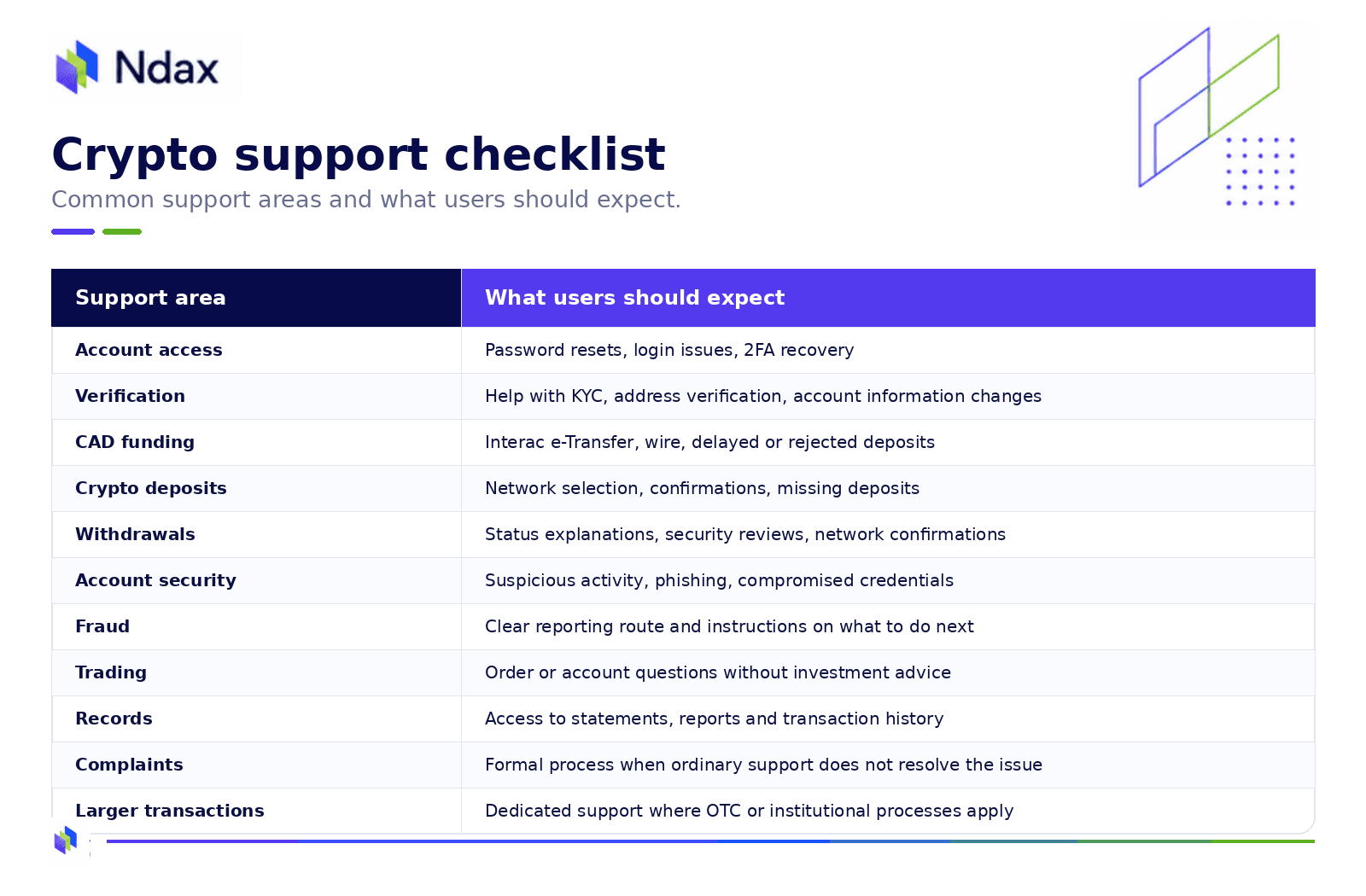
A credible support operation should be able to help users navigate the entire account lifecycle. This extends beyond just asking what hours the platform offers support.
Human support matters everywhere
Recent advancements in AI have helped create chatbots that can handle incoming user queries. While they have a role in customer service by answering routine questions without the need for an agent, many issues require human assistance.
If a user believes their account has been compromised, cannot regain access, has a large transfer under review, or needs clarification on an account-specific transaction, a clear path to human support can be particularly important.
Ndax currently offers several routes depending on the issue. Users can submit a support ticket, contact customer support by email, use live chat, or call the support line. Separate email channels are also available for compliance, security, and OTC inquiries.
Current support hours are:
- Live chat: Monday-Friday, 10:00 AM-12:00 AM EST; Saturday-Sunday, 10:00 AM-10:00 PM EST
- Phone: Monday-Friday, 10:00 AM-4:00 PM EST
Why account recovery may require additional verification
Fast support is usually desirable. Account recovery is one area where too little friction can be a security weakness.
If someone loses access to their two-factor authentication, a platform needs to distinguish between the legitimate account holder and someone attempting to take over the account.
Ndax's 2FA reset process requires a proof-of-identity procedure rather than allowing support to simply disable the security control after an email request. The process involves verification through the email associated with the account, identity verification, review by the Ndax team, and an additional phone verification step before 2FA is disabled.
Ndax will make every attempt to complete all 2FA reset requests within 24 hours or less. As such, support quality should not always be measured by how quickly a platform says yes to sensitive requests. For security-related requests, good support may deliberately ask for additional verification.
Withdrawal support needs to explain where the transaction is
Crypto withdrawals create a particularly important support challenge because several systems can be involved. Once crypto has left a platform and has been broadcast to the blockchain, the receiving service may require a certain number of confirmations before crediting the account.
Before that point, however, the withdrawal may still be moving through the sending platform's workflow.
Ndax gives users specific withdrawal statuses to help identify where the transaction sits. These include statuses such as Manual Review, Delayed, Pending 2FA, Processing, and Rejected. For example, withdrawals made within 72 hours of a password or 2FA reset can be flagged for manual review as a security measure.
A strong support system should help determine whether the issue is:
- Incomplete account confirmation
- Security review
- Platform processing
- Blockchain confirmation
- Incorrect withdrawal information
- Receiving-platform processing
Funding support matters for Canadian users
Interac e-Transfer, EFT, and wire transfers introduce their own processing times, limits, bank-side reviews, cut-off times, and account-matching requirements. Users should be able to find clear answers to questions such as:
- Why has my Interac deposit not arrived?
- Was my wire received?
- Did I use the correct account information?
- Is the transfer waiting on my bank or the crypto platform?
- Why is my Interac e-Transfer deposit under review?
A strong support team becomes even more important as transaction size increases. A delayed $100 deposit is certainly frustrating, but a delayed six-figure wire can affect trade timing and execution planning.
Support around funding can be considered part of the platform’s operational infrastructure, not just customer service.
Fraud support should have a clear route
Crypto scams are an unfortunate reality and continue to grow in sophistication. If a user suspects their credentials have been compromised, clicked a phishing link, or sees activity they do not recognize, they should already know where to report it.
Ndax maintains a dedicated security contact in addition to ordinary customer support. Its support guidance also warns that Ndax will not ask users for their password, 2FA code, or other sensitive account information by email, phone, or social media.
Ndax also advises users to access the platform directly through ndax.io rather than relying on login links from search results, texts, emails, advertisements, or social media, where impersonation and phishing can occur.
Support and security overlap heavily in crypto. A platform cannot credibly talk about account security without also giving users a way to get help when that security may have been compromised.
Incident communication is part of support
Crypto platforms depend on banks, identity-verification vendors, custodians, blockchain networks, liquidity providers, cloud infrastructure, and other external services. When an incident affects one of those systems, users need more than a generic error message.
They need to know what happened, which users or services may be affected, whether funds or account access are impacted, what actions to take, whether additional security checks are required, and where updates will be published.
A recent example is Ndax's disclosure of a 2026 security incident involving its third-party identity-verification provider SumSub. Ndax published an incident notice explaining what occurred, stated that there was no indication Ndax systems had been compromised, notified affected users, provided security guidance, and explained that additional withdrawal checks could create temporary delays while the incident was reviewed.
Users should ask how transparent a platform communicates issues once something happens.
Support and complaints are not the same
Registered investment dealers in Canada operate within formal complaint-handling requirements, which gives users another escalation path when a service or misconduct complaint cannot be resolved through ordinary customer support.
Ndax maintains a formal complaint and dispute-resolution process overseen by a Designated Complaints Officer. Written complaints are logged and investigated by qualified compliance staff rather than the employee who is the subject of the complaint.
Under the published process, Ndax sends an acknowledgement letter within five business days after receiving a written complaint and normally provides a substantive response within 90 calendar days. The process also explains further options available through CIRO, the Ombudsman for Banking Services and Investments, arbitration, or legal counsel where applicable.
For users comparing regulated crypto platforms, it is worth checking whether there is a documented path from: support request → escalation → formal complaint → external recourse.
Support expectations should expand as account size grows
The standard of good support should be the same for every user. Someone making an occasional $50 Bitcoin purchase expects the same quality of support as someone buying $500,000 worth of Bitcoin.
But support needs can differ between users. An active trader may care more about execution, API access, transaction history, or resolving funding issues quickly. The user buying $50 of Bitcoin every other month is unlikely to need many of these features.
A Bitcoin corporate treasury business, family office, or high-net-worth client may need coordinated assistance around larger wire transfers, transaction documentation, and more. Ndax separates general customer support from its OTC desk, giving larger clients a dedicated route for Ndax Wealth inquiries and larger execution requirements.
What Canadians should check before opening an account
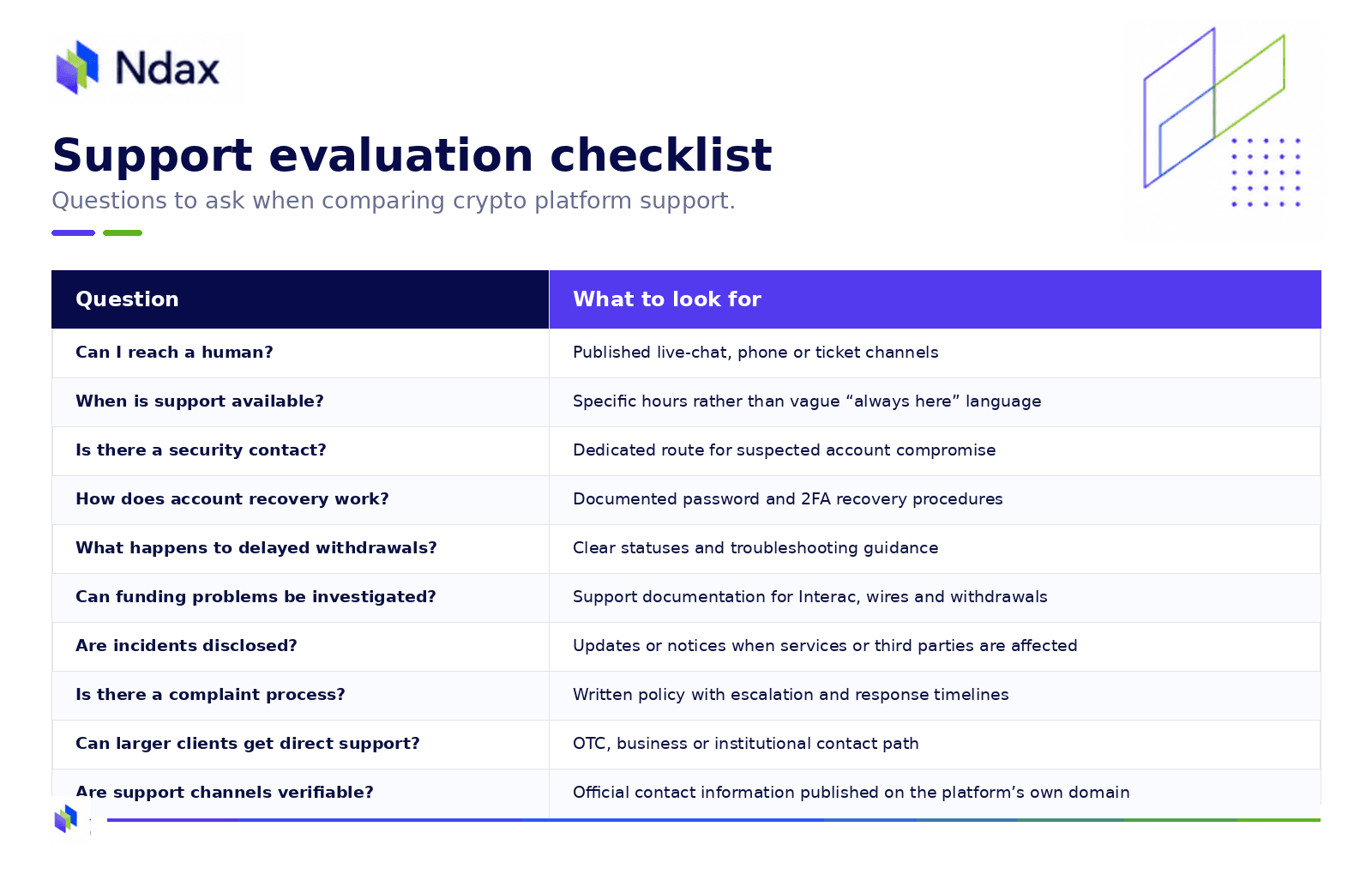
Before depositing money, check whether the platform clearly answers the following:
How Ndax approaches support for Canadian users
Users have access to a searchable Canadian crypto knowledge base, support tickets, direct customer-support email, live chat, and weekday phone support. Separate channels are available for security, compliance, and OTC matters.
That structure becomes useful as an account becomes more complex. A funding question can stay with customer support. A suspected account compromise can go directly to security. Larger transaction requirements can move to the OTC desk. A formal unresolved complaint has a documented regulatory escalation process.
Account recovery is also designed around identity verification rather than simply removing security controls on request, while withdrawal support gives users visibility into whether a transfer is being reviewed, awaiting confirmation, processing on-chain, or has been rejected.
For Canadian users, that makes support part of the broader Ndax proposition: a regulated trading platform with Canadian-dollar funding, transparent fees, defined custody arrangements, and a support structure designed around the actual operational issues that can arise when moving money and crypto.
Bottom line
A strong support team should be built to give users a clear path when funding is delayed, a withdrawal needs investigation, account access is lost, fraud is suspected, or a service problem needs formal escalation. It should also balance fast access to help with the security controls needed to prevent unauthorized account changes.
Ndax gives Canadian users several support routes, including tickets, live chat, phone, customer-support email, and dedicated security, compliance, and OTC contacts, backed by documented account-recovery and complaint procedures.
Don't forget to follow us on social media for more updates and join the conversation on our forums.
Disclaimer: This article is not intended to provide investment, legal, accounting, tax or any other advice and should not be relied on in that or any other regard. The information contained herein is for information purposes only and is not to be construed as an offer or solicitation for the sale or purchase of cryptocurrencies or otherwise.